
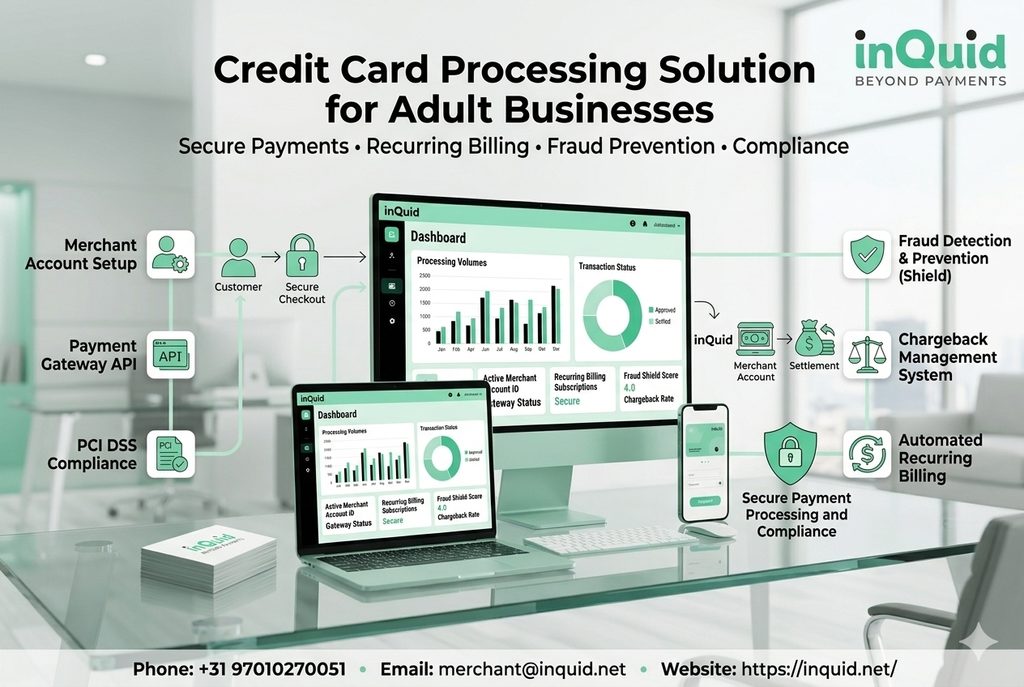
For legal adult businesses, choosing the right credit card processing solution involves more than comparing transaction fees. The right arrangement needs to match the business model, subscription structure, customer locations, payment volumes, fraud profile, compliance requirements, and card-network rules.
Adult businesses can include online retailers, digital-content platforms, subscription services, live-streaming businesses, and other companies operating in the adult sector. Visa states that legal adult-content merchants can face elevated risk of illegal activity and may therefore be subject to enhanced safeguards and closer monitoring through the acquiring relationship.
That makes choosing the right credit card processing solution especially important.
This guide explains what adult businesses should look for in payment processing, including merchant-account support, recurring billing, fraud prevention, chargeback management, PCI DSS responsibilities, international payments, and provider selection.
A credit card processing solution for adult businesses should do more than authorize card transactions.
Businesses should evaluate:
Industry eligibility + underwriting + payment gateway + recurring billing + fraud prevention + chargeback management + PCI DSS + compliance + settlement + geographic coverage
Payment-network rules, regulations, and processor policies can change. Merchants should therefore verify the current requirements applicable to their business model and jurisdiction before onboarding.
What Is Credit Card Processing for Adult Businesses?
Credit card processing is the infrastructure that allows customers to pay a merchant using credit or debit cards.
For an online adult business, the payment journey can involve:
Customer → Checkout → Payment Gateway → Processor/Acquirer → Card Network → Issuing Bank
The issuing bank evaluates the transaction and returns an authorization or decline. When the transaction is successfully completed, the funds are settled to the merchant according to the applicable processing agreement.
A credit card processing solution can therefore involve several services rather than one technology.
These can include:
- Merchant account infrastructure
- Payment gateway
- Payment processor or acquiring relationship
- Fraud-management tools
- Recurring billing
- Transaction monitoring
- Chargeback management
- Reporting and reconciliation
- Settlement services
For adult merchants, the process can be more complex because card networks maintain specific controls for certain adult-content and services transactions.
Visa says legal adult-content merchants can operate on its network but may be subject to enhanced registration and closer performance monitoring through their acquiring relationships.
Mastercard’s Merchant Edition rules also establish requirements for applicable non-face-to-face adult-content and services merchants, including controls around complaints, content, and removal of prohibited or illegal material.
The practical distinction is important:
Legal operation, card-network eligibility, and payment-provider acceptance are related but separate questions.
Why Adult Businesses May Need Specialized Payment Processing
Not every mainstream processor supports adult businesses or every type of adult transaction.
Stripe’s policy, updated September 22, 2026, lists various adult-content and adult-service categories as prohibited, including pornography, adult live-chat features, and adult video stores.
PayPal’s current U.S. guidance similarly does not permit sexually oriented digital goods or content, including downloadable pictures, videos, and website subscriptions. It treats certain physical goods differently and limits those transactions to specified circumstances.
This is why an adult business should never assume that a general-purpose credit card processing solution will support its business simply because the business itself is legally operating.
Before applying, merchants should clearly explain:
- What products or services are sold
- Whether products are physical or digital
- Whether subscriptions are used
- Whether live streaming is involved
- Whether content is user-generated
- Where customers are located
- Whether third-party creators or sellers are involved
- Expected transaction volume
- Average transaction size
- Refund and cancellation practices
Transparent information helps the provider evaluate the business according to its actual activity.
What to Look for in a Credit Card Processing Solution
1. Confirm Industry and Business-Model Support
The first question should be:
Does the provider support my exact adult business model?
An adult retailer may have very different payment needs from a subscription-content platform or live-streaming business.
Do not stop at an industry label such as “adult.” Ask whether the provider supports your specific:
- Products or services
- Billing model
- Customer markets
- Payment volume
- Content model
- Sales channels
For businesses evaluating broader merchant-account infrastructure, Inquid’s merchant account solutions can be considered alongside the merchant’s specific processing requirements.
2. Evaluate Recurring Billing
Recurring billing is particularly important for subscription-based adult businesses.
A suitable credit card processing solution should support the merchant’s subscription structure and provide appropriate tools for recurring transactions.
Customers should clearly understand:
What they are buying
How much they are paying
When they will be charged
How they can cancel
Mastercard’s transaction rules include requirements for subscription and recurring-payment models, including provisions concerning subscription terms, notifications, receipts, and cancellation.
A transparent recurring-payment experience can also help businesses reduce avoidable customer disputes.
3. Prioritize Fraud Prevention
Adult businesses operating online can face card-not-present fraud exposure.
A credit card processing solution should therefore support fraud controls appropriate to the merchant’s risk profile.
Potential tools can include:
- 3-D Secure
- Card verification
- Address verification
- Velocity controls
- Transaction monitoring
- Risk scoring
- Device or behavioral analysis
- Rules-based transaction screening
The objective is not to decline every unusual transaction. Effective fraud management should identify suspicious activity while allowing legitimate customers to complete purchases.
Visa’s monitoring framework includes controls concerning fraud, disputes, and transaction risk across the payment ecosystem.
4. Build a Chargeback Management Process
Chargebacks can affect revenue, operating costs, and a merchant’s relationship with payment providers.
Common sources of preventable disputes can include:
- Customers not recognizing a billing descriptor
- Unexpected subscription renewals
- Difficult cancellation processes
- Unauthorized card use
- Refund misunderstandings
- Product or service dissatisfaction
A good credit card processing solution should provide transaction and dispute reporting that helps merchants understand why chargebacks occur.
Instead of looking only at the number of disputes, merchants should identify patterns by payment method, product, customer type, location, and transaction flow.
Clear billing communication, accurate transaction descriptions, straightforward cancellation, responsive support, and appropriate fraud controls can all contribute to better chargeback management.
PCI DSS and Payment Security
PCI DSS is an important consideration for any merchant accepting payment cards.
Outsourcing payment processing does not automatically eliminate the merchant’s PCI DSS responsibilities.
PCI Security Standards Council guidance states that merchants remain responsible for understanding their applicable obligations, ensuring that relevant third-party providers meet their responsibilities, maintaining appropriate agreements, and monitoring provider compliance where required.
PCI SSC also explains that e-commerce merchants can retain specific responsibilities even when payment processing is outsourced. Under PCI DSS v4.x, certain e-commerce implementations covered by SAQ A can still have requirements relating to the security of merchant-managed webpages and external vulnerability scanning.
For this reason, adult businesses should ask:
- Who handles cardholder data?
- Which systems are in PCI scope?
- What responsibilities remain with the merchant?
- How is the provider’s PCI compliance status verified?
- What security responsibilities are shared?
A secure credit card processing setup should be evaluated together with website security, payment-page architecture, access controls, and data protection.
Age, Identity and Content Controls
For platforms that host or distribute user-generated adult content, payment compliance can extend beyond the checkout process.
Mastercard’s published rules for applicable adult-content merchants address controls such as complaint handling, removal of illegal content, appeals by people depicted in content, and consent-related requirements.
This means payment operations and content governance should work together.
Depending on the business model and applicable laws, a platform may need processes covering:
Identity verification + age verification + consent + content review + complaint handling + takedown procedures + payment monitoring
The exact requirements depend on the merchant’s activities and jurisdictions.
International Credit Card Processing
Many adult businesses serve customers across multiple countries.
That creates additional considerations around:
- Customer geography
- Merchant location
- Settlement currencies
- Currency conversion
- Cross-border transactions
- Local payment regulations
- Fraud patterns
- Chargeback exposure
- Supported card networks
- Settlement arrangements
A suitable international credit card processing solution should therefore be assessed using the merchant’s actual target markets.
Do not rely only on a provider’s statement that it offers “global payments.”
Ask specifically about:
Supported merchant countries + customer markets + currencies + payment methods + settlement destinations
For broader international requirements, businesses can also review Inquid’s payment gateway solutions.
Billing Descriptors and Customer Transparency
Customers should be able to recognize a transaction when reviewing their card statement.
An unclear billing descriptor can lead to customer questions and potentially avoidable disputes.
Adult businesses should ensure that transaction descriptors are accurate and consistent with applicable payment-provider and card-network requirements.
The checkout experience should also make pricing, recurring charges, renewal terms, refund policies, and cancellation procedures easy to understand.
This is not only about customer experience. It is part of a broader payment-risk and chargeback-management strategy.
Real-World Business Examples
- OnlyFans and Subscription-Based Adult Content
OnlyFans is a useful example of the complexity involved in large-scale adult digital payments.
Reuters reported in January 2025 on allegations concerning content and payment activity involving the platform. Visa and Mastercard disputed the allegations and referred to their compliance programs and the role of financial institutions serving the merchant.
The broader lesson is that payment processing for subscription-based adult platforms can intersect with content governance, acquiring relationships, compliance controls, transaction monitoring, and card-network requirements.
A smaller merchant should not assume that another platform’s exact setup will apply to its own business. Payment infrastructure should be designed around the merchant’s actual products, customers, risk profile, and compliance obligations.
- Adult Retail vs. Digital Content
Adult businesses do not all have the same payment requirements.
A physical-goods retailer has different fulfillment and transaction characteristics from a digital-content subscription platform.
That can affect:
- Underwriting
- Fraud exposure
- Refunds
- Chargebacks
- Settlement
- Provider eligibility
When applying for a credit card processing solution, describe the actual business activity instead of using only a broad industry label.
What to Evaluate Before Choosing a Provider
| Evaluation Area | What the Merchant Should Check |
| Industry support | Does the provider support the exact adult business model? |
| Underwriting | What documentation and processing history are required? |
| Recurring billing | Are subscriptions and recurring transactions supported? |
| Fraud controls | Which authentication and monitoring tools are available? |
| Chargebacks | What dispute tools and reporting are provided? |
| PCI DSS | What compliance responsibilities remain with the merchant? |
| Settlement | What are the funding timelines, reserve terms, and currencies? |
| Geographic coverage | Which merchant countries and customer markets are supported? |
| Integration | Can the gateway integrate with the website or platform? |
| Pricing | What processing, gateway, chargeback, FX, and other fees apply? |
The right provider should be evaluated against the merchant’s actual requirements rather than a generic feature list.
Pros and Cons of Specialized Processing
Pros
- Industry-aware underwriting for eligible merchants
- Support for complex adult business models
- Recurring-payment capabilities
- Fraud and chargeback management tools
- Potential cross-border and multi-currency capabilities
- Payment infrastructure aligned with specialized requirements
Cons
- Potentially higher processing costs
- Possible rolling reserve requirements
- More detailed underwriting
- Ongoing transaction and compliance monitoring
- Fewer compatible providers
- Additional operational responsibilities
These conditions vary according to the merchant, provider, jurisdiction, card network, and transaction profile.
How to Choose the Right Credit Card Processing Solution
Before signing an agreement, adult businesses should ask several practical questions.
- Does the provider support my exact business model?
Explain whether your business sells physical products, digital content, subscriptions, live services, or user-generated content.
- Which payment networks are available?
Confirm the card brands and alternative payment methods supported for your specific business type.
- What are the total costs?
Review more than the headline processing rate. Ask about gateway fees, chargeback fees, currency conversion, reserves, minimums, and other applicable charges.
- Are recurring payments supported?
Confirm how card-on-file transactions, subscription renewals, cancellation procedures, and customer notifications are handled.
- Which fraud tools are included?
Ask about authentication, transaction monitoring, risk scoring, and dispute-management capabilities.
- What are the settlement terms?
Understand funding timing, settlement currencies, reserve conditions, and potential account-review procedures.
- Which countries are supported?
Confirm your merchant location, target customer markets, currencies, and settlement destinations.
- What compliance documentation is required?
Ask about business verification, website disclosures, age and identity controls, refund policies, terms and conditions, and other applicable requirements.
Frequently Asked Questions
- Can adult businesses accept credit card payments?
Yes. Some legal adult businesses can accept credit card payments through acquiring and processing arrangements that support their specific business model and applicable requirements. Visa states that legal adult-content merchants can operate on its network while requiring enhanced safeguards for applicable merchants in this category.
- Does every adult business need a high-risk merchant account?
No universal rule applies to every adult business. Classification can depend on the business model, transaction profile, provider underwriting, geography, and other risk factors.
- Can adult businesses accept recurring credit card payments?
Some providers support recurring payments for eligible adult merchants. Subscription businesses should make billing terms, renewal conditions, customer notifications, and cancellation procedures clear and ensure they meet applicable payment-network requirements.
- Does PCI DSS apply when payment processing is outsourced?
Yes. Outsourcing payment processing does not automatically remove the merchant’s PCI DSS responsibilities. Merchants still need to understand their obligations and the responsibilities of relevant third-party service providers.
- Can adult businesses use mainstream payment processors?
It depends on the provider and business model. Some major processors restrict adult content and services. Stripe’s current policy prohibits several adult-content categories, while PayPal’s current U.S. guidance restricts sexually oriented digital goods and content.
- What documents might an adult merchant need?
Requirements vary, but a provider may request company registration details, ownership information, identification documents, bank statements, processing history, website information, refund and cancellation policies, and information about relevant compliance controls.
- How can an adult business reduce chargebacks?
Start with transparent billing, recognizable transaction descriptors, clear subscription terms, easy cancellation, responsive customer support, appropriate fraud controls, and regular dispute analysis.
How Inquid Can Help
Choosing a credit card processing solution is easier when payment requirements are evaluated as part of the wider business infrastructure.
Inquid provides payment infrastructure covering merchant accounts, payment gateways, and credit card processing, along with specialized solutions for businesses with more complex payment requirements.
Inquid also provides dedicated information about adult industry payment solutions and high-risk merchant account solutions.
For adult businesses, payment requirements can extend beyond card acceptance. Payment security, transaction monitoring, recurring billing, fraud prevention, chargeback management, compliance, and settlement may all form part of the overall payment infrastructure.
Looking for payment processing infrastructure for an adult business?
Contact the Inquid team to discuss your business model, target markets, payment requirements, and available processing options.
Conclusion
Choosing a credit card processing solution for an adult business requires a broader assessment than price alone.
The right arrangement should fit the merchant’s business model, payment flow, subscription structure, customer markets, fraud profile, security requirements, compliance responsibilities, and settlement needs.
Adult businesses should verify provider eligibility before applying, understand the relevant card-network requirements, maintain appropriate identity and content controls where applicable, and provide customers with transparent billing and cancellation processes.
The most sustainable approach is to treat credit card processing as part of a broader payment infrastructure strategy rather than simply a transaction-authorization tool.
For adult retailers, subscription businesses, digital-content platforms, and other legal adult businesses, careful provider selection can help create a payment environment that is aligned with day-to-day operations and longer-term business requirements.
Authoritative References