
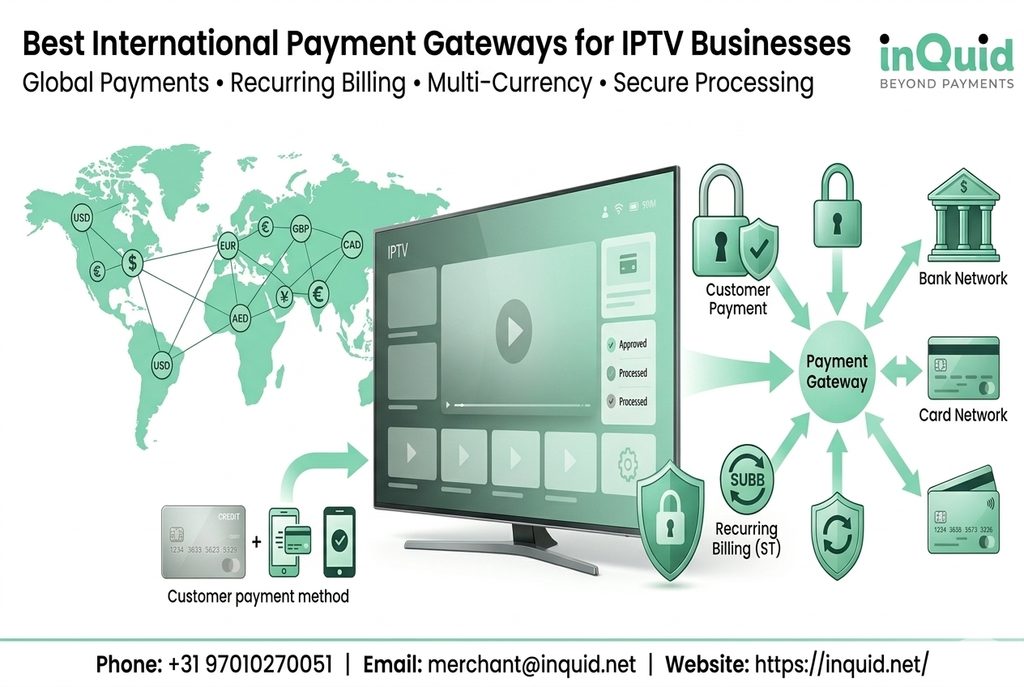
The best international payment gateways for IPTV businesses depend on several factors, including content licensing, merchant location, customer countries, transaction volume, subscription structure, supported currencies, fraud exposure, and payment-provider underwriting.
For a licensed IPTV operator, the right gateway should support more than an initial card payment. It should fit the complete payment lifecycle, including recurring billing, payment-method updates, fraud screening, 3D Secure, refunds, chargeback management, international processing, settlement, and reporting.
There is no single payment gateway that is automatically suitable for every IPTV business. Provider availability and eligibility can differ according to country, product, business model, acquiring arrangement, and compliance requirements.
Introduction
Choosing the best international payment gateways for IPTV businesses requires more than comparing transaction fees.
Many IPTV businesses operate subscription-based services and serve customers across multiple markets. This creates payment requirements that are different from those of a simple ecommerce store selling one-time products.
An IPTV operator may need to:
- Accept international card payments
- Bill customers monthly or annually
- Manage recurring payments
- Support multiple currencies
- Reduce failed subscription renewals
- Detect suspicious transactions
- Handle refunds and disputes
- Maintain appropriate PCI DSS controls
- Settle funds in suitable currencies
This guide is intended for licensed IPTV operators, including telecom-grade IPTV services, hospitality television providers, corporate streaming platforms, and businesses distributing content they own or have the legal right to distribute.
It is not intended to help process payments for unauthorized rebroadcasting or copyright-infringing IPTV services. Stripe’s current restricted-business policy prohibits the sale or distribution of licensed materials without appropriate authorization and can require additional information for restricted businesses. PayPal’s UK Acceptable Use Policy, last updated July 15, 2026, prohibits transactions involving intellectual-property infringement and places live streaming/broadcasting in a restricted category.
For legitimate IPTV businesses, payment infrastructure should therefore be selected around eligibility, compliance, recurring billing, international coverage, and operational reliability, not simply the lowest advertised rate.
What Is an IPTV Payment Gateway?
An IPTV payment gateway is the technology that securely passes payment information from an IPTV website, application, or checkout to the payment-processing ecosystem.
A simplified transaction flow is:
Customer → IPTV website/app → Payment gateway → Processor/acquirer → Card network → Issuing bank
A merchant account may sit alongside the gateway to support eligible card acceptance and settlement.
Depending on the provider and merchant arrangement, an IPTV payment solution can include:
- Credit and debit card payments
- Subscription billing
- Recurring payment scheduling
- Payment retries
- Refunds
- Multi-currency transactions
- Alternative payment methods
- 3D Secure
- Fraud screening
- Chargeback workflows
- Transaction reporting
- API integration
- Hosted checkout
The exact setup differs by provider, merchant country, target market, business model, transaction volume, and acquiring relationship.
Payment Gateway vs. Merchant Account vs. Payment Processor
Understanding payment terminology is essential when comparing the best international payment gateways for IPTV businesses.
These components are related, but they perform different roles.
| Payment Component | What It Does |
| Payment Gateway | Securely transmits payment information from checkout to payment-processing infrastructure |
| Payment Processor | Facilitates transaction processing between merchant, acquirer, networks, and issuer |
| Merchant Account | Account structure used for eligible card-payment settlement |
| Acquirer | Financial institution or acquiring entity handling card transactions for the merchant |
| Card Network | Routes transactions and establishes network operating rules |
Some providers bundle several of these functions. Others use separate partners.
This distinction matters because an IPTV business researching an IPTV payment gateway should confirm whether the advertised service includes the merchant-account and acquiring infrastructure required for actual card acceptance and settlement.
Why IPTV Businesses Need Specialized Payment Infrastructure
IPTV businesses often depend on recurring subscription revenue.
That means the payment journey does not end after the first successful checkout. Every subsequent billing cycle becomes another opportunity for a payment to succeed or fail.
Common reasons for recurring-payment failure include:
- Expired cards
- Reissued cards
- Insufficient funds
- Issuer declines
- Incorrect payment details
- Fraud controls
- Customer disputes
- Technical failures
Visa specifically markets recurring billing for subscription and streaming businesses. Its published materials describe recurring schedules, tokenized payment information, and Visa Account Updater capabilities intended to help keep stored card information current and reduce avoidable payment interruptions.
Mastercard’s transaction-processing rules also contain requirements for recurring-payment and subscription merchants, including disclosure of subscription terms and retention of the customer’s recurring-payment agreement.
For this reason, the best international payment gateways for IPTV businesses should be assessed on recurring-payment performance as well as the initial checkout experience.
Key Features to Look for in an International IPTV Payment Gateway
1. Recurring Billing
Recurring billing is a core requirement for most subscription IPTV businesses.
Look for support for:
- Monthly and annual plans
- Trial-to-paid conversion
- Plan upgrades and downgrades
- Automated payment retries
- Tokenized payment credentials
- Account-updater capabilities
- Payment-method changes
- Cancellation workflows
- Billing notifications
Visa’s recurring-billing infrastructure is specifically designed to support subscription businesses, including streaming services.
Your billing page should also make recurring terms easy to understand. Customers should be able to see the price, billing frequency, renewal terms, and cancellation process clearly.
2. International Card Acceptance
A provider describing itself as an international payment gateway does not necessarily mean that every country is supported for every merchant.
Confirm:
- Where your company can be onboarded
- Which customer countries are supported
- Visa and Mastercard availability
- Local acquiring options
- Settlement countries
- Settlement currencies
- Country-specific restrictions
- Alternative payment methods
A gateway that works for a merchant in the UK may not offer the same acquiring or settlement configuration to a merchant operating elsewhere.
3. Multi-Currency Processing
International IPTV businesses can benefit from accepting payments in currencies familiar to their customers.
Depending on the provider, this may include USD, EUR, GBP, CAD, AUD, CHF, or AED.
However, three separate capabilities should be checked:
Currency display: What currency the customer sees.
Transaction currency: What currency the customer is actually charged in.
Settlement currency: What currency the merchant ultimately receives.
Always confirm foreign-exchange fees and conversion arrangements before onboarding.
4. Fraud Prevention
Card-not-present subscription payments require effective fraud monitoring.
Important controls may include:
- 3D Secure
- Velocity rules
- Device and transaction signals
- Geographic risk checks
- Transaction scoring
- Manual review
- Suspicious-activity rules
The objective is to identify fraudulent transactions without creating unnecessary friction for legitimate subscribers.
5. Chargeback Management
Subscription businesses need a documented dispute process.
Useful evidence can include:
- Customer registration data
- Terms accepted during checkout
- Subscription information
- Billing dates
- Payment confirmations
- Account-access records
- Service-access logs
- Cancellation requests
- Refund records
- Support communications
The evidence required varies by network, acquirer, dispute type, and applicable rules.
IPTV Payment Processing and Compliance
Compliance should be considered before technical integration.
Payment providers may examine:
- Business ownership
- Corporate structure
- Products and services
- Target markets
- Content rights
- Transaction volume
- Expected chargebacks
- Subscription terms
- Processing history
- Website policies
v Content Licensing Is Critical
The most important compliance issue for many IPTV businesses is the legal right to distribute the content being sold.
Stripe’s current policy states that sales or distribution of licensed materials without appropriate authorization are prohibited. Its restricted-business framework also states that certain businesses may require additional due diligence and evidence such as relevant licenses or information about the business model.
PayPal’s current UK policy similarly prohibits intellectual-property infringement and identifies live streaming/broadcasting as a restricted activity.
Therefore, licensed IPTV operators should be prepared to document:
- Content ownership
- Distribution agreements
- Broadcasting licenses
- Geographic rights
- Service territories
- Subscription terms
Payment approval is not a substitute for copyright or broadcasting compliance.
v Subscription Transparency
Recurring-billing terms should be presented clearly at checkout.
Customers should understand:
- What they are purchasing
- The initial price
- The recurring price
- Billing frequency
- Renewal conditions
- Trial terms
- Cancellation procedure
- Refund conditions
Mastercard’s current transaction rules include specific subscription-billing requirements around disclosure and recurring-payment arrangements.
PCI DSS and IPTV Payment Processing
Outsourcing payment processing does not automatically eliminate PCI DSS responsibilities.
PCI Security Standards Council guidance states that PCI DSS can still apply when payment processing is outsourced. Merchants retain responsibilities related to their service providers, shared responsibilities, written agreements, monitoring, and compliance validation.
The scope also depends on the payment-page architecture.
For example, PCI SSC explains that eligibility for SAQ A and SAQ A-EP depends on how payment-page elements are supplied and whether the relevant eligibility criteria are satisfied.
Before selecting a gateway, ask:
- Who handles cardholder data?
- Is payment information tokenized?
- Is a hosted checkout available?
- What PCI DSS responsibilities remain with the merchant?
- What compliance documentation does the provider supply?
- How does the chosen integration affect PCI DSS scope?
Best International Payment Gateway Options for IPTV Businesses
There is no universal ranking of IPTV payment providers because approval depends on the specific merchant and its circumstances.
The following comparison is intended to help businesses conduct due diligence.
| Provider | IPTV / Streaming Positioning | International / Multi-Currency | Recurring Billing | What to Verify |
| Inquid | Markets payment solutions for IPTV and digital businesses | Markets international and multi-currency capabilities | Markets recurring subscription solutions | Contracting entity, acquiring relationship, countries, settlement and reserves |
| PayCly | Markets IPTV merchant-account and gateway solutions | Markets international and multi-currency processing | Markets recurring and subscription payment solutions | Eligibility, pricing, reserves, supported countries and acquiring setup |
| Amald | Markets IPTV payment-processing services | Markets international processing | Markets subscription-oriented IPTV payment services | Current acquiring arrangements, currencies, settlement and underwriting |
| Stripe | Broad payment and subscription infrastructure; eligibility depends on business model and rights | International capabilities vary by supported market and product | Stripe Billing supports recurring subscriptions | Content rights, IPTV eligibility, country availability and restrictions |
| PayPal | General payment and subscription infrastructure | Availability differs by market and product | Recurring payments available for supported products/markets | Applicable Acceptable Use Policy, live-streaming restrictions and pre-approval requirements |
The first three providers in the table market services specifically toward IPTV or higher-risk digital businesses. Their published marketing claims should be treated as starting points for due diligence rather than independent verification.
Stripe and PayPal operate broader payment ecosystems, but eligibility is still subject to their respective policies and merchant reviews. Stripe’s current restricted-business policy explicitly prohibits unauthorized intellectual-property distribution and states that restricted businesses may require additional due diligence. PayPal’s current UK policy contains specific restrictions concerning live streaming/broadcasting.
For any provider, obtain important commercial and operational terms in writing before building the payment integration.
Pros and Cons of Specialized IPTV Payment Processing
Ø Pros
Specialized payment infrastructure can provide:
- Better alignment with subscription business models
- Recurring-payment support
- International processing options
- Access to alternative payment methods
- Dedicated underwriting assistance
- Fraud-management capabilities
- Chargeback support
- Multiple acquiring or settlement options
Ø Cons
Businesses may also encounter:
- More extensive underwriting
- Higher processing costs
- Reserve requirements
- Delayed settlement
- Country-specific restrictions
- Additional compliance checks
- Greater scrutiny of chargebacks
- Limits on specific content or business models
A specialist provider can support a legitimate higher-risk business, but it does not remove the merchant’s legal or compliance responsibilities.
Real-World Subscription Billing Examples
Real-world subscription services demonstrate why recurring billing requires more than simply storing a customer’s card number.
· Netflix
Netflix allows customers to cancel their membership through account management, and access can continue through the end of the existing billing period. This illustrates the importance of straightforward subscription management and clear cancellation processes.
· YouTube TV
YouTube TV automatically charges at the beginning of each new billing cycle until the customer cancels. Its support documentation also explains how customers can update payment methods and how the service handles declined monthly payments and recurring retries.
These examples are not IPTV merchant-account case studies. They illustrate the broader subscription-payment practices that IPTV operators can apply to their own billing systems.
For an IPTV business, the objective is to make recurring payments predictable, transparent, secure, and easy for customers to manage.
How to Choose the Right International IPTV Payment Gateway
Step 1: Document Your Business Model
Clearly explain what your business provides.
Examples include:
- Licensed live television
- Video-on-demand
- Sports programming
- Educational streaming
- Hospitality television
- Corporate content
- Owned media
- Licensed third-party content
Avoid vague descriptions during underwriting.
Step 2: Prepare Your Compliance Documentation
Prepare corporate and operational records before approaching providers.
These may include:
- Certificate of incorporation
- Ownership information
- Identification documents
- Website
- Terms and conditions
- Privacy policy
- Refund policy
- Processing history
- Bank statements
- Expected monthly volume
- Chargeback history
- Content licenses
Step 3: Map Your International Markets
For every target country, identify:
- Customer location
- Currency
- Payment methods
- Local acquiring availability
- Settlement currency
- Regulatory considerations
- Expected transaction volume
Step 4: Test Recurring Billing
Ask whether the gateway supports:
- Tokenization
- Automated retries
- Account updates
- Multiple billing cycles
- Subscription upgrades
- Cancellation management
- Billing notifications
Step 5: Review Fraud and Chargebacks
Ask for details on:
- 3D Secure
- Fraud scoring
- Chargeback alerts
- Representment
- Reporting
- Transaction monitoring
- Dispute evidence requirements
Step 6: Compare the Total Cost
Do not compare only the advertised processing rate.
Calculate:
Processing fee + gateway fee + cross-border cost + FX cost + chargeback fee + reserve impact + settlement cost
The commercial structure should be assessed against your expected transaction volume and markets.
How UK IPTV Businesses Can Check Payment Providers
UK businesses should pay attention to the legal entity behind a payment-provider brand.
The UK’s FCA Financial Services Register is a public record of firms and individuals authorised or registered by the FCA or PRA. The FCA advises businesses to check whether a provider is authorised or registered and whether its permissions match the services being offered.
The FCA also notes that some payment providers operate under different trading names from the legal entity shown on the Register. Businesses should therefore identify the actual regulated entity rather than relying only on a brand name.
This is particularly important when a merchant is evaluating an international payment gateway that works through banking, acquiring, payment-institution, or other third-party relationships.
Common Mistakes IPTV Businesses Should Avoid
· Choosing a gateway before confirming eligibility
Confirm the provider can support the actual business model before investing in development.
· Providing incomplete underwriting information
Your application should accurately describe your products, markets, ownership, processing volumes, and content rights.
· Assuming payment approval means legal approval
A successful payment account does not establish ownership or licensing rights for the content being distributed.
· Focusing only on price
Processing fees are important, but settlement reliability, reserves, supported countries, payment methods, fraud tools, and recurring-billing functionality can have a larger operational impact.
· Ignoring recurring-payment failures
Monitor failed renewals and understand why payments are being declined.
· Making cancellation difficult
Clear cancellation and refund processes can help create a better customer experience and reduce avoidable billing disputes.
· Treating “global coverage” as universal
Ask for actual supported countries and currencies instead of relying on a general international-processing statement.
Frequently Asked Questions
1. What are the best international payment gateways for IPTV businesses?
The appropriate gateway depends on licensing, merchant location, target customers, transaction volume, recurring-billing requirements, supported currencies, risk profile, and provider eligibility. There is no universal provider suitable for every IPTV business.
2. What is an IPTV payment gateway?
An IPTV payment gateway securely transmits payment information from an IPTV checkout to the broader payment-processing infrastructure. It may form part of a larger solution that includes processing, acquiring, fraud management, and merchant settlement.
3. Do IPTV businesses need a merchant account?
Businesses accepting card payments generally need access to acquiring and settlement infrastructure. Depending on the provider, this may be provided through a dedicated merchant account or a bundled payment solution.
4. Are IPTV businesses considered high risk?
Some IPTV businesses may receive enhanced underwriting because of factors such as recurring billing, card-not-present payments, cross-border activity, chargeback exposure, or content-licensing considerations. Risk classification varies by provider and business.
5. Can IPTV businesses accept recurring card payments?
Eligible subscription businesses can use recurring-payment infrastructure. Visa supports recurring billing for subscription and streaming businesses, and Mastercard has specific rules covering subscription-payment arrangements.
6. Does PCI DSS apply when payment processing is outsourced?
Yes. Outsourcing payment processing does not automatically remove all PCI DSS responsibilities. PCI SSC states that merchants still have responsibilities concerning service-provider compliance, agreements, monitoring, and applicable validation requirements.
7. Can Stripe process an IPTV business?
Eligibility depends on the business model, markets, and content rights. Stripe currently prohibits unauthorized distribution of licensed materials and may require additional due diligence for restricted businesses.
8. Can PayPal process IPTV businesses?
PayPal provides payment and recurring-payment products, but merchants must check the policy applicable to their country and product. PayPal’s UK policy currently lists live streaming/broadcasting as a restricted category and prohibits intellectual-property infringement.
9. What documents should an IPTV merchant prepare?
Prepare company-registration documents, ownership and identity information, website and policies, expected transaction volumes, banking information, processing history, chargeback information, and documentation showing your legal right to distribute the content you sell.
10. How can an IPTV business reduce failed subscription payments?
Useful measures include tokenized credentials, account-updater capabilities where available, payment retries, payment-method updates, clear billing communications, and monitoring issuer-decline patterns.
11. How can a UK business verify a payment provider?
Use the FCA Financial Services Register to identify the relevant legal entity and check whether it is authorised or registered for the activities it provides.
Authoritative Payment and Compliance Sources
- PCI Security Standards Council — outsourced payment processing guidance
- Visa — Recurring Billing
- Mastercard — Transaction Processing Rules
- FCA — Financial Services Register
- Stripe — Prohibited and Restricted Businesses
- PayPal — Acceptable Use Policy
Conclusion
The best international payment gateways for IPTV businesses are not necessarily the providers with the lowest advertised transaction rates.
The right solution is the one that fits the merchant’s licensing position, target markets, subscription model, payment methods, currencies, risk controls, acquiring structure, settlement requirements, and compliance obligations.
For licensed IPTV operators, content rights should be addressed before payment integration. Once eligibility is established, businesses can compare recurring billing, tokenization, account-updater functionality, international card acceptance, multi-currency processing, fraud protection, chargeback support, PCI DSS responsibilities, settlement terms, and total cost.
Specialist providers such as Inquid, PayCly, and Amald market solutions toward IPTV and other digital businesses, while larger platforms such as Stripe and PayPal provide broader payment infrastructure subject to their own policies and eligibility requirements. These options should be evaluated based on the individual merchant’s circumstances rather than treated as universally interchangeable.
Before signing a payment agreement, confirm the contracting entity, acquiring relationship, supported countries, supported currencies, recurring-billing capabilities, reserve requirements, settlement schedule, dispute process, PCI DSS responsibilities, and content-licensing requirements.
A strong IPTV payment strategy combines compliant content distribution with reliable payment infrastructure.
Ready to Review Your IPTV Payment Setup?
If your licensed IPTV business is expanding internationally and needs secure payment infrastructure, recurring billing, multi-currency processing, and reliable payment support, review your current requirements before choosing a provider.
Inquid can help businesses evaluate payment infrastructure for international and subscription-based digital businesses. Contact the Inquid team to discuss your business model, target markets, payment requirements, and onboarding needs.