
Introduction
Choosing the best credit card processing solutions is an important decision for businesses that accept online card payments. The right payment infrastructure can affect transaction success, checkout experience, processing costs, fraud prevention, chargeback management, security, and international growth.
Credit card processing involves several connected components, including the merchant, payment gateway, processor, acquiring institution, card network, and issuing bank. The exact structure differs depending on the provider and business model.
For an online business, selecting a payment provider should therefore involve more than comparing transaction rates. Businesses should consider payment acceptance, integration, security, supported markets, payment methods, settlement terms, customer support, and scalability.
This guide compares Inquid, Stripe, WebPays, PAYCLY, and Boxchrge to help businesses understand the factors that matter when choosing a credit card processing partner in 2026.
What Is Credit Card Processing?
Credit card processing is the system that allows a business to accept card payments from customers and receive the corresponding funds after authorization and settlement.
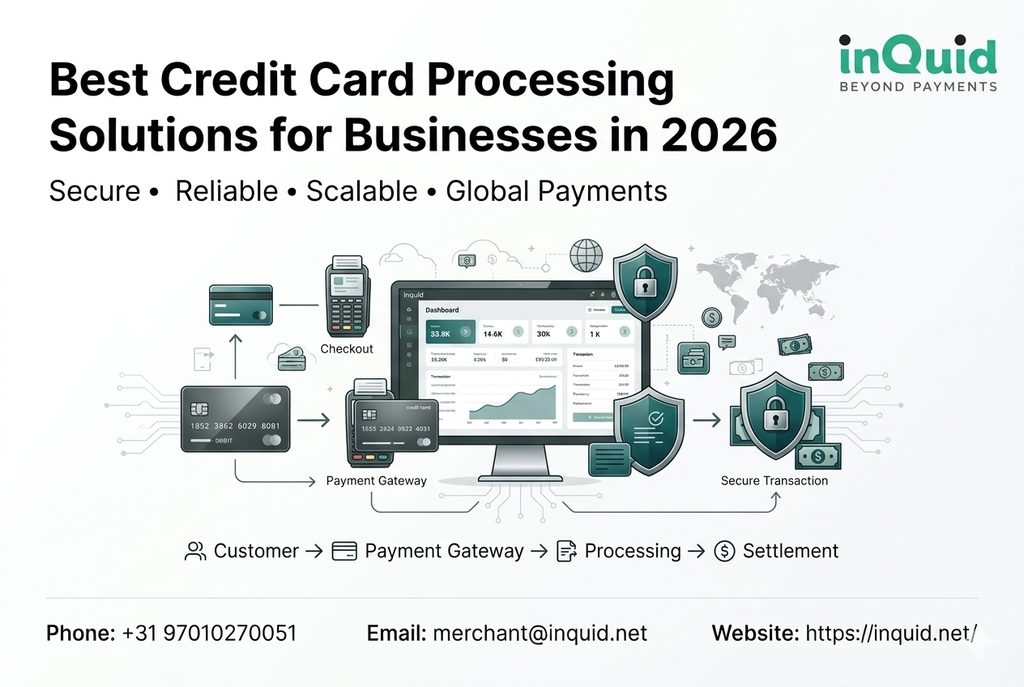
A simplified online card transaction can be represented as:
Customer → Checkout → Payment Gateway → Processor/Acquirer → Card Network → Issuing Bank → Authorization → Settlement
When the customer submits payment information, the transaction is securely transmitted through the payment infrastructure. The issuing bank evaluates the transaction and returns an approval or decline. An approved transaction then moves through clearing and settlement.
The process happens within seconds from the customer’s perspective, but several systems are involved behind the scenes.
Understanding this infrastructure makes it easier to compare credit card processing services and identify which solution fits a business.
Why Credit Card Processing Matters
For e-commerce, SaaS, subscription, digital-service, and international businesses, payment processing is a core part of the customer journey.
A suitable online credit card processing solution can help businesses:
- Accept familiar payment methods
- Provide convenient checkout
- Process payments across supported markets
- Manage recurring transactions where available
- Reduce avoidable payment failures
- Integrate payment functionality into existing platforms
- Monitor transaction activity
- Support refunds and disputes
- Manage payment reporting and reconciliation
At the same time, businesses need to manage fraud, chargebacks, compliance, data security, and processing costs.
The best approach is to treat payments as part of the company’s broader payment infrastructure.
What Makes the Best Credit Card Processing Solutions?
There is no universal provider that is best for every merchant.
A startup may prioritize simple integration. An international company may need multiple currencies and payment methods. A high-risk business may need specialized underwriting and acquiring arrangements.
When comparing the best credit card processing solutions, evaluate the following areas.
1. Payment Acceptance and Reliability
Reliable transaction processing is fundamental.
A payment platform should provide stable authorization and clear transaction statuses while helping merchants identify avoidable failures.
Transactions can be declined for many reasons, including insufficient funds, incorrect card details, authentication issues, issuer decisions, risk controls, and technical problems.
Businesses should ask providers how they approach payment optimization, retries, authentication, and transaction monitoring.
A provider with a broad feature list is not automatically the right provider. Reliability should be assessed against the merchant’s transaction profile and customer geography.
2. Payment Gateway Technology
A payment gateway provides the technology layer that connects a merchant’s checkout experience with payment-processing systems.
Depending on the business, useful capabilities may include:
- Hosted checkout
- API integration
- Payment links
- Tokenization
- 3-D Secure
- Recurring billing
- Refunds
- Transaction reporting
- Webhooks
- Multiple currencies
- Multiple payment methods
Businesses should choose a gateway that fits their technology stack instead of selecting features they will never use.
3. Credit Card Processing Fees
Credit card processing fees are an important part of payment economics, but headline pricing does not tell the complete story.
Potential costs can include:
- Transaction processing fees
- Gateway fees
- Monthly platform charges
- Cross-border fees
- Currency-conversion costs
- Chargeback fees
- Refund costs
- Fraud-management services
- Reserve requirements
A business should request a complete fee schedule before signing an agreement.
The cheapest advertised rate may not result in the lowest overall payment cost.
4. Security and PCI DSS
Payment security should be evaluated before commercial pricing.
The PCI Security Standards Council explains that outsourcing payment processing does not automatically remove the merchant’s PCI DSS responsibilities. Merchants still need to ensure that relevant third-party providers are compliant for the services being provided and understand shared responsibilities.
For online merchants, payment-page architecture also matters. Businesses should understand how payment data is handled and what responsibilities remain within their own environment.
Questions to ask include:
Is the payment environment PCI DSS compliant?
What PCI DSS responsibilities remain with the merchant?
How is sensitive payment information protected?
What security controls are included?
How are security incidents handled?
Security should be viewed as an ongoing process rather than a one-time implementation step.
5. Fraud Prevention
Fraud prevention is another major consideration for secure credit card processing.
Depending on the provider and setup, businesses may have access to controls such as:
- 3-D Secure
- CVV verification
- Address verification
- Transaction monitoring
- Velocity controls
- Rules-based screening
- Risk scoring
- Device intelligence
- Suspicious-activity monitoring
The objective is to reduce fraudulent transactions without creating unnecessary friction for legitimate customers.
Businesses should review fraud tools alongside approval rates and overall customer experience.
6. Chargeback Management
A chargeback occurs when a card transaction is disputed through the applicable card-payment process.
Chargebacks can create direct financial costs and operational work. Excessive dispute activity may also lead to increased monitoring or changes in processing arrangements.
A good payment infrastructure should help merchants identify trends and manage disputes efficiently.
Businesses should maintain:
- Clear refund policies
- Transaction records
- Customer communications
- Delivery or service evidence where appropriate
- Fraud controls
- Internal dispute procedures
Chargeback management should be considered during provider selection, not after disputes become a recurring issue.
7. International Credit Card Processing
Businesses operating across borders may need international credit card processing that supports multiple countries and currencies.
International processing can involve:
- Cross-border card transactions
- Multiple settlement currencies
- Foreign-exchange costs
- Local acquiring arrangements
- Regional payment methods
- Market-specific compliance requirements
A provider may advertise international coverage while still restricting certain countries, business categories, or transaction types.
Businesses should therefore build a country-by-country requirements list before choosing a payment provider.
8. Integration and Developer Support
A payment solution should fit the merchant’s technology environment.
Important factors can include:
- API documentation
- Sandbox access
- Hosted checkout
- Plugins
- Webhooks
- Payment-status notifications
- Reporting APIs
- Reconciliation tools
- Developer support
Integration complexity can directly affect implementation time and operational costs.
A technically strong solution should make it easier for businesses to launch, monitor, and scale payment processing.
Five Credit Card Processing Providers to Compare
This article focuses exclusively on Inquid, Stripe, WebPays, PAYCLY, and Boxchrge.
They represent different payment approaches, business models, and eligibility considerations. This is a comparison framework rather than an objective ranking.
1. Inquid
Inquid provides fintech and payment infrastructure solutions, including merchant accounts, payment processing, payment gateways, open banking, virtual banking, and related payment services.
Its payment infrastructure can be relevant for businesses that need more than a basic checkout tool and are evaluating a broader merchant-account and payment-processing strategy.
Businesses can assess Inquid based on factors such as:
- Merchant account requirements
- Credit card processing
- Payment gateway needs
- International payment requirements
- Alternative payment methods
- Multi-currency processing
- Risk and compliance considerations
- Technical integration
Inquid also focuses on businesses with specialized payment requirements, making it important for merchants to discuss their exact industry, operating markets, and transaction profile during onboarding.
Best suited for
Businesses seeking flexible payment infrastructure, merchant-account services, and international payment solutions based on their specific processing requirements.
Pros
- Broader payment infrastructure offering
- Merchant account and processing solutions
- Payment gateway capabilities
- International payment focus
- Relevant for specialized payment requirements
Cons
- Approval depends on underwriting and business eligibility
- Availability varies by market and business model
- Commercial terms must be confirmed directly
- Specific acquiring arrangements may differ by merchant
2. Stripe
Stripe is a widely used payment technology platform offering APIs, hosted checkout, billing, and other online payment tools.
For mainstream online businesses, its developer-focused infrastructure can be useful for integrating payments into websites, applications, and software platforms.
However, businesses must review its acceptable-use policies carefully.
Stripe’s current prohibited-business policy, updated May 13, 2026, lists gambling, internet gambling, casino games, sweepstakes, and contests involving monetary or material prizes among prohibited categories.
This makes business-category eligibility an essential part of evaluating Stripe.
Best suited for
Eligible mainstream online businesses that value developer-focused APIs, online checkout, and integrated payment technology.
Pros
- Strong API ecosystem
- Developer-friendly tools
- Online checkout capabilities
- Broad payment technology infrastructure
- Useful integrations for eligible businesses
Cons
- Gambling is listed as prohibited
- Business eligibility varies by category and jurisdiction
- Restricted-business policies must be reviewed
- Not every business model is supported
Stripe itself notes that some industries may remain unsupported even when an activity is legal in the merchant’s region because of requirements imposed on payment processors and financial partners.
3. WebPays
WebPays provides online payment infrastructure that includes merchant accounts, payment gateways, credit card processing, and high-risk payment services.
Its published site states that it supports credit card processing across major card networks and offers payment gateway and merchant-account services. It also describes multi-currency payments, 3-D Secure transactions, plugins, APIs, and support for various e-commerce platforms.
For businesses comparing credit card processing providers, WebPays may be relevant where payment gateway flexibility, international processing, and higher-risk payment requirements are important.
Best suited for
Businesses looking for online credit card processing, merchant-account services, gateway integration, and multi-currency payment capabilities.
Pros
- Credit card processing services
- Merchant account solutions
- Payment gateway integration
- Multi-currency payment support
- API and e-commerce integrations
- High-risk payment focus
Cons
- Eligibility depends on business and market
- Pricing varies by merchant
- Provider and acquiring terms should be verified
- Supported business categories can differ by jurisdiction
WebPays states that new merchant approvals are subject to its terms and those of its partnering banks or payment solutions.
4. PAYCLY
PAYCLY provides international payment and merchant-account infrastructure, including credit card services, payment gateways, alternative payment methods, and high-risk merchant solutions.
Its published platform describes worldwide coverage, multi-currency processing, payment reporting, APIs, checkout integration, and payment solutions for specialized industries.
For an international online business, these features can be useful when comparing international credit card processing options.
Best suited for
Businesses that need international payment processing, multi-currency capabilities, credit card services, and specialized merchant-account solutions.
Pros
- Credit card processing services
- International payment infrastructure
- Multi-currency capabilities
- Payment gateway integration
- APIs and plugins
- Specialized merchant solutions
Cons
- Approval depends on underwriting
- Country availability can vary
- Pricing and settlement terms require direct confirmation
- Third-party acquiring arrangements may influence the final setup
PAYCLY also notes that its merchant-processing services are provided in affiliation with third parties such as banks, acquirers, or regulated electronic-money institutions, with application approval and commercial terms depending on those arrangements.
5. Boxchrge
Boxchrge provides global merchant services and payment infrastructure, including international merchant accounts, cross-border payment gateway connectivity, payment orchestration, alternative payment methods, and settlement solutions.
Its published materials also describe credit card merchant accounts for online businesses and explain how payment information moves through the gateway, acquiring setup, and card-payment ecosystem.
For businesses with cross-border requirements, Boxchrge may be considered when comparing international payment infrastructure and merchant-account options.
Best suited for
Businesses that need international merchant services, cross-border payment connectivity, gateway infrastructure, and multi-market payment support.
Pros
- International merchant services
- Cross-border payment gateway
- Payment orchestration capabilities
- Alternative payment methods
- Multi-currency infrastructure
- Settlement solutions
Cons
- Merchant approval is subject to eligibility
- Availability varies by market
- Pricing depends on business requirements
- Acquiring and settlement terms should be reviewed before implementation
Comparison Table
| Provider | Core Strength | Credit Card Processing | Gateway / Technology | International Focus | Key Consideration |
| Inquid | Tailored fintech and payment infrastructure | Yes | Payment gateway and processing solutions | Yes | Suitable payment structure depends on business requirements |
| Stripe | Developer-focused payment technology | Yes for eligible businesses | APIs, Checkout and payment tools | Yes | Gambling and other prohibited categories must be checked |
| WebPays | Online and high-risk payment processing | Yes | Gateway, API and e-commerce integrations | Yes | Verify merchant and jurisdiction eligibility |
| PAYCLY | International and specialized payment services | Yes | Gateway, APIs and plugins | Yes | Commercial terms depend on business and acquiring setup |
| Boxchrge | Global merchant and payment infrastructure | Yes | Gateway, orchestration and settlement technology | Yes | Confirm exact market and business-model support |
Comparison note: Features and eligibility can change. “International” does not mean that every country or transaction type is automatically supported.
Pros and Cons of Credit Card Processing
Advantages
The right credit card processing solution can provide:
- Convenient customer payments
- Access to established card networks
- Faster digital checkout
- International transaction capabilities
- Payment automation
- Recurring billing where supported
- Better transaction reporting
- Integration with business platforms
Potential Challenges
Businesses also need to manage:
- Processing fees
- Chargebacks
- Fraud
- Declined transactions
- PCI DSS responsibilities
- Cross-border costs
- Foreign-exchange expenses
- Reserves
- Settlement timelines
- Provider restrictions
A good provider should help businesses manage these factors without creating unnecessary complexity.
Real-World Business Examples
Example 1: E-Commerce Store
Imagine an online store processing several thousand transactions each month.
Its requirements may include:
- Online credit card processing
- Mobile-friendly checkout
- Fraud screening
- Refunds
- E-commerce integration
- Multiple currencies
For this business, integration quality and transaction reliability may matter more than advanced enterprise infrastructure.
Example 2: SaaS Business
A SaaS company may need a payment solution that handles subscription billing.
Important features could include:
- Recurring payments
- Stored payment methods
- Automated billing
- Failed-payment retries
- Webhooks
- Reporting
- International cards
An API-focused payment environment may be particularly useful.
Example 3: International Business
Consider a company serving customers in Europe, North America, and Asia.
It may need:
- Multiple processing currencies
- International card acceptance
- Local payment methods
- Cross-border settlement
- Currency conversion
- Fraud management
- Regional payment support
In this case, international infrastructure and payment-method coverage may be more important than the lowest domestic rate.
Example 4: Higher-Risk Business
A business with elevated fraud or chargeback exposure may undergo more detailed underwriting.
Its requirements could include:
- Specialized merchant-account support
- Risk monitoring
- Chargeback management
- 3-D Secure
- Higher transaction controls
- Specific settlement arrangements
Businesses in this category should confirm eligibility before implementation rather than assuming that a mainstream payment solution will support them.
How to Choose the Best Credit Card Processing Solution
Start With Your Business Model
Identify what you sell, where your business is established, where customers are located, and how payments are collected.
The provider should be suitable for the complete business model.
Estimate Your Payment Volume
Prepare realistic estimates for:
- Monthly processing volume
- Average transaction value
- Maximum transaction value
- Expected growth
- Refund percentage
- Chargeback history
This information can influence underwriting and pricing.
Identify Your Target Markets
Create a list of countries and currencies you need to support.
Do not assume that international processing means worldwide availability.
Compare Payment Methods
Determine whether your customers primarily use:
- Credit cards
- Debit cards
- Digital wallets
- Bank transfers
- Alternative payment methods
The ideal mix depends on your customers and geography.
Review the Complete Pricing Structure
Ask for:
Transaction fees
Gateway fees
Cross-border fees
Currency-conversion costs
Chargeback fees
Reserve requirements
Settlement terms
This creates a more accurate view of the total cost.
Assess Security
Review PCI DSS responsibilities, authentication, encryption, tokenization, fraud prevention, and access controls.
The PCI SSC recommends that merchants using third-party service providers understand the division of responsibilities and monitor relevant provider compliance.
Check Regulatory Requirements
Businesses operating in regulated financial or payment environments should confirm the status and permissions of relevant entities.
For UK payment services, the FCA provides official information on authorisation and registration and maintains the Financial Services Register for checking relevant firms.
Test Integration Before Launch
Review the API, documentation, sandbox environment, checkout experience, webhook behavior, reporting, and reconciliation process.
Technical testing can identify problems before they affect customers.
Credit Card Processing for Global Businesses
Global businesses often need more than standard card acceptance.
A scalable international credit card processing environment may need to support:
- Multiple currencies
- Cross-border card transactions
- Local customer preferences
- Currency conversion
- International settlement
- Regional fraud considerations
- Different regulatory requirements
A business entering a new country should therefore review payment infrastructure as part of its market-entry strategy.
The provider that works well in one country may not provide the same capabilities in another.
Credit Card Processing and Compliance
Compliance is a shared responsibility.
Businesses should understand card-network rules and the requirements imposed by payment providers, acquirers, regulators, and other relevant parties.
Mastercard maintains rules and compliance programs that apply to merchants and processors, and notes that its official rules can change over time.
Visa also maintains its own merchant and acceptance rules.
For UK businesses, the FCA advises users to check whether non-bank payment service providers are authorised or registered and whether they have permission for the services being offered.
Businesses should therefore verify regulatory and provider information directly rather than relying only on marketing claims.
Frequently Asked Questions
- What are the best credit card processing solutions for businesses in 2026?
The five providers compared in this guide are Inquid, Stripe, WebPays, PAYCLY, and Boxchrge. The right choice depends on business model, target markets, transaction volume, industry, integration requirements, security needs, and eligibility.
- How does credit card processing work?
A typical card transaction moves from the merchant checkout through payment-processing infrastructure to authorization and settlement. The exact flow varies by payment architecture and provider.
- What is a payment gateway?
A payment gateway is a technology layer that securely connects a merchant’s checkout with payment-processing systems and transmits transaction information during the payment flow.
- What are credit card processing fees?
They are the costs associated with accepting card payments. Depending on the arrangement, they may include transaction fees, gateway charges, cross-border costs, currency conversion, chargeback fees, and other service charges.
- Is PCI DSS still relevant when payment processing is outsourced?
Yes. PCI SSC states that outsourcing payment processing does not automatically remove a merchant’s responsibilities. Merchants must still understand shared responsibilities and ensure relevant service providers meet applicable PCI DSS obligations.
- What is high-risk credit card processing?
High-risk credit card processing refers to payment arrangements for businesses that payment providers or acquiring institutions consider to have elevated risk based on factors such as industry, transaction profile, chargebacks, fraud exposure, or regulatory complexity.
- Can businesses accept international credit cards?
Many providers support international card transactions, but available countries, currencies, business categories, and settlement arrangements vary.
- How can businesses reduce card-payment declines?
Businesses can review checkout design, payment-method coverage, authentication, transaction data, fraud rules, and issuer-decline patterns. Payment optimization should focus on reducing avoidable declines without weakening fraud controls.
- Should a business use more than one processing provider?
A multi-provider strategy can offer redundancy, additional payment methods, or broader geographic coverage. However, it can also increase integration and reconciliation complexity.
- What should I compare besides processing fees?
Compare payment acceptance, security, gateway technology, fraud tools, chargeback support, settlement timing, supported countries, currencies, customer service, and scalability.
Conclusion
The best credit card processing solutions are not necessarily the providers with the lowest advertised rates or the largest feature lists.
A suitable payment partner should fit the business’s industry, transaction profile, target markets, technology stack, security requirements, and growth strategy.
In this comparison, Inquid, Stripe, WebPays, PAYCLY, and Boxchrge offer different approaches to payment processing and infrastructure. However, businesses should verify current provider policies, pricing, supported markets, underwriting requirements, and business-category eligibility before making a final decision.
For businesses that process payments internationally or operate in specialized industries, detailed due diligence is particularly important.
The right processing strategy can help improve payment reliability, simplify operations, strengthen security, and create a better customer checkout experience.
Build Your Payment Infrastructure with Inquid
Inquid provides fintech and payment solutions including merchant accounts, credit card processing, payment gateways, open banking, virtual banking, and related payment infrastructure.
Businesses can evaluate their transaction needs, target markets, payment methods, and integration requirements to develop a suitable processing strategy.
Contact Inquid to discuss your credit card processing requirements and identify a payment infrastructure solution aligned with your business goals.
Sources