
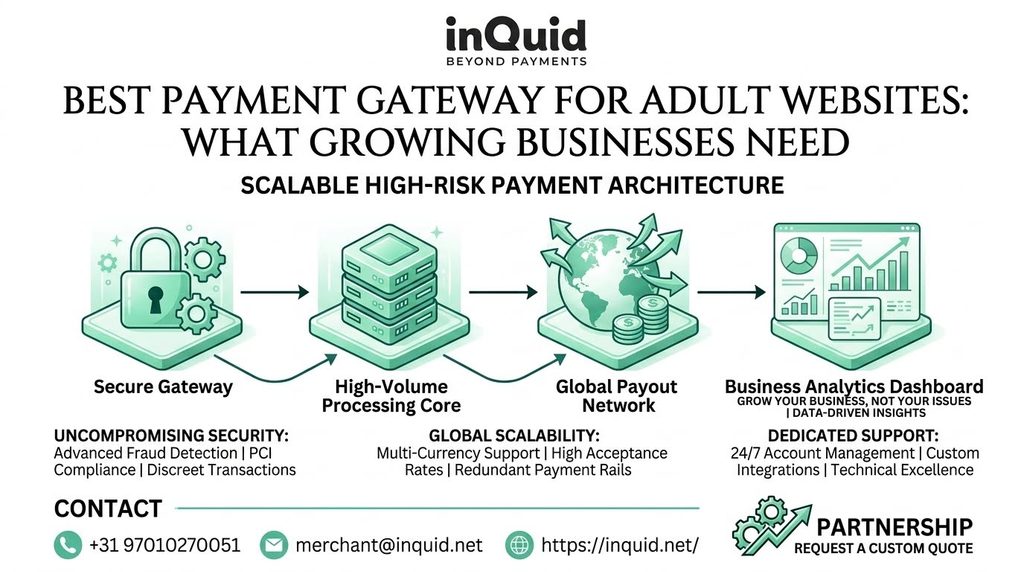
Choosing the best payment gateway for adult websites involves much more than comparing transaction fees.
For a growing adult business, payment infrastructure can influence checkout conversion, transaction approval, cash flow, fraud exposure, chargebacks, recurring revenue, international expansion and long-term stability.
Adult businesses can face additional underwriting and compliance considerations because certain adult-content and service categories can be subject to enhanced payment-network safeguards. Visa identifies Adult Content and Services as a category subject to specific network requirements and enhanced safeguards.
That makes choosing a payment gateway a strategic business decision rather than simply a technical implementation task.
This guide explains what growing adult websites should consider when evaluating payment gateways, how gateways connect with merchant accounts and processing, and which factors can help create a payment infrastructure built for sustainable growth.
What Is a Payment Gateway for an Adult Website?
A payment gateway for adult websites is technology that securely transmits payment information between a customer, merchant website, payment processor, acquiring institution and payment network.
A simplified transaction may look like this:
Customer → Adult Website → Payment Gateway → Processor/Acquirer → Card Network → Issuing Bank → Authorisation → Settlement
The gateway is only one part of the wider payment ecosystem.
Depending on the provider, an adult business may also require:
- An adult merchant account
- Adult credit card processing
- Fraud prevention
- 3-D Secure
- Tokenisation
- Recurring billing
- Chargeback management
- Multi-currency processing
- International payments
- Reporting and reconciliation
This distinction matters because a business can have an effective gateway but still experience difficulties if the underlying merchant account or acquiring relationship does not support its business model.
Businesses comparing broader payment gateway solutions can also explore Inquid’s merchant account solutions when evaluating the wider payment ecosystem.
Why Adult Websites May Need Specialised Payment Infrastructure
The adult category is not a single business model.
It can include:
- Adult ecommerce
- Subscription platforms
- Membership websites
- Digital content services
- Streaming businesses
- Creator platforms
- Marketplaces
- Other legally operated adult businesses
Each model creates different payment and risk considerations.
A subscription platform may need sophisticated recurring billing and payment-recovery tools. An adult ecommerce store may place greater emphasis on card acceptance, checkout performance and international payments. A marketplace may need stronger identity, age and content-governance processes.
Card-network requirements can also affect the payment environment.
Mastercard’s published rules for applicable non-face-to-face adult-content merchants include controls around content-provider agreements, identity and age verification, consent, pre-publication review, complaint handling and removal of unlawful content. Visa also identifies enhanced safeguards for applicable legal adult-content merchants.
This is why an adult payment strategy should connect payment processing, compliance, fraud prevention and business operations rather than treating them as separate functions.
High-Risk Does Not Automatically Mean Illegal
Being classified as high-risk does not automatically mean that a business is illegal or non-compliant.
In payment processing, higher-risk classification can reflect factors such as chargeback exposure, transaction characteristics, customer geography, recurring billing, regulatory complexity or the business model itself.
Eligibility still depends on the provider’s underwriting criteria, applicable laws, acquiring arrangements and card-network rules.
Businesses that require specialised adult merchant account solutions should therefore evaluate the full underwriting and compliance framework rather than focusing only on approval.
8 Things to Look for in a Payment Gateway for Adult Websites
1. Industry Acceptance and Underwriting
The first question isn’t simply whether a provider says it supports “adult businesses.”
You need to know whether the provider and its acquiring partners support your specific business model.
Ask:
- What products or services are permitted?
- Which countries and customer markets are supported?
- What documentation is required?
- Does enhanced underwriting apply?
- Are reserves required?
- Are transaction limits applicable?
- Are any activities restricted?
Visa’s published rules identify Adult Content and Services as a category subject to applicable network requirements. Businesses should confirm their classification and obligations directly with their acquirer or provider rather than relying on broad industry labels.
For a growing merchant, clarity at the beginning can prevent significant disruption later.
Businesses with more complex risk profiles can also evaluate high-risk payment processing as part of their broader payment strategy.
2. Security and Fraud Prevention
Security is essential for every online payment environment.
For adult businesses, fraud management can become particularly important because disputes, fraud losses and suspicious transactions may affect payment costs and account stability.
Depending on the provider, relevant tools may include:
- Tokenisation
- 3-D Secure
- CVV verification
- Address verification
- Transaction monitoring
- Risk scoring
- Velocity controls
- Device intelligence
- Fraud screening
- Chargeback monitoring
The objective is not to block as many transactions as possible.
It is to protect the business while keeping legitimate payments convenient.
Too little fraud protection can increase losses. Too much payment friction can create false declines and lost revenue.
A suitable high-risk payment gateway should therefore balance transaction security with a smooth customer experience.
3. Recurring Billing and Subscription Payments
Subscription-based adult businesses should pay particular attention to recurring payment capabilities.
A first payment can succeed while later transactions fail because:
- A card expires
- A customer receives a replacement card
- Payment credentials change
- An issuer declines the transaction
- Additional authentication is required
- Funds are temporarily unavailable
Payment infrastructure supporting tokenised credentials, account-updater functionality and appropriate retry mechanisms can help businesses recover transactions that might otherwise be lost.
The question isn’t simply:
Can the provider process the first payment?
It is:
Can the payment infrastructure help maintain the payment relationship over time?
Reliable recurring payment solutions can support customer retention and help make revenue more predictable where appropriate.
4. Chargeback Management
Chargebacks can be a major operating issue for businesses in higher-risk categories.
Frequent disputes can increase costs and may affect the merchant’s relationship with its acquiring or payment provider.
Businesses should maintain appropriate records, including:
- Transaction details
- Authentication records
- Purchase timestamps
- Billing information
- Subscription records
- Terms and conditions acceptance
- Refund policies
- Customer communications
- Delivery or service-access records
Businesses should also monitor why disputes are occurring.
Recurring disputes can point to:
- Unclear billing descriptors
- Difficult cancellation processes
- Customer confusion
- Fraud
- Poor customer support
- Recurring-billing problems
Strong chargeback management is therefore about identifying operational causes, not simply responding to individual disputes.
5. International and Multi-Currency Payments
Many adult businesses serve customers across borders.
That creates requirements around:
- International card acceptance
- Currency conversion
- Multi-currency pricing
- Cross-border processing
- International settlement
- Local payment preferences
- Geographic risk controls
A business might begin in the UK and later expand into Europe, North America or other regions.
Instead of choosing a gateway based only on today’s domestic transactions, identify:
Current markets + Target markets + Required currencies + Settlement requirements
Then confirm whether the provider can support those requirements.
A provider advertising “global payments” does not necessarily support every country or currency.
For businesses expanding across borders, international payment processing capabilities should therefore be evaluated alongside currencies, settlement and customer payment preferences.
A multi-currency payment gateway can also be valuable when businesses want to manage multiple markets through a more unified payment infrastructure.
6. Compliance and Content Governance
For adult websites, payment compliance cannot be separated from content governance—particularly for platforms where third-party creators or users upload content.
Mastercard’s published requirements for applicable non-face-to-face adult-content merchants include measures around identity and age verification, consent, content-provider verification, pre-publication review, complaint handling and removal mechanisms.
Visa likewise states that applicable legal adult-content merchants may be subject to enhanced registration and monitoring requirements.
Businesses should therefore consider payment readiness alongside:
- Age verification
- Identity verification
- Consent documentation
- Content review
- Complaint handling
- Content-removal procedures
- Record keeping
- Applicable local laws
For marketplace and creator-platform models, these controls can be just as important to payment continuity as the gateway technology itself.
7. Settlement and Cash-Flow Reliability
Accepting a payment is only part of the process.
Growing businesses also need predictable access to their funds.
Before selecting a provider, ask about:
- Settlement frequency
- Payout timing
- Supported settlement currencies
- Reserve requirements
- Payout restrictions
- Transaction limits
- Refund handling
- Chargeback deductions
- Account reviews
A provider with slightly higher fees but predictable settlement may offer more practical value than a cheaper option with uncertain funding conditions.
Cash-flow visibility is especially important for businesses managing marketing, staffing, technology, suppliers and international operations.
8. Scalability and Integration
The best payment gateway for a small adult website may not remain the best solution after significant growth.
As transaction volume increases, businesses may need:
- Higher transaction capacity
- Additional payment methods
- Multi-currency support
- Recurring billing
- Advanced fraud tools
- API integrations
- Automated reconciliation
- Improved reporting
- Multiple websites or entities
Before signing an agreement, ask:
- Can this provider support substantially higher processing volume?
- Can the same infrastructure support additional markets?
- Can it integrate with the existing website and financial systems?
- How are technical and account issues handled?
For online businesses, ecommerce payment solutions may also be evaluated alongside gateway, merchant-account and fraud-management requirements.
Scalability should be evaluated before it becomes an operational problem.
Payment Gateway vs. Adult Merchant Account
A payment gateway and an adult merchant account are related but different components.
The gateway primarily handles the technology used to transmit payment information securely.
The merchant account is part of the acquiring arrangement through which eligible card transaction funds are received.
Depending on the provider, businesses may receive:
Payment Gateway + Merchant Account + Processing
as one combined service.
In other cases, these components may involve different providers.
This is why businesses should understand exactly what they are purchasing.
A low gateway fee does not necessarily mean low overall payment costs if separate processing, merchant-account, chargeback or settlement fees apply.
Businesses can compare merchant account solutions alongside the gateway itself to understand the complete payment structure.
Traditional vs. Specialised Payment Processing
For adult businesses, specialised infrastructure can differ from conventional payment processing in several ways.
| Requirement | General Payment Processing | Specialised Adult Payment Processing |
| Industry acceptance | Provider dependent | Designed for eligible adult businesses |
| Underwriting | Standard | May involve enhanced review |
| Fraud management | General controls | Greater emphasis on risk management |
| Chargebacks | Standard monitoring | Often requires closer management |
| Recurring billing | Provider dependent | Important for subscription models |
| International processing | Varies | Important for many growing merchants |
| Content controls | Usually not central | Important for applicable platforms |
| Settlement | Provider dependent | May include specific reserve terms |
| Scalability | Provider dependent | Should be evaluated carefully |
Specialised does not automatically mean better.
The right solution depends on the business model, customer markets, transaction profile and growth objectives.
Pros and Cons of Specialised Adult Payment Processing
Pros
- Better alignment with eligible adult business models
- More relevant underwriting experience
- Stronger focus on fraud and chargeback management
- Support for recurring payment models
- Potential international payment capabilities
- Infrastructure designed around higher-risk considerations
- Better alignment between payment and business requirements
Cons
- More detailed underwriting
- Potentially higher processing costs
- Possible reserve requirements
- Additional compliance obligations
- Provider or market restrictions
- More operational oversight
Businesses should evaluate the full commercial and operational picture—not simply whether an account can be approved.
Real-World Business Scenarios
The following are illustrative business scenarios, not claims about specific Inquid customers.
Adult Ecommerce Store
A UK-based adult ecommerce store begins domestically and later expands into Europe.
Its payment requirements could include:
- GBP and EUR payments
- International card acceptance
- Mobile-friendly checkout
- Fraud monitoring
- Chargeback management
- Predictable settlement
The business may evaluate ecommerce payment solutions alongside its merchant account and gateway infrastructure.
Rather than changing providers every time it enters another market, the business can evaluate payment infrastructure against its expansion roadmap from the beginning.
Subscription-Based Adult Website
A subscription platform relies heavily on recurring revenue.
Its payment strategy could focus on:
- Tokenisation
- Recurring billing
- Payment retries
- Account-updater capabilities
- Customer notifications
- Fraud monitoring
- Chargeback management
Here, the gateway’s ability to support recurring transactions can be as important as its initial authorisation capabilities.
Adult Content Marketplace
A marketplace allowing third-party content providers to upload material faces additional operational considerations.
It may need:
- Creator identity verification
- Age verification
- Consent documentation
- Content review
- Complaint handling
- Content removal
- Payment monitoring
Mastercard’s published rules specifically address controls for applicable non-face-to-face adult-content merchants and content-provider environments.
For this type of business, payment technology and content governance need to work together.
What Should Businesses Compare?
Before choosing a provider, compare the factors that can affect long-term payment performance.
| Factor | What to Evaluate |
| Industry fit | Does the provider support the exact business model? |
| Compliance | What documentation and controls are required? |
| Payment methods | Which cards and alternative methods are supported? |
| Security | What fraud and authentication tools are included? |
| Recurring billing | Can subscriptions be managed effectively? |
| Chargebacks | What monitoring and dispute tools are available? |
| Pricing | What is the complete payment cost? |
| Settlement | When are funds available? |
| Reserves | Are rolling or other reserves required? |
| International | Which countries and currencies are supported? |
| Integration | Are APIs, plugins and webhooks available? |
| Scalability | Can the infrastructure support future growth? |
| Support | Is technical and account support available? |
This comparison is more useful than selecting a provider based only on a headline transaction rate.
Security and PCI DSS
Payment security should be considered from the start of implementation.
The PCI Security Standards Council describes PCI DSS as a baseline of technical and operational requirements designed to protect payment-account data. It applies to entities involved in storing, processing or transmitting payment-account data and others that can affect the security of the cardholder-data environment.
PCI SSC’s current document library includes PCI DSS v4.0.1.
Using a third-party payment gateway can reduce the amount of sensitive card data a merchant directly handles, but it does not automatically eliminate the merchant’s applicable responsibilities.
Businesses should understand:
- What payment data they handle
- What their provider handles
- Their applicable PCI DSS responsibilities
- Access controls
- Security monitoring
- Third-party responsibilities
- Incident-response procedures
For authoritative payment-security guidance, consult the PCI Security Standards Council.
Businesses can also review Inquid’s credit card processing solutions when assessing broader card-payment infrastructure.
Don’t Choose a Payment Gateway Based Only on Price
Transaction fees matter, but they are only one part of the economics.
Businesses should consider:
Processing fees + chargebacks + refunds + FX costs + reserves + fraud losses + operational costs
A lower advertised rate can be less valuable if the provider offers limited international coverage, weaker risk tools, slower settlement or poor support.
A slightly higher rate can sometimes provide better overall business value when it comes with stronger reliability and infrastructure.
The important question is:
What total value does this payment infrastructure provide to the business?
rather than:
Which provider has the lowest advertised fee?
Businesses evaluating payment processing solutions should therefore compare total business impact instead of one isolated pricing figure.
Building a Payment Strategy That Can Grow
A payment gateway should fit into a broader financial and payment infrastructure:
Payment Gateway → Adult Merchant Account → Fraud Management → Recurring Billing → Chargeback Management → International Payments → Reporting
Each component should support the others.
As transaction volume increases, a business may face:
- More fraud signals
- Higher chargeback exposure
- More international customers
- Greater reporting requirements
- Larger settlement balances
- More complex reconciliation
- Increased customer-support requirements
A payment strategy that works at low transaction volume may require additional capabilities as the business scales.
Businesses can also evaluate digital payment solutions and relevant open banking solutions where they fit the broader financial strategy.
Planning for growth early can make the transition considerably easier.
Frequently Asked Questions
- What is the best payment gateway for adult websites?
There is no universal best provider. The appropriate solution depends on the business model, countries served, payment methods, transaction volume, compliance requirements, risk profile and scalability needs.
- Can adult websites accept credit cards?
Eligible adult businesses may be able to accept card payments through providers and acquiring arrangements that support their business model and applicable network requirements. Businesses should confirm eligibility directly with their provider.
- Why do adult websites sometimes need specialised payment processing?
Certain adult-content and service categories can involve elevated risk and enhanced payment-network requirements. Visa and Mastercard publish rules and safeguards relevant to applicable adult-content merchants.
- Can adult websites offer recurring payments?
Some eligible businesses can support subscriptions and recurring billing, subject to provider policies, acquiring arrangements and card-network requirements.
- What is the difference between a payment gateway and an adult merchant account?
A payment gateway primarily provides the technology for transmitting payment information, while a merchant account forms part of the acquiring arrangement through which eligible card transactions are funded to the merchant.
- What should an adult business look for in a payment gateway?
Businesses should evaluate industry eligibility, compliance, security, payment methods, recurring billing, chargeback management, international coverage, settlement, pricing, integration and scalability.
- Does PCI DSS apply to adult websites?
PCI DSS applicability is determined by an organisation’s involvement with payment-account data and its impact on the cardholder-data environment—not simply because the business operates in the adult industry. PCI SSC provides the applicable standards and guidance.
- Can adult websites process international payments?
Some providers support international transactions, but availability depends on the merchant location, customer markets, currencies, payment methods, business model and acquiring arrangement.
- What makes a payment gateway scalable?
Scalable payment infrastructure can support increasing transaction volume, additional payment methods, international markets, recurring billing, reporting, fraud management and technology integrations without requiring a complete platform replacement.
- How can chargebacks affect an adult merchant account?
Providers may monitor chargeback levels closely for higher-risk categories. Persistently high dispute levels can affect commercial terms, risk controls, reserves or the ongoing processing relationship, which makes clear billing practices, customer support and dispute documentation important from the beginning.
- How do adult businesses choose a payment gateway?
Adult businesses should compare industry eligibility, compliance requirements, payment methods, security, recurring billing, chargeback management, settlement, international coverage, pricing, integration and scalability rather than focusing on one feature.
Conclusion
The best payment gateway for adult websites is not necessarily the provider with the lowest transaction rate or the fastest onboarding.
For growing businesses, the better choice is payment infrastructure that supports:
Reliable payment acceptance + Security + Recurring billing + Chargeback management + International growth + Compliance + Scalability
Adult businesses should evaluate the complete payment ecosystem rather than looking only at the gateway.
The right questions are:
Does the provider support my exact business model?
Can it manage the payment and compliance requirements associated with my business?
Can it support my target markets and payment methods?
Can its infrastructure scale as transaction volume grows?
For businesses exploring specialised payment infrastructure, Inquid’s payment gateway solutions, adult merchant account solutions, high-risk merchant account solutions, and credit card processing solutions provide relevant areas to evaluate based on the business’s specific requirements.
Authoritative Resources