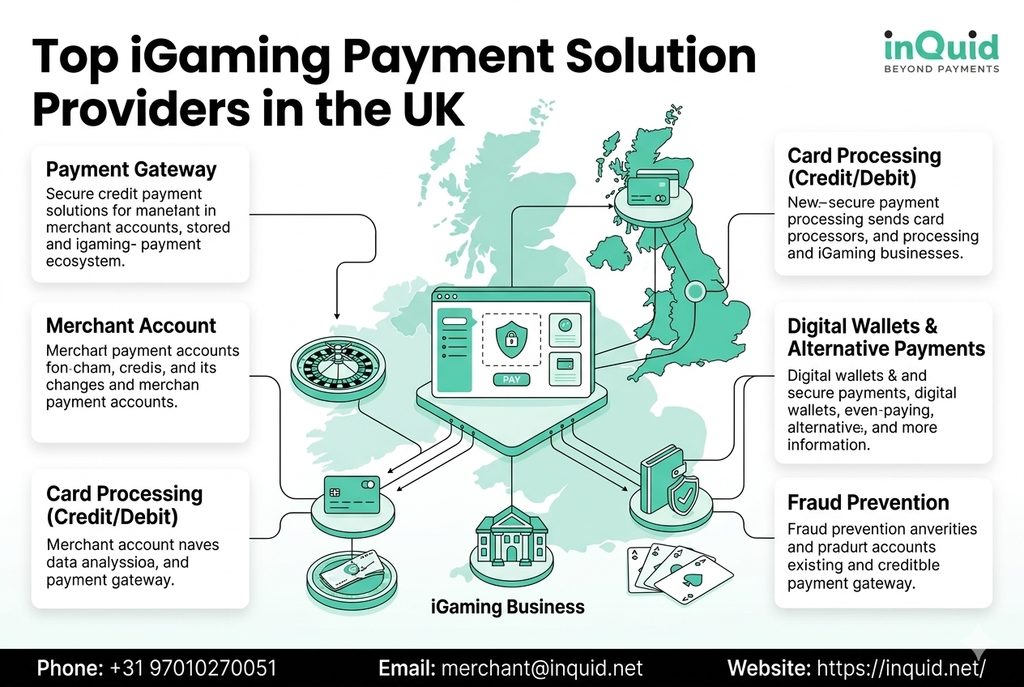
The UK is one of the world’s established regulated gambling markets, and payment infrastructure is a critical part of operating an online casino, sportsbook, bingo platform, lottery service, or other regulated iGaming business. Operators need payment solutions that can support deposits, withdrawals, transaction monitoring, fraud prevention, reconciliation, and customer-friendly payment methods.
Choosing an iGaming payment solution provider involves more than comparing transaction fees. A UK operator should also consider payment-method coverage, merchant account availability, acquiring relationships, payouts, fraud controls, integration options, settlement, and the provider’s eligibility requirements.
For applicable remote casino, bingo and betting licensees operating in Great Britain, the UK Gambling Commission requires payments involving payment services to be provided by a qualifying payment service provider under Licence Condition 5.1.2. UK gambling licensees must also not accept payment for gambling by credit card, including payments made through a money service business.
What Is an iGaming Payment Solution Provider?
An iGaming payment solution provider supplies payment technology, merchant services, acquiring connectivity, or related financial infrastructure used by online gambling and gaming businesses.
Depending on the provider and business model, an iGaming payment solution may include:
- iGaming merchant accounts
- Payment gateway infrastructure
- Card and debit-card processing
- Bank transfers and account-to-account payments
- Alternative payment methods (APMs)
- Digital wallets
- Payment orchestration
- Multi-currency processing
- Player deposits and withdrawals
- Fraud prevention
- 3D Secure authentication
- Chargeback management
- Transaction monitoring
- Reporting and reconciliation
A payment gateway and a merchant account are also not necessarily the same thing. The gateway handles payment technology and transaction communication, while acquiring and merchant-account arrangements determine how transactions are ultimately processed and settled.
iGaming Payment Solution Providers to Consider
1. Inquid
Inquid provides payment infrastructure for online businesses with international and complex payment requirements, with a dedicated iGaming offering covering online casinos, sportsbooks, lotteries, and gaming platforms.
According to Inquid’s published iGaming materials, its offering includes iGaming merchant accounts, multi-currency acquiring, AI-based fraud detection, 3D Secure 2.2, chargeback tools, dedicated gaming MIDs, local acquiring, and payment processing across multiple markets. Inquid also states that its iGaming infrastructure supports cards, bank transfers, e-wallets, alternative payment methods, and crypto on/off-ramp functionality.
Its published technology and infrastructure claims include:
- PCI-DSS Level 1 infrastructure
- 3D Secure 2.2
- Tokenization
- AI/ML-based fraud detection
- Dedicated gaming MIDs
- Multi-currency processing
- REST APIs and SDK integrations
- Local acquiring across the UK and other regions
- T+1 to T+3 settlement options, subject to the arrangement
Inquid also states that its iGaming infrastructure supports 135+ currencies and 150+ markets, with availability depending on the business, jurisdiction, and processing setup.
2. WebPays
WebPays is positioned around high-risk merchant accounts, gaming merchant accounts, payment gateways, and international payment processing.
Its current website specifically presents a gaming merchant account offering, while its UK gambling-payment content discusses payment infrastructure for online casinos, sports betting, fantasy games, online bingo, and other gambling businesses.
WebPays publishes several features that are particularly relevant to an iGaming payment setup, including:
- Gambling payment gateway infrastructure
- Multi-currency payment processing
- Multiple acquiring-bank relationships
- Fraud-prevention features
- 3D Secure transactions
- Multiple online payment methods
- PCI-DSS-compliant payment solutions
- API and server-side integration options
- Plugins for platforms such as WordPress, WooCommerce, Magento and PrestaShop
- Dedicated account-management support
Its UK gambling-payment page also describes a merchant onboarding process involving business information, ownership, licensing, website details, target markets, expected transaction volumes, and payment requirements.
WebPays states that its merchant processing operates in affiliation with banks and acquirers and that new merchant approvals are subject to its own terms and those of its partnering bank or solutions.
3. Boxchrge
Boxchrge provides global merchant services, cross-border payment gateway connectivity, alternative payment methods, settlement solutions, and payment orchestration.
Its published payment-orchestration platform focuses on multi-acquirer connectivity, cascading logic, smart routing, regional optimization, failover handling, and performance monitoring. Boxchrge states that the platform can route eligible transactions across multiple acquiring partners through a unified infrastructure layer.
Its broader infrastructure includes:
- International merchant accounts
- Cross-border payment gateways
- Multi-currency processing
- Local APMs
- Hosted checkout
- S2S APIs
- Webhooks
- 3DS authentication
- Tokenization
- Fraud-prevention rules
- Transaction monitoring
Boxchrge states that its services are available subject to merchant profile, jurisdiction, documentation, compliance review, and partner availability.
Its orchestration model can be particularly relevant to merchants that want more than a single acquiring relationship, although payment orchestration does not guarantee higher approval rates; actual performance depends on acquirers, corridors, transaction types, and merchant configuration.
4. Amald
Amald offers merchant-account and payment-processing solutions for high-risk businesses, including online casinos and gaming businesses.
Its published iGaming materials specifically discuss 3D Secure and non-3DS payment processing, while its broader merchant-account information lists payment gateway services, alternative payment methods, and high-risk merchant accounts.
For online casino businesses, Amald publishes information covering:
- 3DS payment processing
- Non-3DS processing
- eCheck processing
- ACH processing
- Virtual terminal and MOTO payments
- Major card-brand acceptance
- Multi-currency payment options
- High-risk merchant accounts
- Offshore merchant-account options
- Payment gateway services
Amald’s online casino page also describes multi-currency processing for international payments.
The combination of 3DS and non-3DS processing is a useful area to investigate for operators that need different authentication flows, while eligibility remains dependent on the merchant, payment channel, acquiring relationship, and applicable rules.
5. PayCly
PayCly provides payment infrastructure and industry-specific merchant accounts for gaming, casino, gambling, and other high-risk businesses.
Its published casino merchant-account materials describe 100+ payment methods and 160+ currencies, along with dedicated casino/gaming merchant accounts and international payment gateway services.
PayCly also makes its processing structure relatively explicit: its website states that merchant-processing services are provided in affiliation with third-party banks, acquirers, or regulated e-money institutions, and that application approval and proposed commercial terms are dependent on those third parties.
Other published capabilities include:
- Gaming merchant accounts
- Casino merchant accounts
- Gambling payment processing
- International payment gateways
- Alternative payment methods
- Multi-currency processing
- Dedicated merchant IDs
- Fraud and chargeback controls
- Crypto settlement options
For a UK operator, the relevant due-diligence question is not simply whether PayCly advertises gambling payment services, but whether the exact operator, licence, geography, transaction profile, and intended payment methods can be supported through the applicable acquiring partners.
6. Stripe
Stripe is a major global payment technology platform, but it is important to distinguish its general payment capabilities from its current gambling policy.
Stripe’s current Restricted and Prohibited Businesses policy explicitly lists games of chance including gambling, internet gambling, casino games, sweepstakes and contests, fantasy sports leagues with monetary or material prizes, sports forecasting or odds-making, lotteries, and other gambling-related activities as prohibited. The policy was updated on September 22, 2026.
As a result, a UK gambling operator should not assume that holding a UK gambling licence automatically makes the business eligible for Stripe.
7. Wise
Wise is primarily a cross-border financial-services and money-transfer platform rather than a specialist iGaming payment gateway.
Its current business eligibility information explicitly states that gambling, betting, online gaming, and video gaming businesses are not eligible for Wise Business services.
Wise’s gambling policy also distinguishes between certain permitted personal gambling-related transfers and business use. Wise states that it does not support businesses involved in gambling anywhere in the world.
Therefore, Wise should not be treated as a conventional iGaming merchant account provider or gambling payment processor for a UK operator.
8. PayPal
PayPal is a global payment platform that can support certain gambling-related sellers, but gambling transactions require specific eligibility and approval.
PayPal states that approved gambling sellers may use PayPal in certain jurisdictions where gambling is legal. Approval can require the seller to demonstrate that it can prevent gambling transactions involving prohibited jurisdictions or customers.
PayPal’s acceptable-use policy also identifies gambling, casino games, sports betting, horse and greyhound racing, fantasy sports, lotteries, games of skill with entry fees and prizes, and other gambling-related activities within its gambling rules.
For UK iGaming businesses, PayPal therefore needs to be evaluated on an approved-merchant basis rather than assumed to be available to every operator.
9. Payoneer
Payoneer provides international business payment and cross-border financial services, including multi-currency receiving capabilities.
That distinction matters when comparing Payoneer with specialist iGaming payment solution providers. A platform designed for general cross-border business payments should not automatically be treated as a gambling merchant processor.
Businesses considering Payoneer should verify the exact permitted use, transaction flow, customer relationship, and applicable terms before relying on the service for an iGaming operation.
10. Authorize.net
Authorize.net is a payment gateway that supports card and checking-account transaction submission and routing through processing networks. Its published product information also includes services such as eCheck, recurring billing, customer-information management, and fraud-detection tools.
Authorize.net’s current eCommerce page states that it supports cross-border eCommerce payments for businesses based in the United States, Canada, United Kingdom, Europe, and Australia.
However, gambling operators should examine the underlying merchant-service and acquiring arrangements rather than assuming that general UK gateway availability means iGaming eligibility. Authorize.net’s published eCheck agreement information specifically identifies gambling among the business types that may cause high-risk eCheck services to be cancelled.
For a UK iGaming operator, the appropriate question is therefore whether a particular merchant-service provider and acquiring relationship will support the intended gambling activity and payment methods.
Comparison of the 10 Providers
| Provider | Main Focus | Gateway | Merchant Account | International Payments | UK / Great Britain Considerations |
| Inquid | iGaming and global payment infrastructure | Yes | Yes | Yes | Subject to business, licensing and underwriting |
| WebPays | Gaming and high-risk payment processing | Yes | Yes | Yes | Subject to business profile and partner approval |
| Boxchrge | Payment orchestration and global merchant services | Yes | Yes | Yes | Subject to jurisdiction and partner availability |
| Amald | iGaming and high-risk merchant services | Yes | Yes | Yes | Subject to approval |
| PayCly | Gaming, casino and high-risk payments | Yes | Yes | Yes | Third-party partner approval applies |
| Stripe | General payment infrastructure | Yes | No traditional merchant account | Yes | Gambling prohibited under current policy |
| Wise | Cross-border financial services | No specialist iGaming gateway | No | Yes | Gambling businesses not eligible |
| PayPal | General payments / approved gambling sellers | Yes | No traditional merchant account | Yes | Gambling requires approval |
| Payoneer | Cross-border business payments | Not specialist iGaming | No traditional merchant account | Yes | Gambling identified as restricted |
| Authorize.net | General payment gateway | Yes | Through merchant-service/acquiring relationships | Yes | Gambling eligibility must be verified |
Provider capabilities and eligibility can change. This table is a high-level editorial comparison, not an independent certification of availability.
What Should UK iGaming Businesses Look for in a Payment Provider?
1. Regulatory Compatibility
The payment solution needs to fit the operator’s gambling licence, operating model, target markets, and applicable payment regulations.
For applicable remote casino, bingo and betting licensees in Great Britain, the Gambling Commission requires payment services to be provided by a qualifying payment service provider under LCCP condition 5.1.2.
2. Payment Method Coverage
A modern UK iGaming payment gateway may need to support several payment methods rather than relying on a single option.
Depending on the operator and provider, this can include:
- Debit cards
- Bank transfers
- Open banking
- E-wallets
- Alternative payment methods
- Local payment options
The important question is not simply how many methods a provider advertises, but which methods are actually available to the specific operator.
3. Deposits and Withdrawals
An effective iGaming payment processing solution should address the complete transaction lifecycle.
Operators should review:
- Deposit processing
- Withdrawal processing
- Refunds
- Payment verification
- Settlement
- Reconciliation
- Transaction reporting
Fast deposits without dependable withdrawals can still create a poor player payment experience.
4. Fraud Prevention
Online gaming businesses can face payment fraud, account takeover, bonus abuse, suspicious transaction activity, and disputes.
Payment infrastructure may include:
- 3D Secure
- Transaction monitoring
- Velocity controls
- Risk scoring
- Tokenization
- Device and behavioural signals
- Chargeback management
- Identity and KYC controls
5. Multi-Currency Processing
Operators targeting multiple countries may require a multi-currency payment gateway or acquiring arrangement.
However, international processing should always be evaluated alongside the gambling regulations, licensing requirements, payment-method availability, and settlement rules in the target market.
6. Integration
Technical teams should compare:
- Hosted checkout
- REST APIs
- SDKs
- Webhooks
- Server-to-server integration
- Plugins
- Payment orchestration
- Reporting dashboards
The right option depends on the casino platform, sportsbook technology, CRM, cashier, and internal payment architecture.
UK iGaming Payment Compliance
Payment compliance is one of the most important elements of UK gambling payment processing.
- Credit Cards Cannot Be Used for Gambling
The Gambling Commission’s LCCP condition 6.1.2 states that licensees must not accept payment for gambling by credit card. The restriction also covers payments made through a money service business.
- E-Wallet Funding Also Matters
The Gambling Commission has specifically stated that operators must not accept gambling payments through an e-wallet where the wallet provider cannot prevent the wallet from being funded by a credit card.
This makes the funding source behind an apparent alternative payment method an important part of payment compliance.
- Payment Service Providers Must Qualify
Under LCCP condition 5.1.2, applicable remote casino, bingo and betting licensees must use qualifying payment service providers for payment services used by customers in Great Britain.
- Great Britain and Northern Ireland Are Different Regulatory Areas
The Gambling Commission regulates gambling under the Gambling Act 2005 in England, Scotland and Wales. Gambling in Northern Ireland, apart from the National Lottery, is regulated under a separate framework.
This distinction should be considered when an operator describes itself as serving the entire “UK.”
Specialist iGaming Providers vs. Mainstream Payment Platforms
There is an important difference between a specialist iGaming payment provider and a general payment platform.
Specialist providers such as Inquid, WebPays, Boxchrge, Amald and PayCly specifically publish material related to gaming, gambling, high-risk merchants, merchant accounts, payment gateways, or international payment infrastructure. Their exact capabilities and approval criteria still need to be confirmed for each operator.
How to Choose an iGaming Payment Provider
Before signing an agreement, ask each provider the same core questions.
- Business eligibility
Can the provider support your exact activity?
For example:
- Online casino
- Sports betting
- Bingo
- Lottery
- Fantasy gaming
- Poker
- Other regulated gaming
- Licensing
What gambling licence and corporate documentation must be provided?
- Acquiring
Which acquiring banks, PSPs, or financial institutions sit behind the payment arrangement?
- Payment methods
Which cards, bank methods, wallets and APMs are available to the specific business?
- Settlement
Ask about settlement currencies, settlement frequency, reserves, reconciliation and payout terms.
- Risk management
Review 3DS, fraud prevention, chargeback handling, transaction monitoring and KYC/AML requirements.
- Technical integration
Confirm whether the provider supports API integration, hosted checkout, webhooks, plugins, SDKs or orchestration.
- Geographic coverage
For international expansion, verify whether the provider has actual acquiring and payment support in each target market rather than simply advertising global coverage.
Pros and Cons of Specialist iGaming Payment Providers
Advantages
Specialist providers may offer industry-focused underwriting, gambling-specific payment infrastructure, higher-risk merchant-account options, multiple payment methods, international processing and additional payment-routing capabilities.
Considerations
Operators may also encounter more extensive underwriting, rolling reserves, higher processing costs, jurisdiction limitations, additional documentation and partner-dependent approvals.
The actual commercial arrangement depends on the merchant profile and payment structure.
Frequently Asked Questions
- What is an iGaming payment solution provider?
An iGaming payment solution provider supplies payment technology or financial infrastructure that helps online casinos, sportsbooks, bingo operators, lotteries and other gaming businesses process deposits, withdrawals and related transactions.
- What is an iGaming payment gateway?
An iGaming payment gateway connects a gaming website or application with payment-processing infrastructure. It securely transmits payment information and transaction responses between the merchant, payment provider and acquiring environment.
- What is an iGaming merchant account?
An iGaming merchant account is an account arrangement used to receive and process card or other eligible payment transactions for a gaming business. The merchant account and payment gateway may be provided by different parties.
- Can UK iGaming businesses accept credit cards?
No. The Gambling Commission’s condition 6.1.2 prohibits gambling licensees from accepting payment for gambling by credit card, including through a money service business.
- Can an e-wallet be used for UK gambling payments?
Potentially, but operators need to consider how the wallet is funded. The Gambling Commission states that operators must not accept gambling payments through an e-wallet where the wallet can be funded by a credit card.
- Are all 10 providers suitable for UK iGaming?
No. The providers in this article represent different types of payment infrastructure. Some specifically publish iGaming or high-risk offerings, while several mainstream platforms have restrictions on gambling.
- Does Stripe support online gambling?
Stripe’s current policy lists gambling, internet gambling, casino games, lotteries, and other specified gambling activities as prohibited.
- Does Wise support gambling businesses?
Wise states that gambling, betting, online gaming and video gaming businesses are not eligible for Wise Business services.
- Does PayPal support iGaming?
PayPal states that approved gambling sellers may use its services in certain jurisdictions where gambling is legal, subject to its approval requirements.
What should an online casino look for in a payment provider?
An online casino should evaluate licensing compatibility, merchant-account availability, payment methods, deposit and withdrawal support, fraud prevention, chargeback controls, settlement, integration, pricing and international coverage.
Final Thoughts
Choosing among iGaming payment solution providers in the UK requires a business-specific assessment rather than a simple comparison of transaction rates.
Specialist providers such as Inquid, WebPays, Boxchrge, Amald and PayCly publish solutions aimed at gaming, gambling, high-risk merchants, international payment processing, merchant accounts, gateways, or payment orchestration. Their actual suitability depends on the operator’s business model, licence, target markets, transaction profile, acquiring relationships and underwriting outcome.
The mainstream platforms in this comparison illustrate why operators need to check current policies rather than assume that a well-known payment brand accepts gambling businesses. Stripe and Wise currently publish explicit gambling restrictions, PayPal requires approval for gambling sellers, and Payoneer identifies gambling as a restricted industry.
For businesses serving Great Britain, payment strategy should also reflect the Gambling Commission’s rules around qualifying payment service providers and the prohibition on credit-card gambling.
The most practical approach is to compare providers using the same checklist: licensing compatibility, merchant-account availability, payment methods, gateway technology, acquiring structure, fraud prevention, payouts, settlement, integration and geographic coverage.
Looking for iGaming Payment Infrastructure?
Inquid provides payment infrastructure and merchant-account solutions for iGaming businesses, including online casinos, sportsbooks, lotteries and gaming platforms. Its published iGaming offering covers areas such as multi-currency processing, merchant accounts, payment gateways, fraud prevention, 3D Secure and international payment connectivity.
Businesses should confirm current eligibility, supported jurisdictions, available payment methods and commercial terms directly with Inquid before onboarding.
Sources