Businesses in higher-risk industries cannot always choose payment infrastructure in the same way as a standard e-commerce merchant. Industry restrictions, chargeback exposure, international transactions, regulatory requirements, and fraud risk can all influence which payment providers are willing and able to support a business.
A high-risk payment gateway can help connect a business’s checkout experience with payment processing infrastructure while supporting the tools required to manage transactions and payment risk.
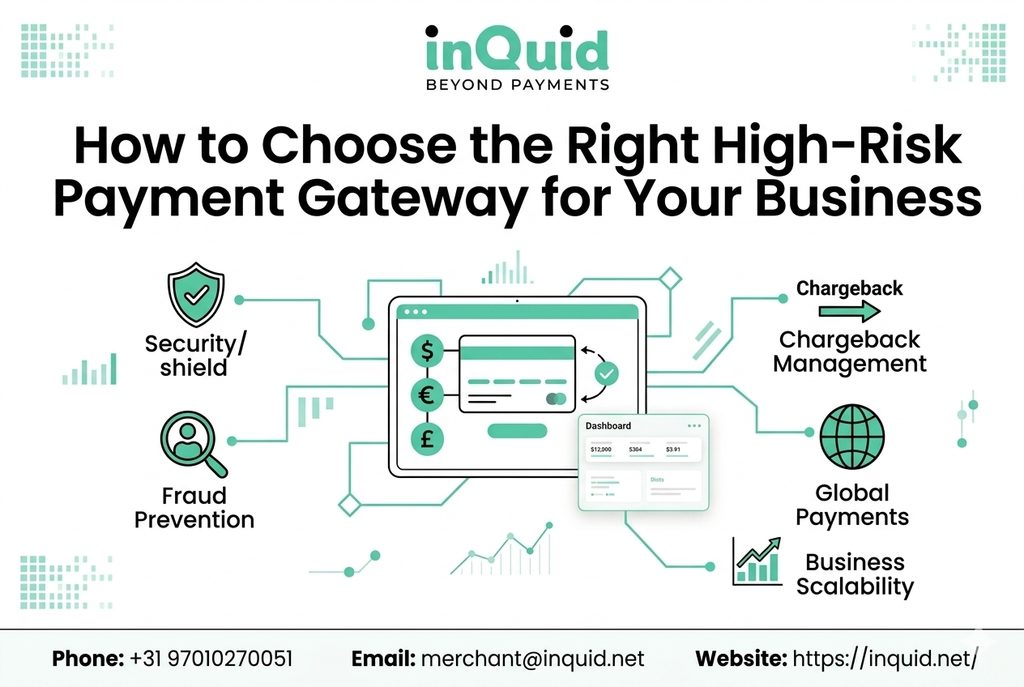
The right solution should be evaluated across more than price. Businesses should consider industry acceptance, security, fraud prevention, chargeback management, authorization performance, payment methods, international coverage, compliance, integrations, settlement terms, customer support, and scalability.
This guide explains what to look for when comparing a high-risk payment gateway and how to select a solution that fits your business model and growth plans.
Quick Answer
The right high-risk payment gateway should support your industry, target markets, processing volume, payment methods, security requirements, and compliance needs. Compare total costs, authorization performance, fraud controls, chargeback tools, integrations, settlement arrangements, and scalability before choosing a provider.
What Is a High-Risk Payment Gateway?
A high-risk payment gateway is a payment technology solution used by businesses whose industry, transaction profile, geography, business model, or risk characteristics may result in greater scrutiny from banks, acquirers, payment processors, or other financial institutions.
Examples can include businesses operating in sectors such as:
- Adult services
- iGaming and betting
- Forex and CFD trading
- Digital goods and services
- Subscription businesses
- Certain nutraceutical businesses
- International or cross-border businesses
- Other industries subject to enhanced underwriting
A high-risk classification does not automatically mean that a business is unsafe or non-compliant. Risk assessments vary by provider and may consider factors such as transaction history, customer geography, chargebacks, product type, delivery model, regulatory environment, and expected processing volume.
For that reason, businesses should evaluate providers based on their actual requirements, rather than assuming that every high-risk payment solution works in the same way.
A payment gateway is also only one part of the broader payment ecosystem. Depending on the arrangement, a business may also need a suitable merchant account, acquiring relationship, processor, fraud tools, and other payment services.
Why Choosing the Right High-Risk Payment Gateway Matters
Providers underwriting higher-risk accounts may assess a wide range of factors, including:
- Industry and business model
- Expected monthly processing volume
- Average transaction value
- Customer locations
- Refund and chargeback history
- Subscription or recurring billing
- Product or service delivery
- Website and marketing practices
- Compliance procedures
- Fraud exposure
- Countries in which the business operates
A well-matched gateway can connect the merchant’s checkout experience with payment infrastructure while providing tools that support payment security and risk management.
The wrong setup can contribute to problems such as transaction declines, unnecessary checkout friction, higher dispute costs, settlement complications, or account restrictions.
This is why businesses should evaluate the complete payment environment rather than choosing a provider solely because it advertises the lowest rate.
10 Factors to Consider When Choosing a High-Risk Payment Gateway
1. Does the Provider Actually Support Your Industry?
The first question should be whether the payment gateway provider supports your exact business model.
A provider may support general e-commerce but restrict certain industries, products, services, countries, or transaction types.
Before proceeding, ask:
- Is my industry supported?
- Are there prohibited products or services?
- Can you support recurring payments?
- Do you support international customers?
- Are there transaction or volume limits?
- Which countries are restricted?
- What underwriting documents are required?
A forex business may have different requirements from an online retailer, while a subscription business may place greater importance on recurring payments and stored payment credentials.
Get clear confirmation before investing significant time in integration.
2. Review PCI DSS Compliance and Payment Security
Payment security should be one of the most important selection criteria.
The PCI Data Security Standard (PCI DSS) establishes technical and operational requirements designed to protect payment account data. The specific responsibilities of a merchant, processor, acquirer, or service provider depend on their role and how payment data is handled.
When reviewing a high-risk payment gateway, ask:
- How is payment information handled?
- Does the solution support tokenization?
- What security controls are available?
- What documentation can the provider provide?
- Which PCI DSS responsibilities remain with the merchant?
- How is sensitive payment data transmitted and stored?
Using a payment gateway does not automatically eliminate all merchant compliance responsibilities. Those responsibilities depend on the technical architecture and the way cardholder data flows through the payment environment.
Businesses should therefore review both the provider’s security approach and their own PCI DSS compliance requirements.
3. Evaluate Fraud Prevention and 3D Secure
High-risk payment processing requires more than simply authorizing transactions.
Look for fraud prevention and risk-management capabilities such as:
- 3D Secure authentication
- Transaction monitoring
- Velocity controls
- Address verification
- CVV verification
- Device and IP analysis
- Risk scoring
- Configurable fraud rules
- Allow and block lists
- Manual review workflows
EMVCo describes EMV 3-D Secure as a technology that supports consumer authentication and can help reduce card-not-present fraud by using transaction, payment-method, and device information. EMVCo’s EMV 3-D Secure resources provide further technical information.
Visa also provides information about Visa Secure, its EMV 3-D Secure program.
However, stronger fraud controls do not automatically mean better payment performance. A system that rejects too many legitimate customers can reduce conversions.
The goal should be to balance fraud prevention, customer experience, and transaction approval.
4. Compare Total Fees, Not Just the Transaction Rate
The headline processing rate tells only part of the story.
Your total payment costs may include:
- Transaction fees
- Gateway fees
- Monthly account fees
- Setup or onboarding fees
- Chargeback fees
- Refund fees
- Cross-border fees
- Currency conversion costs
- Rolling reserves
- Payout fees
- Fraud-prevention tools
- Additional payment-method fees
Visa recommends that businesses comparing acquirers consider rates and fees while also confirming that the acquiring relationship and contracting entity are clearly understood. See Visa’s guidance on finding an acquirer.
For a high-risk business, the provider with the lowest advertised rate may not have the lowest overall cost.
For example, a slightly higher processing fee may be commercially reasonable if the payment setup provides better authorization performance, suitable fraud controls, and fewer operational problems.
5. Review Chargeback Management
Chargeback management is particularly important for businesses with higher dispute exposure.
A chargeback occurs when a cardholder disputes a transaction through their card issuer. High volumes of disputes can increase costs, create operational work, and affect payment relationships.
Look for:
- Chargeback alerts
- Dispute dashboards
- Evidence-management tools
- Reason-code reporting
- Transaction-level reporting
- Refund controls
- Fraud monitoring
- Dispute trend analysis
Ask prospective providers how disputes are handled and how much information merchants receive.
Understanding why disputes occur is just as important as responding to individual disputes. Patterns may reveal issues with customer communication, billing descriptions, fulfilment, recurring payments, or fraud.
6. Check Authorization Rates and Decline Handling
Payment acceptance directly affects revenue, making authorization performance an important consideration.
Ask the provider about:
- Authorization performance
- Soft and hard declines
- Decline-code reporting
- Transaction retries
- Account updater capabilities where applicable
- Smart routing
- Processing redundancy
- Transaction recovery options
A high-risk payment gateway should not simply process transactions; it should fit into a payment strategy designed to maximize legitimate payment acceptance while controlling risk.
Businesses should also ask how the provider measures approval performance and whether reporting is available at transaction, market, card, or payment-method level.
7. Verify Countries, Currencies, and International Coverage
Businesses operating internationally should evaluate geographic coverage carefully.
Check whether the provider supports:
- Target customer countries
- Merchant operating countries
- Processing currencies
- Settlement currencies
- Local payment methods
- Cross-border card transactions
- International payouts
- Multi-currency payment acceptance
An international payment gateway may support international customers, but the details of settlement and local payment-method availability can differ considerably.
For example, a company serving customers across the UK, Europe, North America, and Asia may need both international cards and local payment methods.
Obtain a written list of supported countries, currencies, and payment methods rather than relying on a general marketing statement.
8. Compare Payment Methods and Checkout Flexibility
Customers increasingly expect multiple ways to pay.
Depending on the market and business model, businesses may need:
- Visa and Mastercard
- Bank payments
- Digital wallets
- Alternative payment methods
- Local payment methods
- Recurring billing
- Stored payment credentials
- Payment links
The right payment method mix depends on customer behavior.
A global e-commerce business may prioritize local payment methods, while a B2B software provider may place greater importance on recurring payments and bank-based payments.
For this reason, choosing the payment gateway with the longest list of supported methods is not necessarily the right approach.
Businesses should prioritize the methods their customers use.
For broader payment-method coverage, businesses can also evaluate alternative payment solutions.
9. Evaluate APIs, Integration, and Payment Orchestration
Technical compatibility matters for businesses using custom websites, mobile applications, marketplaces, SaaS platforms, or payment orchestration systems.
Important capabilities can include:
- REST APIs
- Hosted checkout
- Payment links
- Webhooks
- Recurring-payment APIs
- Tokenization
- Sandbox environments
- Developer documentation
- E-commerce plugins
- CMS integrations
- Reporting APIs
Have your technical team test the integration before signing a long-term agreement.
A more sophisticated business may also evaluate payment orchestration, smart routing, multiple processor connections, and failover strategies.
Payment orchestration can add flexibility, but it also increases technical and operational complexity. It should be considered when it solves a genuine business requirement rather than adopted simply because it is available.
10. Verify Regulation, Contracting Entity, and Scalability
Businesses should understand which legal entity will provide or contract for the payment service.
This is especially important when a provider operates across multiple countries or uses processing or acquiring partners.
For UK-related payment services, the FCA Financial Services Register can be used to check whether a firm is authorised or registered and what permissions it holds.
Before onboarding, review:
- Legal entity
- Regulatory status where applicable
- Acquiring relationships
- Processing partners
- Contracting party
- Settlement arrangements
- Reserve requirements
- Termination clauses
- Restricted-business policies
You should also consider whether the provider can support your expected growth.
Ask whether it can handle:
- Higher processing volumes
- Additional countries
- New currencies
- New payment methods
- Multiple websites or brands
- Changing risk requirements
- Additional processing connections
High-Risk Payment Gateway Comparison Checklist
| Factor | What to Check | Why It Matters |
| Industry support | Accepted business categories and restrictions | Prevents onboarding problems |
| Security | PCI DSS responsibilities, tokenization, data controls | Protects payment information |
| Fraud prevention | 3DS, transaction rules, monitoring | Helps manage fraud risk |
| Authorization | Approval rates, declines, routing and retry tools | Supports payment acceptance |
| Chargebacks | Alerts, reporting and dispute tools | Helps control dispute exposure |
| Pricing | Transaction, gateway, reserve, FX and other fees | Reveals total processing cost |
| Global coverage | Countries and currencies | Supports international expansion |
| Payment methods | Cards, wallets, APMs and bank payments | Matches customer preferences |
| Integration | API, hosted checkout, plugins and webhooks | Reduces technical friction |
| Compliance | Legal entity, licensing and underwriting | Supports informed provider selection |
| Support | Account management and technical assistance | Helps resolve payment issues |
| Scalability | Processing capacity and expansion support | Supports long-term growth |
Pros and Cons of High-Risk Payment Processing
Pros
- Industry-specific support:
Some specialist providers may support business models that certain mainstream payment providers do not accept. - Risk-management capabilities:
Depending on the provider, businesses may have access to tools such as fraud screening, 3D Secure, transaction monitoring, and configurable risk controls. - International capabilities:
Some solutions support multiple countries, currencies, and alternative payment methods. - Flexible payment infrastructure:
Businesses may be able to combine merchant accounts, payment gateways, acquiring relationships, and additional payment tools according to their requirements. - Scalability:
The right infrastructure can support increasing transaction volumes and expansion into new markets.
Cons
- Potentially higher costs:
Higher-risk businesses may face higher processing rates, reserves, or other risk-related charges. - Additional underwriting:
Providers may require more information about ownership, products, customers, transaction history, and compliance procedures. - Greater monitoring:
Accounts may be subject to enhanced monitoring or periodic risk reviews. - Reserve requirements:
Some agreements may include rolling reserves or other risk-management conditions. - Greater complexity:
Some businesses require several payment components rather than a single provider or simple checkout integration.
High-Risk Payment Gateway Examples by Business Model
Online Subscription Business
Consider a subscription-based digital service accepting recurring card payments.
The business may prioritize:
- Reliable recurring billing
- Tokenization
- 3D Secure where appropriate
- Fraud monitoring
- Retry and account-update functionality
- Chargeback reduction
- International card acceptance
For this type of business, recurring-payment reliability and customer retention may matter more than simply selecting the lowest advertised rate.
Forex or CFD Business
A forex or CFD business may process international transactions while operating in an environment with additional regulatory and underwriting considerations.
Its requirements may include:
- International payment acceptance
- Transaction monitoring
- Geographic controls
- 3D Secure
- Detailed reporting
- Compliance-focused onboarding
- Appropriate settlement arrangements
The business should verify which countries and customer markets it is permitted to serve and whether the payment provider supports those markets.
Digital Goods or IPTV Business
A digital-content or IPTV business may prioritize fast transaction processing, recurring billing, international card acceptance, and dispute management.
It should pay close attention to:
- Authorization performance
- Chargeback rates and patterns
- Fraud controls
- Recurring billing
- Customer communication
- Business-model restrictions
- Geographic coverage
The provider should understand the specific products and services being sold rather than treating every business as generic e-commerce.
What to Ask a High-Risk Payment Gateway Provider
Before signing an agreement, ask the provider:
1. Do you support my exact business model?
Get confirmation in writing rather than relying only on a general industry category.
2. Which legal entity will contract with my business?
This helps you understand who is providing the relevant payment service.
3. Who is the acquiring bank or processing partner?
The gateway itself may not be the acquiring entity.
4. What are all the fees?
Request a complete pricing schedule covering processing, gateway access, refunds, chargebacks, FX, reserves, and payouts.
5. Which countries and currencies are supported?
Confirm both payment acceptance and settlement capabilities.
6. What fraud and authentication tools are included?
Ask specifically about 3D Secure, monitoring, velocity rules, risk scoring, and configurable controls.
7. How are chargebacks managed?
Understand alerting, dispute handling, evidence submission, reporting, and associated fees.
8. What happens as my processing volume grows?
Ask about volume reviews, pricing changes, additional acquiring capacity, and new-market support.
9. What happens when transactions are declined?
Ask what reporting, retry, routing, and recovery options are available.
10. Can my technical team test the integration?
A sandbox and developer documentation can help identify technical problems before launch.
Frequently Asked Questions
- What is the best high-risk payment gateway for a business?
There is no single best high-risk payment gateway for every business. The right choice depends on industry, risk profile, target markets, transaction volume, currencies, payment methods, compliance requirements, technical needs, and commercial terms.
- How is a high-risk payment gateway different from a standard payment gateway?
A high-risk payment gateway is generally used within payment arrangements where the merchant or transaction profile presents greater underwriting, fraud, chargeback, regulatory, geographic, or business-model considerations. The exact classification varies by provider and acquiring relationship.
- Are high-risk payment gateways more expensive?
They can be. Businesses may face higher processing costs, reserves, additional monitoring, or other risk-related fees. The most useful comparison is therefore total cost of processing rather than the advertised transaction rate alone.
- Does a high-risk business need a merchant account?
In many card-processing arrangements, a merchant account or equivalent acquiring setup is part of the payment infrastructure. The exact structure depends on the provider and processing model. Businesses should understand how the merchant account, gateway, processor, and acquirer fit together.
- Do businesses still have PCI DSS responsibilities when using a gateway?
Potentially, yes. PCI DSS responsibilities depend on the merchant’s environment, payment architecture, and role in handling payment account data. Using a gateway does not automatically remove all compliance obligations.
- Does 3D Secure help high-risk businesses?
3D Secure can add an authentication layer to e-commerce transactions and can help address card-not-present fraud. Its effectiveness and customer-experience impact depend on how authentication is implemented and when it is applied.
- Can a high-risk payment gateway support international payments?
Some providers support international processing, but coverage varies. Businesses should verify supported countries, currencies, acquiring locations, settlement options, and local payment methods before onboarding.
- What should businesses compare between payment gateway providers?
Compare industry acceptance, pricing, authorization performance, security, fraud prevention, chargeback management, geographic coverage, payment methods, integration, compliance, settlement terms, support, and scalability.
- Can a business use multiple payment processors?
Some businesses use multiple processing or acquiring relationships, often through payment orchestration or multi-processor strategies. This can increase resilience and geographic coverage but also adds technical and operational complexity.
- What is payment orchestration?
Payment orchestration is an approach that can connect a business to multiple payment processors or acquiring relationships through a centralized technical layer. Depending on the implementation, it can support routing, redundancy, and payment-method management.
How Inquid Can Help
Choosing payment infrastructure is about more than finding a provider that accepts your business. It is about building a setup that matches your risk profile, customers, target markets, payment methods, security requirements, and growth plans.
Inquid provides payment and fintech solutions across areas including merchant accounts, payment gateways, credit card processing, alternative payment methods, open banking, digital banking, and virtual banking.
For businesses operating in higher-risk sectors, selecting the right combination of payment processing, merchant account, gateway, risk controls, and international capabilities can help create a more suitable payment environment.
Before choosing a provider, assess your current processing volume, target markets, customer payment preferences, chargeback exposure, compliance requirements, and technical needs.
Then compare providers against those requirements rather than focusing on price alone.
Ready to evaluate your payment options? Contact Inquid to discuss high-risk merchant accounts and payment processing solutions aligned with your business model and target markets.
Conclusion
Choosing the right high-risk payment gateway requires more than comparing transaction fees.
The right solution should align with your industry, risk profile, payment volume, target markets, currencies, payment methods, security requirements, compliance obligations, and growth plans.
Start by confirming that the provider supports your exact business model. Then evaluate pricing, authorization performance, fraud prevention, 3D Secure, chargeback management, international coverage, integrations, settlement arrangements, support, and scalability.
It is also important to understand how the payment gateway fits into the broader payment ecosystem. A gateway, merchant account, processor, and acquiring bank can play different roles, and the exact structure varies by provider.
For businesses expanding internationally or operating in higher-risk sectors, the objective should not simply be finding a gateway that can process transactions.
The goal is to build secure, reliable, commercially practical payment infrastructure that supports legitimate customer payments while giving the business room to grow.