
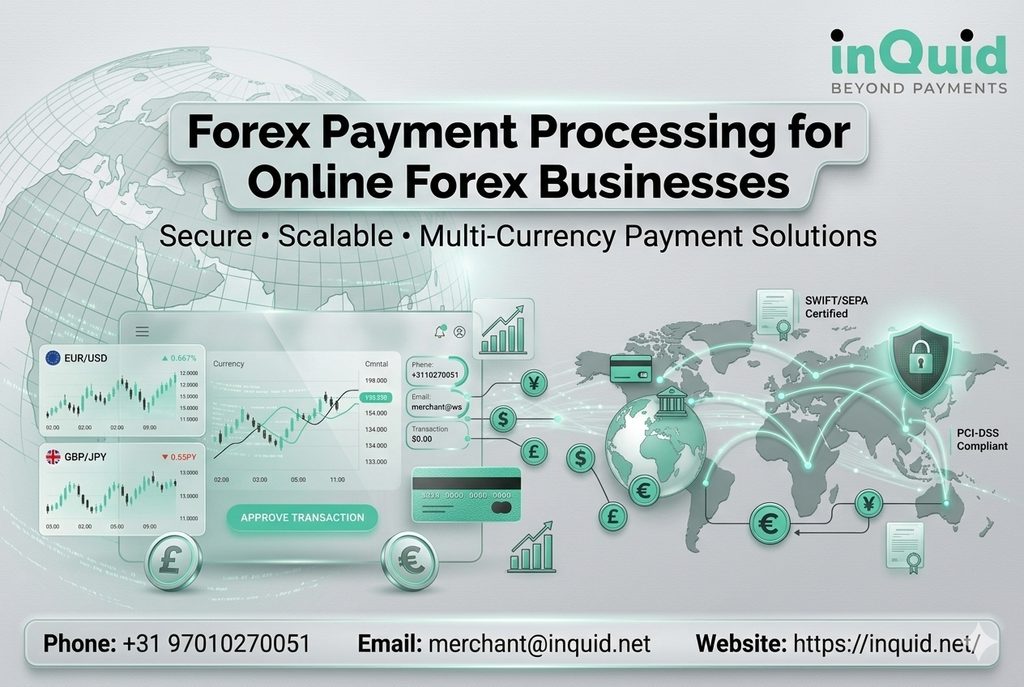
Forex payment processing is a critical part of running an online forex business. Brokers, trading platforms, and other forex-related businesses need a reliable way to accept deposits, process transactions, support multiple currencies, and manage payment risk across international markets. A suitable payment infrastructure can improve the customer experience while helping businesses manage fraud, chargebacks, settlement, and operational complexity.
Unlike conventional e-commerce, forex businesses can operate across multiple jurisdictions, currencies, payment methods, and regulatory environments. That makes payment processing an important strategic consideration rather than simply a technical feature.
This guide explains how forex payment processing works, what businesses should look for in a provider, common payment methods, key risks, compliance considerations, and practical steps for building a scalable payment strategy.
What Is Forex Payment Processing?
Forex payment processing refers to the systems and services used to authorize, transmit, settle, and reconcile payments for businesses operating in the foreign-exchange sector.
A typical payment ecosystem can include:
Customer → Forex Platform → Payment Gateway → Payment Processor/Acquirer → Issuing Bank → Authorization → Settlement
The exact flow depends on the payment method and providers involved.
For an online forex business, payment processing may support customer deposits, account funding, merchant payments, refunds, withdrawals through appropriate financial channels, and transaction reporting.
The payment gateway generally handles the technology layer that securely transmits transaction information, while processors, acquirers, issuers, banks, and other financial institutions can perform different roles within the overall payment ecosystem.
Why Forex Payment Processing Requires a Specialized Approach
Forex businesses can face payment challenges that are different from those of ordinary online retailers.
Customers may be located in different countries and prefer different payment methods. Transactions may involve multiple currencies, while businesses may also need stronger fraud detection, customer verification, transaction monitoring, and dispute-management processes.
For firms operating in regulated financial markets, payment infrastructure also needs to be aligned with the applicable legal and regulatory requirements.
For example, the UK’s Financial Conduct Authority explains that payment services can include execution of payment transactions, acquiring, money remittance, account information services, and payment initiation services. Businesses providing regulated payment services in the UK may require the appropriate authorization or registration.
This means a forex business should evaluate payment processing as part of its broader operational and compliance framework.
How Forex Payment Processing Works
A simplified card-payment transaction may follow these steps:
1. Customer initiates a payment
The customer selects a supported payment method on the forex platform and enters the required information.
2. Payment gateway securely transmits the transaction
The payment gateway sends relevant transaction information through the payment infrastructure.
3. Fraud and risk checks are applied
Depending on the setup, the transaction can be evaluated using authentication and fraud-prevention controls.
4. The transaction is authorized
The relevant payment network and issuing bank determine whether the transaction can be approved.
5. The merchant receives a response
The platform receives an approval or decline response and updates the customer experience accordingly.
6. Settlement occurs
Approved funds are settled according to the commercial and financial arrangements between the merchant, processor, acquirer, and other parties.
7. Reconciliation and reporting
The business then reconciles transactions, fees, refunds, disputes, and settlements using its financial and payment reporting systems.
A well-designed forex payment processing setup should make this process efficient for customers while giving the business adequate visibility and control.
Common Payment Methods for Forex Businesses
The ideal payment mix depends on the countries served, customer preferences, regulatory requirements, transaction values, and the capabilities of the selected providers.
| Payment Method | Advantages | Potential Considerations |
| Credit and debit cards | Familiar and convenient | Fraud, chargebacks, authorization performance |
| Bank transfers | Useful for larger transactions | Can be slower or less convenient in some markets |
| Local payment methods | Better regional customer experience | Geographic limitations and integration requirements |
| Digital wallets | Convenient for supported customers | Availability varies by country and provider |
| Alternative payment methods | Can expand market coverage | Varying adoption, costs, and integration complexity |
| Open banking/payment initiation | Can provide account-based payment experiences | Availability and regulatory requirements differ by market |
The goal should not be to offer every possible payment method. Instead, businesses should choose the methods that are relevant to their target customers.
Forex Payment Gateway vs. Forex Payment Processor
These terms are sometimes used interchangeably, but they can refer to different components.
A payment gateway primarily provides the technology for securely transmitting payment information and communicating transaction responses.
A payment processor handles transaction processing between relevant participants in the payment ecosystem and may coordinate authorization, clearing, and other processing functions.
An acquirer is the financial institution or acquiring organization that maintains the merchant relationship for card acceptance.
In some commercial arrangements, a provider may offer several of these capabilities together.
Understanding the difference helps businesses compare providers more accurately instead of evaluating a gateway solely on its interface or headline transaction fee.
Forex Payment Processing and Multi-Currency Support
International forex businesses often need to support more than one currency.
Multi-currency capabilities can influence:
- Customer experience
- Conversion rates
- Currency-conversion costs
- Settlement arrangements
- Accounting processes
- Reconciliation
- Geographic expansion
A business should determine which currencies its customers actually need instead of assuming that every available currency should be enabled.
It is also important to understand whether the provider supports the required currencies for authorization, settlement, reporting, or conversion, because these capabilities are not always identical.
The Importance of Payment Security
Security is fundamental to any online payment environment.
The Payment Card Industry Data Security Standard (PCI DSS) applies to entities that store, process, or transmit cardholder data or that can affect the security of the cardholder-data environment. PCI Security Standards Council materials identify payment-card account data such as the primary account number, cardholder name, expiration date, and service code as relevant cardholder data.
For businesses, this means payment security should be considered during architecture and provider selection, not after a payment system has already been deployed.
Depending on the implementation, relevant controls can include:
- Secure payment-page design
- Strong authentication
- Tokenization where appropriate
- Access controls
- Transaction monitoring
- Fraud detection
- Secure API practices
- Logging and monitoring
- Incident-response procedures
Businesses should also understand which security responsibilities remain with them and which are handled by third-party payment providers.
Fraud Prevention in Forex Payment Processing
Fraud can directly affect payment acceptance, customer trust, operational costs, and relationships with financial partners.
Common risk patterns can include:
- Account takeover
- Stolen card activity
- Identity misuse
- Suspicious deposit patterns
- Transaction anomalies
- Friendly fraud and disputed payments
- Multiple accounts associated with unusual behavior
A strong payment strategy should combine authentication, transaction monitoring, customer verification, and appropriate risk rules.
Visa describes compliance checks at the acquiring level before merchants can accept Visa payments and notes that certain categories can be subject to enhanced registration and closer performance monitoring.
Mastercard also publishes rules and compliance programs covering merchant and processor responsibilities, including areas related to fraud monitoring and merchant monitoring.
For forex businesses, these controls should be integrated into the payment architecture rather than treated as separate processes.
Chargebacks and Payment Disputes
Chargebacks can create direct financial costs, administrative work, and operational risk.
A good dispute-management process should include:
- Accurate transaction records
- Clear customer communication
- Appropriate authentication
- Refund procedures
- Dispute monitoring
- Documentation for representment where applicable
- Analysis of recurring dispute patterns
Businesses should track chargeback performance over time and investigate recurring causes instead of viewing disputes only as individual incidents.
Compliance Considerations for Forex Businesses
Compliance requirements vary depending on the company’s business model, location, customers, products, and regulated activities.
A forex business should determine which regulations apply to its particular activities and obtain appropriate professional advice where necessary.
For UK businesses and payment providers, the FCA explains that firms providing regulated payment services may need authorization or registration under the applicable framework.
The FCA also provides guidance for firms applying for authorization and registration, including payment institutions and other regulated payment businesses.
For companies operating forex or CFD-related businesses, regulatory expectations can extend beyond payments. The FCA specifically highlights requirements and expectations for firms offering contracts for difference and rolling spot foreign exchange to retail customers.
Therefore, businesses should avoid assuming that choosing a payment provider automatically makes the underlying business compliant.
What to Look for in a Forex Payment Processing Provider
Selecting a provider should involve more than comparing transaction fees.
- Geographic coverage
Determine whether the provider supports the countries where your customers are located and whether its acquiring and payment-method coverage is suitable for those markets.
- Currency support
Check which currencies are supported for payment acceptance, settlement, and reporting.
- Payment-method coverage
Review whether the provider can support the payment methods that matter most to your target customers.
- Fraud and risk management
Evaluate available authentication, monitoring, fraud-screening, and dispute-management capabilities.
- Integration
Consider whether the provider offers suitable APIs, hosted payment pages, SDKs, plugins, or other integration options for your platform.
- Reporting
Strong reporting can make finance, reconciliation, and operational management easier.
Look for visibility into:
- Transaction status
- Fees
- Refunds
- Chargebacks
- Settlements
- Currency activity
- Declines
Scalability
A payment solution should be able to accommodate increases in transaction volume, customers, markets, and payment methods without forcing the company to rebuild its entire infrastructure.
- Operational support
Payment failures can directly affect deposits and customer satisfaction. Evaluate the provider’s support model, escalation procedures, documentation, and technical assistance.
Comparing Forex Payment Processing Approaches
| Approach | Best For | Main Benefit | Main Challenge |
| Single payment provider | Businesses with simple market requirements | Easier management | Greater dependency on one provider |
| Multiple payment providers | International businesses | Greater flexibility and redundancy | More operational complexity |
| Gateway + separate acquiring | Businesses seeking more control | Flexible payment architecture | More integrations to manage |
| Local payment-method strategy | Regionally focused growth | Strong local relevance | Requires market-specific setup |
| Orchestrated payment setup | Larger or complex businesses | Routing and provider flexibility | Higher technical and operational complexity |
A smaller forex business may prefer simplicity, while a multinational operation may prioritize redundancy, geographic coverage, and routing flexibility.
Pros and Cons of a Strong Forex Payment Processing Strategy
Pros
- Supports international customer payments
- Can improve payment convenience
- Enables multiple payment methods
- Can support multi-currency operations
- Provides stronger transaction visibility
- Creates opportunities for scalable payment infrastructure
- Can improve fraud and dispute management
Cons
- Payment costs can vary significantly
- More payment methods can increase operational complexity
- International processing requires careful market analysis
- Fraud and chargeback management require continuous monitoring
- Regulatory obligations can differ by jurisdiction
- Using multiple providers can increase technical complexity
The right strategy balances customer convenience, operational efficiency, security, compliance, and cost.
Real-World Business Examples
Example 1: A growing forex broker
Imagine a broker expanding from one market into several European countries.
Instead of adding every available payment option, the broker could identify its highest-volume customer markets, select relevant card and bank-based payment methods, and optimize the payment experience for those regions.
The business could then monitor authorization rates, failed deposits, disputes, and customer preferences before expanding the payment mix further.
Example 2: An international trading platform
A trading platform serving customers across several continents may need multiple currencies and region-specific payment methods.
In this case, relying on a single payment route could create unnecessary concentration risk. A more flexible architecture may involve multiple acquiring or payment partners, supported by centralized reporting and transaction monitoring.
Example 3: A fintech startup entering forex infrastructure
A fintech startup building services for forex businesses may prioritize API-based payment infrastructure and strong reporting from the beginning.
Instead of optimizing only for initial transaction costs, the startup can evaluate scalability, integration time, payment-method coverage, and future geographic expansion.
These examples illustrate why the best payment approach depends on the operating model rather than a one-size-fits-all formula.
How to Improve Forex Payment Processing Performance
Payment performance should be measured continuously.
Useful metrics include:
- Authorization rate: How many transactions are approved?
- Payment conversion rate: How many customers successfully complete the payment journey?
- Decline rate: What percentage of transactions fail, and why?
- Chargeback rate: How frequently are customers disputing transactions?
- Refund rate: Are refunds concentrated around specific products, markets, or payment methods?
- Settlement timing: How quickly does the business receive funds?
- Cost per successful transaction: What is the real cost after processing fees and operational expenses?
A business can use these metrics to identify underperforming payment routes and make evidence-based improvements.
Common Mistakes Businesses Should Avoid
- Choosing only on price
A lower processing fee does not necessarily mean lower total payment cost.
A provider with better authorization performance or stronger market coverage may create more value even with a different fee structure.
- Adding too many payment methods
More choices can help customers, but excessive payment options can also complicate operations and reconciliation.
- Ignoring the customer journey
Even a technically functional payment system can perform poorly if the checkout or deposit process is confusing.
- Treating risk controls as optional
Fraud monitoring and transaction controls should be incorporated from the beginning.
- Failing to review provider requirements
Forex businesses should understand onboarding criteria, prohibited activities, geographic restrictions, documentation requirements, and ongoing monitoring expectations before committing to a provider.
How to Choose the Right Forex Payment Processing Solution
A practical selection process can be divided into five steps.
Step 1: Define your markets
List your target countries, currencies, customer types, and expected transaction volumes.
Step 2: Map your payment requirements
Identify cards, bank payments, local methods, wallets, or other channels that are genuinely relevant.
Step 3: Evaluate providers
Compare geographic coverage, integration, fraud controls, settlement, reporting, support, pricing, and onboarding requirements.
Step 4: Test before scaling
Where possible, test the payment journey, integration, transaction reporting, and operational support before committing to larger volumes.
Step 5: Monitor performance
Review authorization, declines, disputes, costs, and customer behavior regularly.
This process can help businesses build a payment environment that is practical today while remaining adaptable for future growth.
Frequently Asked Questions
- What is forex payment processing?
Forex payment processing is the infrastructure used to accept, authorize, process, settle, and reconcile payments for forex-related businesses. It can involve gateways, processors, acquirers, payment methods, banks, fraud controls, and reporting systems.
- What is the difference between a forex payment gateway and a processor?
A payment gateway generally handles the technology used to transmit payment information and receive transaction responses, while a payment processor handles transaction processing between participants in the payment ecosystem. The exact responsibilities can vary by provider and commercial arrangement.
- Do forex businesses need multiple payment methods?
Not necessarily. The right payment mix depends on target markets and customer preferences. A focused selection of relevant payment methods can be more effective than offering every available option.
- Is multi-currency support important?
It can be important for businesses serving international customers. However, businesses should assess not only whether currencies can be accepted but also how conversion, settlement, fees, and reporting are handled.
- How can forex businesses reduce payment declines?
Businesses can review decline reasons, improve the customer payment experience, use relevant authentication and fraud controls, optimize payment routing where available, and work with providers that have appropriate market and acquiring coverage.
- Is PCI DSS relevant to forex payment processing?
PCI DSS can be relevant when a business stores, processes, or transmits payment-card account data, or can affect the security of the cardholder-data environment. The exact compliance requirements depend on the implementation and the organization’s role.
- Should a forex business use one payment provider or several?
It depends on the business. A single provider can simplify operations, while multiple providers can provide greater geographic coverage, redundancy, or payment-method flexibility. The trade-off is additional operational and technical complexity.
- Does using a payment provider make a forex business compliant?
No. Payment-provider availability and regulatory compliance are separate considerations. Businesses need to determine which laws, licensing requirements, payment rules, and industry obligations apply to their own activities.
Final Thoughts
Forex payment processing is a foundational part of the infrastructure behind an online forex business. A strong setup needs to do more than accept transactions. It should support appropriate markets and payment methods while providing effective security, reporting, risk management, settlement, and scalability.
The most effective strategy depends on the business model, customer locations, currencies, transaction profile, regulatory environment, and growth plans.
For forex businesses, the right approach is usually to start with a clear understanding of customer needs, select payment methods based on market relevance, assess provider capabilities carefully, and continuously monitor payment performance.
As international payment expectations continue to evolve, businesses that treat payment infrastructure as a strategic capability—not simply a checkout function—are better positioned to create smoother customer experiences and support sustainable expansion.
How Inquid Can Help
Inquid provides payment and fintech solutions designed to help businesses manage payment acceptance, merchant accounts, payment processing, alternative payment methods, and international payment requirements.
For businesses reviewing their forex payment processing infrastructure, the right starting point is to assess your target markets, payment requirements, transaction profile, and operational needs.
Speak with Inquid about your payment requirements and explore a payment setup designed around your business model and international growth plans.
Source References
- PCI Security Standards Council – PCI DSS: https://www.pcisecuritystandards.org/standards/pci-dss/
- Visa – Visa Network Integrity: https://corporate.visa.com/en/about-visa/visa-network-integrity.html
- Mastercard – Rules & Support: https://www.mastercard.com/us/en/business/support/rules.html
- FCA – Payment Services: https://www.fca.org.uk/firms/consider-if-you-provide-payment-services
- FCA – Contracts for Difference (CFDs) & Forex: https://www.fca.org.uk/firms/contract-for-differences