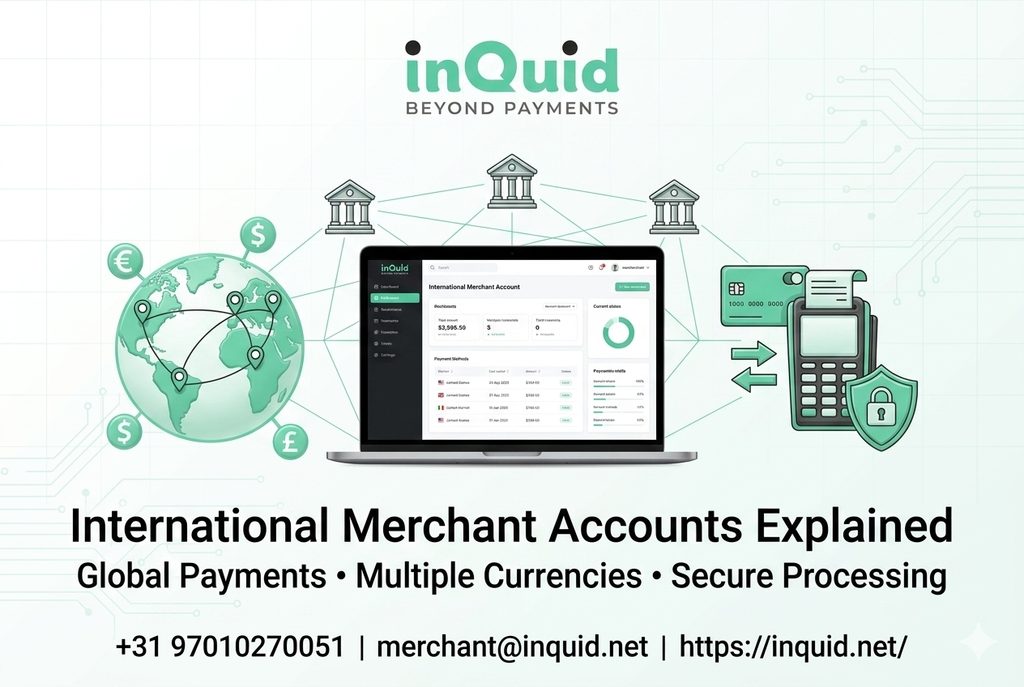
Selling to customers across borders can create significant growth opportunities, but accepting international payments requires more than simply enabling foreign cards.
An international merchant account is a payment-processing arrangement that can help businesses accept card payments from customers in multiple countries and, depending on the provider, support multiple currencies, cross-border transactions, and international settlement.
For ecommerce companies, SaaS platforms, subscription businesses, travel companies, digital service providers, and international B2B businesses, the right payment infrastructure can influence payment acceptance, customer experience, cash flow, security, and expansion.
Choosing an international merchant account provider requires careful evaluation. Businesses need to understand payment gateway capabilities, international card processing, currency conversion, settlement, processing fees, fraud prevention, chargeback management, security, and regulatory responsibilities before entering into an agreement.
This guide explains how international merchant accounts work, what businesses should look for, the costs and challenges to consider, and how to build an international payment strategy that can support long-term growth.
What Is an International Merchant Account?
An international merchant account is a payment-processing arrangement designed to help a business accept payments from customers in different countries or regions.
A domestic merchant account may be structured primarily around one market. An international arrangement can support a broader geographic footprint, cross-border transactions, international cards, and multiple currencies, depending on the provider and acquiring setup.
The actual structure varies.
A business may interact with an acquiring bank, payment processor, payment facilitator, independent sales organization, or payment service provider. These organizations can have different responsibilities within the payment ecosystem.
Mastercard describes a payment facilitator as a service provider registered by an acquirer to facilitate transactions on behalf of sub-merchants.
This distinction is important because the term merchant account is sometimes used broadly in payment-industry marketing.
Before signing an agreement, businesses should establish:
- Which legal entity they are contracting with
- Which entity provides acquiring services
- Who processes the transaction
- Who provides the payment gateway
- Which currencies are supported
- How settlement works
- Which party is responsible for particular payment and security functions
Understanding these details helps businesses compare providers on substance rather than terminology.
How Does an International Payment Work?
A simplified online card payment flow looks like this:
Customer → Payment Gateway → Payment Processor → Card Network → Acquirer → Merchant
The customer enters payment information during checkout.
The payment gateway securely transmits the transaction information into the relevant payment-processing environment.
The transaction is then routed through the processor and card network before the card issuer makes an authorization decision.
If approved, the transaction proceeds to settlement according to the merchant agreement.
International transactions can add further considerations, including:
- Customer and merchant locations
- Transaction currency
- Settlement currency
- Cross-border costs
- Foreign-exchange conversion
- Regional payment methods
- Fraud screening
- Country-specific requirements
Settlement timing and transaction routing can differ by provider, acquiring arrangement, market, currency, risk controls, and other operational factors.
For that reason, businesses should evaluate the complete payment stack rather than asking only whether foreign cards are accepted.
Why International Payment Processing Matters
International customers expect payment experiences to feel familiar, convenient, and secure.
A well-designed international payment processing strategy can help businesses support growth across multiple markets.
- Reach More Customers
A business can sell beyond its domestic market and accept transactions from customers in additional countries, subject to provider and market availability.
- Support Familiar Currencies
Presenting customers with relevant currencies can make pricing easier to understand and can reduce unnecessary checkout friction.
- Offer Relevant Payment Methods
Customer payment preferences differ between countries. Cards may be dominant in one market while bank-based or wallet-based payment methods may be more important in another.
- Support Market Expansion
A scalable payment infrastructure can make it easier to enter additional countries without rebuilding the entire payment stack each time.
- Improve Financial Operations
A suitable provider can centralize transaction reporting, settlement, reconciliation, and payment management across supported markets.
International vs. Domestic Merchant Accounts
The key difference is the geographic and operational scope of the payment setup.
| Feature | Domestic Merchant Account | International Merchant Account |
| Primary market | Usually one main market | Multiple markets |
| International card acceptance | May be supported | Core requirement |
| Currency support | Usually narrower | Often broader |
| Cross-border payments | Secondary capability | Core use case |
| Local payment methods | Market-specific | May span multiple regions |
| Multi-currency processing | May be limited | Often important |
| International settlement | Depends on provider | Depends on provider and structure |
| Global expansion | More limited | Designed with expansion in mind |
| Cross-border costs | May apply | Important consideration |
| Multi-market reporting | May be basic | Often more important |
PayFac vs. Traditional Merchant Account
Businesses may encounter different ways of accessing payment processing.
- Traditional Merchant Account
With a traditional or dedicated merchant relationship, the business is typically underwritten for its own merchant arrangement with an acquiring institution or related provider.
Depending on the acquiring structure, this can provide greater flexibility over processing terms, account configuration, and volume requirements.
However, onboarding can be more involved because the business may undergo detailed underwriting and documentation review.
- Payment Facilitator Model
Under the payment facilitator (PayFac) model, a business is generally onboarded as a sub-merchant under the facilitator’s acquiring relationship.
Mastercard states that payment facilitators are service providers registered by an acquirer to facilitate transactions on behalf of sub-merchants.
PayFac models can simplify onboarding and make it easier for some businesses to start accepting payments. However, pricing, processing limits, reserve structures, account controls, settlement arrangements, and other terms depend on the facilitator.
Which model is right?
There is no universal answer.
A newer or lower-volume business may prioritize fast onboarding and simplicity.
An established business with significant, predictable processing volume may place greater importance on dedicated underwriting, commercial flexibility, settlement arrangements, and long-term scalability.
The right choice depends on the company’s requirements.
Who Uses International Merchant Accounts?
Different types of businesses can benefit from international payment infrastructure.
- Ecommerce Businesses
International ecommerce companies may need:
- International card processing
- Multi-currency payment processing
- Fraud prevention
- Local payment methods
- Mobile-friendly checkout
- Reliable settlement
- SaaS and Software Businesses
Subscription businesses often require:
- Recurring payments
- Tokenization
- Payment retries
- Multi-currency billing
- Subscription management
- Chargeback monitoring
- Digital Service Providers
Businesses selling online services often need broad geographic payment acceptance while keeping checkout simple.
- Travel and Hospitality Companies
Travel businesses can deal with customers from many countries, higher-value transactions, cancellations, and refunds.
Their payment infrastructure often needs strong international card acceptance and effective dispute management.
- International B2B Businesses
B2B companies may process fewer but significantly larger transactions.
Their priorities can include:
- Secure payment processing
- Predictable settlement
- Multi-currency support
- Detailed reporting
- Reliable account support
What to Evaluate in an International Merchant Account Provider
Choosing an international merchant account provider should be based on the complete solution.
1. Geographic Coverage
Check the exact countries supported.
Do not assume that a provider describing itself as “global” supports every jurisdiction.
Ask:
- Which countries can I accept payments from?
- Are there country-specific restrictions?
- Can new markets be added later?
2. Currency Support
Understand both payment and settlement currencies.
Ask:
- Which currencies can customers pay in?
- Which currencies can I settle in?
- Are additional currencies available?
- What currency-conversion costs apply?
3. Card and Payment Method Support
Confirm the card networks and alternative payment methods available in your target markets.
A good global payment solution should be aligned with the payment preferences of the customers you actually serve.
4. Payment Gateway Technology
Evaluate whether the international payment gateway integrates with your website, ecommerce platform, mobile application, or software.
Important features may include:
- API integration
- Hosted checkout
- Recurring billing
- Tokenization
- Payment links
- Refund management
- Reporting
- Fraud controls
5. Total Cost
Look beyond the advertised processing rate.
Consider:
- Processing fees
- Cross-border fees
- Gateway charges
- Refund fees
- Chargeback fees
- Currency-conversion costs
- Monthly or account fees
6. Settlement
Ask when funds are expected to become available, which currencies can be settled, and whether reserves or other conditions apply.
7. Fraud Prevention
Review the tools available for:
- Transaction monitoring
- Authentication
- Device analysis
- Velocity controls
- Geographic risk
- Manual review
8. Chargeback Management
Understand what support is available for dispute alerts, evidence collection, and chargeback reporting.
9. Security and Compliance
Establish what responsibilities remain with your business and which are handled by the service provider.
10. Scalability and Support
A payment provider should be capable of supporting increasing transaction volume, additional markets, and evolving technology requirements.
Comparing International Payment Processing Costs
Payment pricing can be complicated.
A provider offering the lowest headline processing rate may not necessarily provide the lowest total cost.
Consider this illustrative comparison:
| Cost Area | Provider A | Provider B |
| Base processing fee | Lower | Slightly higher |
| Cross-border fee | Higher | Lower |
| FX markup | Additional | Competitive |
| Gateway | Additional | Included |
| Local payment methods | Limited | Broader |
| Reporting | Basic | Advanced |
Currency Conversion and Foreign Exchange
Foreign exchange can directly affect margins.
Consider a customer paying €100 while your business settles in USD.
The final amount depends on the exchange rate used and any applicable conversion or provider charges.
When evaluating multi-currency payment processing, ask:
- What exchange rate is applied?
- Is the provider’s markup disclosed?
- Are FX costs charged separately?
- Which settlement currencies are available?
- Can you settle in the currencies needed for operating expenses?
For businesses with significant international payment volume, small FX differences can add up over time.
Understanding currency conversion before signing an agreement can prevent unexpected costs later.
Payment Settlement and Cash Flow
A successful payment is not the same thing as immediately available cash.
Settlement is the process through which transaction funds are made available to the merchant under the agreed terms.
For international merchants, settlement can involve:
- Settlement frequency
- Settlement currency
- Processing cut-off times
- Reserve arrangements
- Refund deductions
- Chargeback deductions
- Currency conversion
Businesses should model these factors against their actual cash-flow needs.
For example, an ecommerce business purchasing inventory may prioritize predictable settlement, while a SaaS business may care more about recurring-payment reconciliation and reporting.
Payment Security and PCI DSS
Security should be part of provider selection from the beginning.
PCI DSS establishes requirements intended to protect payment account data for entities involved in storing, processing, or transmitting cardholder data.
Outsourcing payment processing can reduce the amount of payment data handled within a merchant’s environment, but it does not automatically eliminate merchant responsibilities.
PCI Security Standards Council explains that merchants outsourcing their payment processing still have responsibilities that can include ensuring the provider is compliant for the services supplied, maintaining appropriate written agreements, monitoring provider compliance, and understanding shared responsibilities.
When evaluating a payment provider, ask:
- What PCI DSS responsibilities remain with us?
- What security controls are included?
- Is tokenization available?
- Is 3-D Secure supported?
- How is payment information protected?
- How are security incidents handled?
These responsibilities should be clearly documented rather than assumed.
Fraud Prevention for International Payments
Cross-border commerce can introduce different transaction patterns and fraud considerations.
Businesses should monitor their payment data and adjust controls as their markets change.
Depending on the business model, useful fraud prevention tools can include:
- Transaction monitoring
- Device analysis
- Address verification
- Velocity controls
- Customer authentication
- Geographic analysis
- Risk scoring
- Manual review
The objective is not simply to block as many transactions as possible.
Overly aggressive controls can also decline legitimate customers.
A good fraud strategy balances loss prevention with payment acceptance and customer experience.
Chargeback Management
Chargebacks can affect revenue, operational resources, and the overall health of a merchant’s payment relationship.
Businesses should maintain records such as:
- Order information
- Customer communications
- Delivery or fulfillment evidence
- Refund records
- Cancellation requests
- Terms and conditions
Visa provides merchant resources covering disputes and related payment practices, while Mastercard maintains rules and resources for its payment ecosystem. Businesses should refer to the applicable network rules and their acquiring agreements for current requirements.
The causes of chargebacks can also provide valuable business information.
For example:
- Unrecognized transactions: Review transaction descriptors and billing communication.
- Delivery disputes: Improve fulfillment communication and documentation.
- Subscription disputes: Make recurring billing and cancellation terms clearer.
- Fraud-related disputes: Review authentication and fraud controls.
Effective chargeback management is therefore both a payment function and a customer-experience function.
International Payment Compliance and Due Diligence
International payment processing can involve different regulatory obligations depending on the countries involved, the services provided, and the structure of the payment arrangement.
Businesses should identify the entities involved before signing an agreement.
Key questions include:
- Who is the contracting entity?
- Who is the acquiring institution?
- Who is the payment processor?
- Who operates the gateway?
- What regulatory permissions apply?
- Which jurisdiction governs the contract?
- What responsibilities belong to the merchant?
For UK-related payment services, the Financial Conduct Authority states that non-bank payment service providers such as payment institutions and electronic money institutions must be authorized or registered, and businesses can use the FCA Financial Services Register to check authorization and permissions. The FCA also notes that some providers operate under names different from the legal entity shown on the Register.
That is an important due-diligence point: verify the legal entity behind the brand.
Visa also maintains a Global Registry of Service Providers. Visa states that merchants and clients should reference the Registry as part of due diligence when outsourcing relevant payment services.
Businesses should obtain professional legal or regulatory advice when the applicable requirements are unclear.
International Merchant Account by Region
The practical requirements of international payment processing differ by market.
- UK
UK-focused businesses may need to consider GBP settlement, local payment preferences, cross-border transactions, and relevant UK regulatory considerations.
- United States
US-focused merchants may prioritize USD settlement, broad card acceptance, fraud management, and ecommerce payment infrastructure.
- Europe
Businesses selling across European markets should consider currency requirements, local payment methods, cross-border processing, and market-specific compliance considerations.
- UAE and Middle East
Businesses expanding into the UAE and wider Middle East should evaluate supported local payment methods, currencies, settlement requirements, and geographic availability.
- Asia-Pacific
Markets such as Singapore and other Asia-Pacific jurisdictions may require additional consideration of local payment preferences, currencies, and market-specific payment infrastructure.
The important point is that global payment processing should be designed around specific target markets—not simply treated as a single worldwide configuration.
Illustrative Business Scenarios
- Ecommerce Brand Expanding Across Europe
A UK ecommerce company begins selling in Germany, France, Spain, and the Netherlands.
It needs:
- EUR payment support
- International card processing
- Local payment methods
- Mobile-friendly checkout
- Fraud prevention
- Predictable settlement
Rather than choosing a provider based only on a domestic processing rate, the company compares total costs across its target markets.
- Global SaaS Company
A SaaS company serves customers across North America and Europe.
Its key requirements are:
- Recurring payments
- Multi-currency billing
- Tokenization
- Payment retries
- Subscription management
- Chargeback monitoring
For this business, gateway capabilities and recurring-payment reliability may be more important than the lowest headline transaction rate.
- International B2B Business
A B2B company processes high-value transactions from customers in several countries.
Its priorities include:
- Secure payment processing
- International card acceptance
- Settlement predictability
- Multi-currency capabilities
- Detailed reporting
- Strong customer support
For this company, settlement and operational reliability may be more important than a marginal difference in processing fees.
Pros and Cons of International Merchant Accounts
Advantages
- Global Customer Access
Businesses can accept payments from customers across multiple markets, subject to provider and country availability.
- International Expansion
A suitable payment infrastructure can support entry into new countries.
- Multi-Currency Capability
Customers may be able to pay using familiar currencies, depending on the provider.
- Broader Payment Options
International payment infrastructure can support cards and, where available, local payment methods.
- Centralized Management
Businesses may be able to manage transactions, settlement, and reporting across markets through a more unified setup.
- Scalability
A well-designed payment infrastructure can support higher transaction volumes and geographic expansion.
Potential Challenges
- Higher Costs
Cross-border processing and foreign-exchange charges can increase payment expenses.
- Greater Complexity
Managing different markets can involve additional payment, operational, and compliance considerations.
- Fraud Exposure
International transactions may require stronger monitoring and fraud controls.
- Currency Risk
Foreign-exchange movements can affect margins.
- Regulatory Differences
Requirements vary between jurisdictions and business activities.
Common Mistakes to Avoid
Choosing Only on the Processing Rate
The lowest advertised fee does not necessarily mean the lowest total cost.
Assuming “Global” Means Every Country
Always verify exact country, currency, and payment-method coverage.
Ignoring FX Costs
Foreign-exchange charges can become significant as international volumes grow.
Overlooking Local Payment Methods
Customer preferences vary from market to market.
Ignoring Settlement Conditions
Understand when funds become available and in which currency.
Treating Chargebacks Reactively
Track the underlying cause of disputes and improve the customer journey.
Failing to Verify the Legal Entity
Know which company you are actually contracting with.
Choosing a Provider That Cannot Scale
A payment system that works today may become a limitation as transaction volume and geographic reach increase.
Frequently Asked Questions
- What is an international merchant account?
An international merchant account is a payment-processing arrangement designed to help businesses accept payments from customers in multiple countries. Depending on the provider and acquiring structure, it may support multiple currencies, international card payments, and cross-border settlement.
- What is the difference between an international and domestic merchant account?
A domestic account is typically structured around one primary market, while an international arrangement is designed to support customers and transactions across multiple markets. Exact features vary by provider.
- Is an international merchant account the same as a global merchant account?
The terms are often used interchangeably in marketing, but they do not necessarily describe the same processing structure. Businesses should verify the actual countries, currencies, acquiring markets, payment methods, and settlement capabilities available.
- What is an international payment gateway?
An international payment gateway is technology that facilitates the secure transmission of payment information and transaction requests between a merchant’s website or application and the relevant payment-processing infrastructure.
- Can businesses accept multiple currencies?
Depending on the provider, businesses may be able to accept transactions in multiple currencies and settle in selected currencies. Currency availability and conversion costs vary.
- How much does international payment processing cost?
Costs vary by provider, card network, country, currency, acquiring arrangement, and business model. Possible charges include processing fees, cross-border fees, gateway charges, refund fees, chargeback fees, and currency-conversion costs.
- Is international payment processing secure?
It can be, provided the merchant and relevant service providers use appropriate security controls and meet applicable requirements. PCI DSS provides a baseline for protecting payment account data.
- Does outsourcing payment processing remove PCI DSS responsibilities?
No. PCI Security Standards Council states that outsourcing payment processing does not automatically remove merchant responsibilities. Merchants still need to understand shared responsibilities and relevant provider-compliance requirements.
- How can businesses reduce international payment costs?
Compare the full cost structure, including processing, cross-border, gateway, refund, chargeback, and foreign-exchange charges. Also consider settlement terms and supported payment methods.
- Do international merchants need fraud prevention?
Fraud prevention is important for businesses accepting online and cross-border payments. The right controls depend on transaction values, customer locations, business model, and risk profile.
- How do I choose an international merchant account provider?
Compare geographic coverage, currencies, payment methods, gateway capabilities, total pricing, settlement, fraud prevention, chargeback management, security, support, regulatory considerations, and scalability.
- Can a small business use international payment processing?
Yes. Small businesses can use international payment solutions when their business model, target markets, transaction profile, and provider requirements are suitable.
Conclusion: Build International Payments Around Your Business
An international merchant account can be an important component of a global payment strategy, but the account itself is only one part of the solution.
Businesses should evaluate the complete payment ecosystem—including international payment processing, international merchant account providers, payment gateways, international card processing, multi-currency payments, cross-border payments, foreign exchange, payment settlement, fraud prevention, chargeback management, payment security, and compliance.
The right setup depends on the business.
An ecommerce company expanding across Europe may have different requirements from a global SaaS company or an international B2B organization.
Before committing to a provider, verify exactly which markets are supported, what the complete cost structure looks like, when funds settle, what security responsibilities remain with your business, and whether the infrastructure can scale as your company grows.
A strong international payment strategy should do more than process foreign transactions.
It should help your business accept payments efficiently, serve customers across borders, manage risk, protect cash flow, and expand into new markets with confidence.
Build Your Global Payment Infrastructure With Inquid
Inquid provides global fintech and payment solutions for businesses, including merchant accounts, international payment processing, payment gateways, credit card processing, digital banking, open banking, and global payment solutions.
Talk to Inquid about your international payment requirements and build a payment setup aligned with your markets, customers, and growth plans.
Sources