
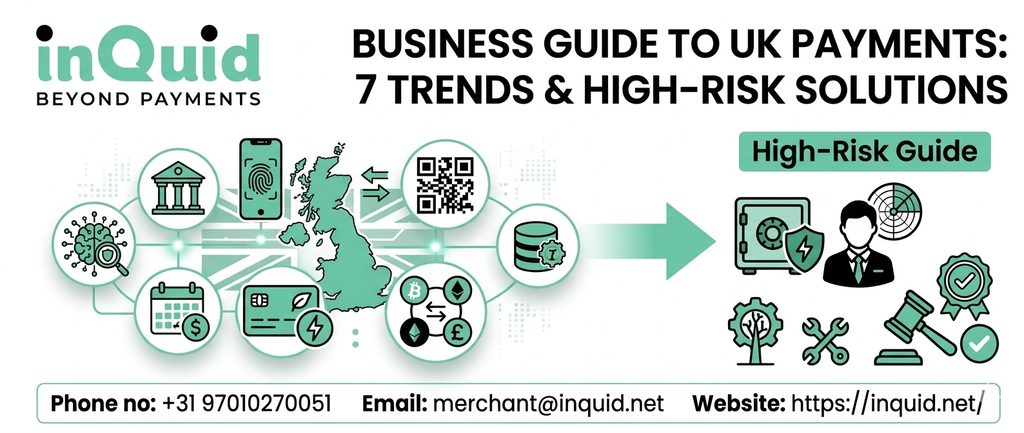
Credit card processing in the UK is evolving quickly. Contactless payments, digital wallets, AI-powered fraud prevention, Strong Customer Authentication and open banking are reshaping how businesses accept payments — and how customers expect to pay.
For UK businesses, accepting cards is no longer just a terminal or a checkout button. The right credit card solutions can influence conversion, fraud exposure, cash flow, customer experience, international expansion and regulatory compliance. That’s especially true for online sellers, businesses accepting international cards, or those operating in higher-risk industries where high-risk credit card processing UK providers play a specialised role.
This guide covers the seven biggest trends shaping the market, a deep look at high-risk credit card processing UK options, and a practical framework for choosing credit card transaction services that hold up as a business grows.
What Is Credit Card Processing?
Credit card processing is the technology and financial infrastructure that lets a business accept card payments from a customer. A simplified online transaction flows like this:
Customer → Checkout → Payment Gateway → Processor/Acquirer → Card Network → Issuing Bank → Authorisation → Settlement
A payment gateway securely transmits payment data; processors and acquiring institutions handle the transaction between merchant and financial networks. From the merchant’s side, modern credit card transaction services typically include payment gateways, merchant accounts, fraud prevention, 3-D Secure, Strong Customer Authentication, tokenisation, recurring billing, digital wallets, multi-currency processing, chargeback handling and reporting.
Businesses comparing providers can start with Inquid’s payment gateway solutions or browse credit card processing solutions for a broader overview of what’s available.
Why Payment Processing Is Changing in the UK
The UK has one of the most developed digital payments markets in the world, and expectations keep rising: customers want payments that are fast, secure, convenient and frictionless. At the same time, businesses face growing pressure to strengthen fraud controls, authentication and card-data security.
Regulation adds another layer. The FCA sets out guidance on Strong Customer Authentication, which applies to certain electronic payments and online account access, subject to applicable exemptions. That leaves UK businesses balancing two questions at once: how easily can customers pay, and how securely and compliantly can the business process those payments?
7 Trends Shaping Credit Card Processing in the UK
1. Contactless Payments Have Become the Standard
Tapping a card, phone or wearable at a supported terminal is now the default for many in-person transactions in the UK. Modern terminals need to reliably support contactless cards, NFC, mobile wallets, chip and PIN, and digital receipts — the FCA’s technical standards include provisions covering contactless transactions and the relevant SCA exemptions.
A slow or outdated checkout creates friction customers no longer tolerate. Retailers, hospitality, events and service businesses should check whether their setup supports the payment methods customers already expect.
2. Digital Wallets Are Changing the Checkout
Stored payment credentials mean customers increasingly skip manual card entry altogether. For ecommerce, that can mean fewer checkout steps; for physical retailers, compatible mobile wallets work alongside existing contactless terminals.
The point isn’t to offer every payment method available — it’s to offer the right ones without adding complexity to the customer journey. It’s worth checking how well a provider’s wallet support integrates with your existing checkout, something Inquid’s ecommerce payment tools are built around.
3. AI Is Reshaping Fraud Prevention
Older fraud systems relied heavily on fixed rules. Machine-learning models can now weigh multiple signals at once — transaction amount, device fingerprint, customer behaviour, frequency, location and purchasing patterns — to flag suspicious activity while cutting down false declines on legitimate customers.
The same tools increasingly help with chargeback management, organising transaction records and surfacing supporting evidence, which matters most for high-volume and higher-risk merchants where excessive chargebacks can jeopardise a processing relationship. AI is best treated as a risk-management aid, not a substitute for human oversight and compliance controls.
4. Strong Customer Authentication Is Critical
SCA is one of the most consequential requirements in UK online payments. The FCA confirms it applies to certain electronic payments and online account access, subject to applicable exemptions, and is designed to cut fraud through stronger authentication.
Before choosing a provider, it’s worth asking directly: how is SCA supported, is 3-D Secure included, which exemptions apply, how are authentication failures handled, and how are legitimate customers protected from unnecessary declines? The aim is strong security without unnecessary checkout friction.
5. PCI DSS Remains Central to Payment Security
Any business handling card data needs to take this seriously. PCI DSS version 4.0.1, published in June 2024 as an update to the March 2022 version 4.0, is currently the latest version of the requirements, covering access controls, authentication, encryption, tokenisation, vulnerability management, monitoring, incident response and third-party service-provider management.
Outsourcing to a payment provider can reduce how much cardholder data a merchant directly handles, but it doesn’t eliminate a business’s own PCI DSS responsibilities — those still need to be understood and documented. The PCI Security Standards Council publishes official guidance for merchants and service providers directly.
6. Open Banking Is Adding a New Payment Rail
The FCA’s framework for account-information and payment-initiation services is opening up options beyond cards. Businesses can now realistically run a multi-rail strategy — cards, digital wallets and open banking side by side — choosing the rail that fits the customer, the transaction type and the cost. Businesses building this out can explore Inquid’s open banking solutions. Open banking isn’t replacing cards; it’s giving businesses another lever to pull.
7. Cross-Border and Multi-Currency Payments Are Growing
More UK businesses are selling internationally — to the US, Germany, France, the Netherlands, Canada, Australia, the UAE and beyond — which raises the bar for what processing infrastructure needs to handle: international cards, multiple currencies, currency conversion, cross-border settlement and localised fraud controls.
Choosing a provider purely on the strength of its UK processing rate can become limiting later. The better question is whether the infrastructure can support the markets a business plans to enter.
High-Risk Credit Card Processing UK: A Closer Look
Not every UK business has the same risk profile, and high-risk credit card processing UK has become its own specialised category for a reason: mainstream acquirers often decline or heavily restrict certain sectors, regardless of how well-run the individual business is.
What Makes a Business “High-Risk”?
Sectors that commonly need accept credit cards high risk solutions include:
- Online gaming and gambling-adjacent services
- Digital subscription and membership businesses
- Travel and booking platforms
- Nutraceuticals and supplements
- Adult content and services
- Cryptocurrency-related businesses
- Certain financial services and forex-adjacent products
- Businesses with a history of high chargeback ratios
Being labelled “high-risk” isn’t a judgment on legitimacy — it reflects statistical patterns in chargebacks, refund rates, regulatory scrutiny or transaction disputes that acquirers factor into underwriting.
How High-Risk Underwriting Actually Works
Specialised providers look past the industry label to the specifics of the business: processing history, chargeback levels, average transaction size, customer geography, refund policies, product or service type, and existing compliance documentation. Two businesses in the same “high-risk” category can get very different terms depending on these factors.
This is also where the phrase credit card processing instant approval deserves a caveat. Some providers market fast onboarding, and streamlined digital applications genuinely have sped up the process — but real underwriting for high-risk accounts still involves document review, risk assessment and sometimes a reserve arrangement. Treat “instant” claims as a signal to ask more questions, not a promise to take at face value. What’s realistic to expect is quick credit card processing onboarding once documentation is in order, rather than approval with no review at all.
What Good High-Risk Processing Looks Like
A well-structured high-risk merchant account typically includes transparent reserve terms (rather than open-ended holds), active chargeback monitoring and alerts, fraud controls tuned to the specific industry, support for international customers and currencies, and a settlement schedule the business can plan around. Businesses in these sectors can review Inquid’s high-risk merchant account solutions for a sense of what specialised underwriting looks like in practice.
For these merchants, approval is only the starting point — the infrastructure needs to remain sustainable as transaction volume grows, not just workable on day one.
Traditional vs. Modern Processing
| Requirement | Traditional Approach | Modern Approach |
| Card payments | Basic acceptance | Multi-channel acceptance |
| Checkout | Manual card entry | Cards + digital wallets |
| Security | Basic verification | Tokenisation + authentication + fraud tools |
| Fraud management | Rule-based | Analytics and AI-assisted |
| Authentication | Limited options | SCA and 3-D Secure |
| International payments | Limited currencies | Multi-currency processing |
| Reporting | Manual reconciliation | Automated reporting and APIs |
| Payment rails | Cards only | Cards + wallets + open banking |
| High-risk support | Often declined outright | Specialised underwriting available |
| Scalability | Fixed infrastructure | Built to scale |
Pros and Cons
Pros: a smoother customer experience; stronger security through modern authentication and tokenisation; easier international expansion via multi-currency support; more flexibility in how customers can pay; and less manual admin thanks to automated reporting and APIs.
Cons: more moving parts to manage as payment methods multiply; ongoing compliance obligations that don’t disappear just because a provider is involved; processing costs — fees, chargebacks, refunds, FX — that can add up; fraud risk that never fully goes away; and integration work that may require real technical resources.
Real-World Examples
- A UK fashion retailer expanding into Europe might combine UK card acceptance, digital wallets, 3-D Secure, fraud monitoring, GBP/EUR support, international card acceptance and automated reconciliation — extending its reach without rebuilding its payment stack from scratch.
- A UK SaaS company running subscriptions typically prioritises reliable recurring payments, automated retries, tokenisation, digital wallets, international card support and solid API integration — recurring-payment reliability tends to matter more here than shaving basis points off the headline rate.
- A higher-risk UK nutraceuticals business generally needs more than approval: chargeback monitoring, fraud controls tuned to subscription and trial-offer models, transparent reserve terms, international acceptance and dependable settlement — with the account structured to hold up as volume increases, not just to get through initial underwriting.
How to Choose a Credit Card Processing Provider
Before signing with a provider, it’s worth getting clear answers on the following:
- Industry and eligibility. Does the provider support your industry, especially if you fall into a high-risk category? Are UK eligibility and onboarding requirements clearly laid out?
- Payment method coverage. Which cards, wallets and contactless methods are actually supported — not just listed on a marketing page?
- Authentication and fraud tools. How is SCA handled, is 3-D Secure included, and what fraud-monitoring capability comes as standard versus as a paid add-on?
- Total cost, not headline rate. Add up processing fees, chargeback fees, refund handling, FX costs and cross-border fees — the advertised rate is rarely the full picture, and this matters even more for businesses evaluating quick credit card processing setup fees against long-term costs.
- Settlement and reserves. How quickly do funds actually settle, and are there reserve requirements or account holds to plan around — particularly relevant for high-risk accounts.
- Scalability. Can the infrastructure support higher transaction volume and new markets without a full platform migration down the line?
- Support and transparency. Is there a real point of contact for underwriting questions, disputes and technical integration, or is support limited to a ticketing queue?
Frequently Asked Questions
- What is credit card processing in the UK? It’s the infrastructure — gateways, processors, acquiring institutions and card networks — that lets UK businesses accept and process card payments.
- Is credit card processing regulated in the UK? Yes. UK payment services sit within a regulatory framework that includes the Payment Services Regulations and applicable FCA requirements; the exact obligations depend on the service and business structure.
- What’s the difference between standard and high-risk credit card processing UK providers? Standard acquirers typically decline entire industry categories outright. High-risk specialists underwrite based on the specific business — processing history, chargebacks, transaction size — rather than the industry label alone, often at higher rates that reflect the added risk.
- Is “credit card processing instant approval” realistic? Fast digital onboarding is real, but genuine underwriting — especially for high-risk accounts — still involves document review and risk assessment. Treat guarantees of truly instant, no-review approval with scepticism.
- How long does it take to get approved for a high-risk merchant account in the UK? It varies by provider and how complete the application is, but a realistic range is a few days to a few weeks for full underwriting, faster for lower-risk categories with clean processing history.
- What is Strong Customer Authentication? A security requirement affecting certain electronic payments and online account access, using authentication factors to help confirm a payment or account action is genuinely authorised, subject to applicable exemptions.
- Do UK businesses need to think about PCI DSS? Yes — any business in a card-payment environment needs to understand its applicable PCI DSS responsibilities. Version 4.0.1 is the current standard.
- Can UK businesses accept international card payments? Generally yes, depending on the provider and merchant account setup — worth checking supported countries, currencies, networks and settlement options directly.
- Is open banking replacing card payments? Not really — it’s an additional rail. Most businesses end up running cards, wallets and open banking alongside each other.
- What should a UK business look for in a payment provider? Industry fit (including high-risk support if relevant), transparent total costs, solid fraud and authentication tools, reliable settlement, international capability, and infrastructure that can scale.
Conclusion
Payment processing in the UK is becoming more flexible, more digital and more security-focused. Choosing the right credit card solutions is no longer just about comparing headline transaction rates — the real questions are whether a provider can support your customers, your industry, your compliance needs and your growth, without compromising on transaction security.
A payment strategy that holds up combines customer experience, security, compliance, flexibility and scalability. Businesses exploring their options can look at Inquid’s payment gateway solutions, and those in higher-risk sectors can review high-risk merchant account solutions directly.