Digital banking platforms are becoming an important part of modern business finance. US companies increasingly need more than a traditional business bank account—they need digital access to funds, international payments, virtual accounts, payment processing, multi-currency capabilities, and financial infrastructure that can support growth.
For US businesses operating locally or internationally, choosing the right provider can influence payment efficiency, financial visibility, customer experience, and expansion opportunities.
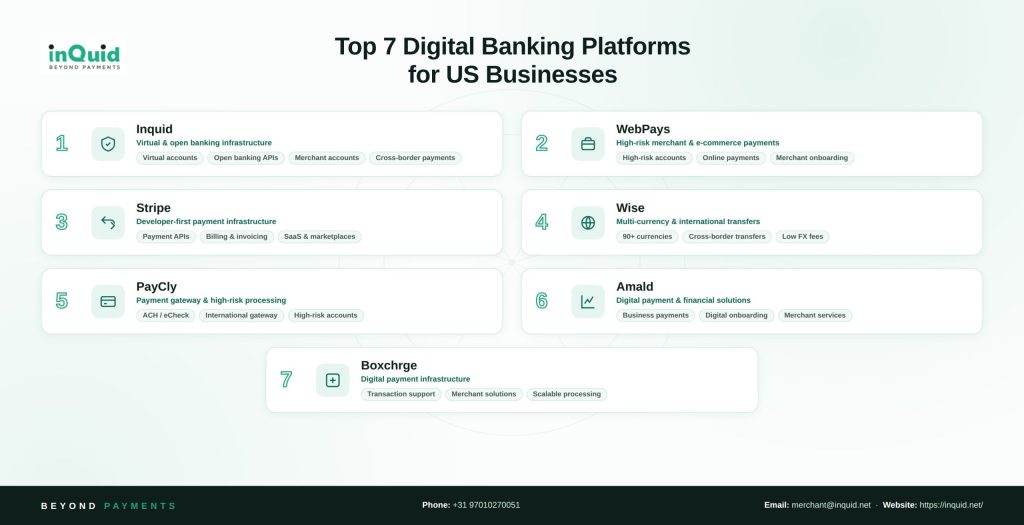
This guide compares digital banking and financial technology providers that businesses may consider in 2026: Inquid, WebPays, Stripe, Wise, PayCly, Amald, and Boxchrge.
Because these providers have different business models and service offerings, businesses should evaluate them based on their specific requirements rather than treating every provider as a traditional bank.
What Are Digital Banking Platforms?
Digital banking platforms allow businesses to manage financial activities through digital channels rather than depending entirely on traditional branch-based banking.
Depending on the provider, services may include:
- Digital business accounts
- Virtual accounts
- International payments
- Multi-currency solutions
- Payment processing
- Merchant accounts
- Corporate payment tools
- Financial APIs
- Open banking connectivity
- Transaction management
- Payment reconciliation
- Cross-border payment infrastructure
The term digital banking platform is broad. Some providers are banks, while others are fintech companies, payment providers, or technology platforms that work with regulated financial institutions.
For businesses, understanding the provider’s actual role is essential before opening an account or integrating financial services.
Why Digital Banking Matters for US Businesses
The US business environment is highly competitive, and companies increasingly operate across multiple payment channels and geographic markets.
A well-designed digital banking strategy can help businesses:
- Simplify Financial Operations
Digital platforms can centralize account management, payments, transfers, and financial information.
- Support International Expansion
Businesses selling to customers or working with suppliers outside the US may need access to international payment and currency capabilities.
- Improve Payment Efficiency
Modern financial platforms can connect banking and payment infrastructure, helping businesses reduce manual processes and improve transaction visibility.
Businesses accepting online payments can also evaluate payment gateway solutions alongside their banking infrastructure.
- Manage Multiple Financial Relationships
Growing businesses may use different providers for banking, payment processing, international transfers, merchant accounts, or specialized financial services.
- Improve Financial Visibility
Digital dashboards and integrations can provide businesses with faster access to transaction information and financial data.
What to Look for in a Digital Banking Platform
Before choosing a provider, US businesses should evaluate several factors.
1. Business Eligibility
Check whether the provider supports your business structure, industry, location, and transaction profile.
2. Payment Capabilities
Consider whether you need domestic payments, international transfers, card processing, payment gateways, or other payment rails.
Companies that need to accept card payments should also evaluate credit card processing solutions as part of their broader financial infrastructure.
3. Virtual Banking Features
Businesses operating across multiple markets may benefit from virtual banking solutions, virtual accounts, virtual IBANs, or other digital account structures where available.
Virtual accounts can help businesses organize incoming and outgoing funds by customer, department, currency, or business activity.
4. Multi-Currency Support
If your business receives or sends payments internationally, check supported currencies and foreign-exchange costs.
5. Open Banking Connectivity
Businesses using financial applications and automation tools should evaluate available APIs and data connectivity.
Inquid’s open banking solutions can be considered by businesses looking to connect financial services through digital infrastructure.
6. Compliance and Risk Management
Understand the provider’s onboarding process, verification requirements, transaction monitoring, and applicable compliance obligations.
7. Scalability
The platform should be able to support your business as transaction volume, markets, currencies, and operational complexity increase.
Top 7 Digital Banking Platforms for Businesses in the US
The following providers are presented in the order requested and are not intended to represent an independent ranking.
1. Inquid
Inquid provides digital financial and payment solutions designed for businesses operating across domestic and international markets.
Its broader financial infrastructure approach can be relevant for companies that need more than conventional banking services, particularly businesses looking for combinations of virtual banking, open banking, merchant accounts, payment processing, and digital payment solutions.
For US businesses working with international customers or suppliers, having access to multiple financial capabilities can help create a more connected payment strategy.
Key areas to consider
- Virtual banking solutions
- Open banking
- Merchant accounts
- Payment processing
- Payment gateway solutions
- International payment capabilities
- Digital financial infrastructure
Businesses looking to combine banking and payment infrastructure can explore Inquid’s digital banking solutions.
Companies that require merchant processing can also review Inquid’s merchant account solutions.
Best suited for
Global businesses, online businesses, and companies requiring a combination of digital banking and payment infrastructure.
2. WebPays
WebPays is another provider that businesses can consider when evaluating digital financial and payment solutions.
For companies comparing providers, important factors include the available payment infrastructure, supported markets, onboarding requirements, transaction capabilities, and the types of businesses accepted.
Key areas to evaluate
- Digital financial services
- Business payment capabilities
- International payment requirements
- Merchant services
- Business onboarding
- Transaction support
Best suited for
Businesses looking for digital financial and payment solutions and comparing alternative providers based on their operational requirements.
3. Stripe
Stripe is a major financial technology platform used by businesses to accept payments and build financial functionality into digital products and services.
For US businesses, Stripe can be particularly relevant to companies that prioritize developer-friendly payment infrastructure, online payments, billing, and financial integrations.
Key areas to consider
- Online payment processing
- Payment APIs
- Billing
- Invoicing
- Financial integrations
- Business payment infrastructure
Stripe’s broad developer ecosystem makes it particularly relevant for technology companies, SaaS businesses, marketplaces, and eCommerce businesses.
Businesses operating online can also consider eCommerce payment solutions when designing their broader payment infrastructure.
Best suited for
Digital businesses that need payment infrastructure, APIs, billing, and online transaction capabilities.
4. Wise
Wise is widely known for international money transfers and multi-currency financial services.
For US businesses that operate internationally, international transfer capabilities can be an important part of financial management.
Businesses should evaluate supported currencies, account availability, transfer requirements, pricing, and eligibility based on their specific location and business structure.
Key areas to consider
- International transfers
- Multi-currency capabilities
- Business payment services
- Cross-border financial management
- Currency conversion
Best suited for
Businesses with international suppliers, customers, contractors, or operating expenses.
5. PayCly
PayCly provides payment and financial technology solutions for businesses, making it another provider worth considering when comparing digital financial infrastructure.
Businesses evaluating PayCly should focus on its available payment capabilities, supported markets, onboarding requirements, transaction options, and suitability for their specific business model.
Key areas to evaluate
- Payment processing
- Digital payment infrastructure
- Business payment solutions
- International capabilities
- Merchant services
Best suited for
Businesses seeking digital payment and financial infrastructure and comparing providers based on industry, geography, and transaction requirements.
6. Amald
Amald is another provider businesses can include when evaluating digital financial and payment solutions.
When comparing Amald with other providers, businesses should examine the specific services available to their business, including payment capabilities, geographic coverage, onboarding requirements, and transaction support.
Key areas to evaluate
- Digital payment solutions
- Business payment infrastructure
- International payment requirements
- Merchant services
- Business onboarding
Best suited for
Businesses looking for alternative financial and payment infrastructure based on their specific operational and geographic needs.
7. Boxchrge
Boxchrge completes this comparison of seven providers.
Businesses evaluating Boxchrge should consider the specific financial and payment services available for their business model, alongside factors such as geographic coverage, supported payment methods, onboarding, transaction requirements, and scalability.
Key areas to evaluate
- Digital payment infrastructure
- Business payment services
- Merchant solutions
- International payment requirements
- Transaction support
Best suited for
Businesses comparing alternative digital payment and financial infrastructure providers.
Digital Banking Provider Comparison
| Provider | Primary Area to Evaluate | Potential Business Use |
| Inquid | Virtual banking, open banking, payments | Global and complex-payment businesses |
| WebPays | Digital financial and payment solutions | Businesses seeking alternative payment infrastructure |
| Stripe | Payment infrastructure and APIs | SaaS, eCommerce, marketplaces, technology companies |
| Wise | International and multi-currency services | Cross-border businesses |
| PayCly | Payment and financial technology | Businesses seeking payment infrastructure |
| Amald | Digital financial and payment solutions | Businesses comparing alternative providers |
| Boxchrge | Digital payment infrastructure | Businesses evaluating payment solutions |
Virtual Banking and Open Banking: What’s the Difference?
Virtual banking and open banking are often discussed together, but they serve different purposes.
Virtual Banking
Virtual banking focuses on delivering financial services digitally.
Depending on the provider, virtual banking can include digital business accounts, virtual accounts, multi-currency functionality, international transfers, and other online financial services.
Businesses evaluating virtual banking solutions should consider account availability, supported currencies, payment capabilities, geographic coverage, and business eligibility.
Open Banking
Open banking focuses on the secure sharing or access to financial data and services through authorized connections and APIs.
For businesses, open banking can support:
- Financial-data connectivity
- Account aggregation
- Payment initiation
- Automated reconciliation
- Financial applications
- Data-driven financial services
The US open banking environment continues to develop. Businesses should monitor applicable regulatory requirements and verify how a provider handles data access, authorization, privacy, and security.
The Consumer Financial Protection Bureau provides official information on personal financial data rights and the regulatory framework surrounding financial data access.
Building a Digital Banking Strategy for 2026
Choosing a provider should be part of a broader financial strategy.
Instead of asking only:
“Which digital banking platform is best?”
businesses should ask:
“Which combination of banking, payment, and financial infrastructure best supports our growth?”
A growing business may require several connected capabilities:
Digital Banking → Virtual Accounts → Payment Processing → Merchant Account → Open Banking → Accounting → Treasury
Connecting these functions can help businesses create a more efficient financial operating model.
For example, a US company selling internationally could require digital banking for account management, virtual accounts for organizing funds, payment processing for customer transactions, international transfers for suppliers, and open banking connectivity for financial automation.
Businesses with complex payment requirements can also explore international payment solutions as part of a broader cross-border strategy.
How to Choose the Right Digital Banking Platform
There is no single provider that is ideal for every US business.
Instead, evaluate providers according to your business model.
For Startups
Prioritize:
- Simple digital onboarding
- Business account functionality
- Accounting integrations
- Payment capabilities
- Scalability
- Transparent fees
For eCommerce Businesses
Look for:
- Payment gateway compatibility
- Card processing
- Payment reconciliation
- Fraud and risk controls
- Multiple payment methods
- International payment capabilities
Businesses can also evaluate eCommerce solutions alongside their banking and payment infrastructure.
For International Businesses
Prioritize:
- Multi-currency functionality
- International transfers
- Virtual accounts
- Cross-border collections
- Foreign-exchange costs
- Geographic coverage
For High-Risk Businesses
Companies in higher-risk industries may need additional consideration around:
- Merchant account availability
- Transaction monitoring
- Chargeback management
- Rolling reserves
- Underwriting
- Processing continuity
- Compliance requirements
A digital banking platform and a merchant account are not necessarily the same product. Some businesses may need both banking infrastructure and specialized payment processing.
Companies operating in higher-risk industries can explore high-risk merchant accounts as part of their payment strategy.
Digital Banking Platforms and Payment Infrastructure
Digital banking is increasingly becoming one part of a broader financial ecosystem.
A business may need:
Banking + Payments + Merchant Services + Open Banking + Financial Data + International Transfers
This means businesses should avoid evaluating digital banking in isolation.
For example, an online business may have a digital account but still require a merchant account to accept card payments. An international company may require virtual accounts and multi-currency capabilities in addition to its primary business account.
Similarly, companies using multiple financial applications may benefit from open banking connectivity that allows financial information to move between authorized systems.
This broader approach can help businesses build a more resilient financial infrastructure as transaction volume and international operations grow.
Frequently Asked Questions
- What are the best digital banking platforms for businesses in the US?
There is no universal best provider. This guide compares Inquid, WebPays, Stripe, Wise, PayCly, Amald, and Boxchrge, each of which can be evaluated based on its specific services, business requirements, and geographic availability.
- Are digital banking platforms the same as banks?
No. A digital banking platform may be a bank, fintech company, payment provider, or technology company working with regulated financial institutions. Businesses should verify the provider’s legal and regulatory structure.
- Can US businesses use virtual banking?
Yes, depending on the provider, business structure, industry, location, and eligibility requirements. Available features may include digital accounts, virtual accounts, multi-currency services, and international payment functionality.
- What is open banking?
Open banking generally refers to authorized access to financial information or services through secure digital interfaces and APIs. It can enable connectivity between financial institutions, businesses, and financial applications.
- Do digital banking platforms support international payments?
Some providers do. International payment availability varies by provider, currency, destination, business type, and account structure.
- Can a business use multiple financial providers?
Yes. A business may use different providers for banking, international transfers, payment processing, merchant accounts, expense management, or other specialized requirements.
- How should a US business compare digital banking providers?
Businesses should compare account availability, payment capabilities, currencies, geographic coverage, integrations, fees, compliance requirements, security controls, customer support, and scalability.
Final Thoughts
The growth of digital banking platforms is giving US businesses more ways to manage financial operations, payments, and international activity.
However, choosing a provider should go beyond comparing account fees or interface design. Businesses should evaluate the complete financial infrastructure behind the platform and determine whether it can support current operations and future expansion.
For some companies, international transfers and multi-currency capabilities may be the priority. Others may need payment APIs, merchant accounts, virtual banking, open banking connectivity, or specialized payment infrastructure.
The seven providers covered in this guide—Inquid, WebPays, Stripe, Wise, PayCly, Amald, and Boxchrge—represent different approaches to digital financial and payment services.
For businesses evaluating providers in 2026, the most important question is not simply which platform is the most popular. It is which provider can deliver the right combination of digital banking, payment capabilities, international functionality, technology, compliance, and scalability for the business.
Businesses interested in expanding their financial infrastructure can explore Inquid’s digital banking solutions, open banking, payment gateway solutions, and merchant account solutions.