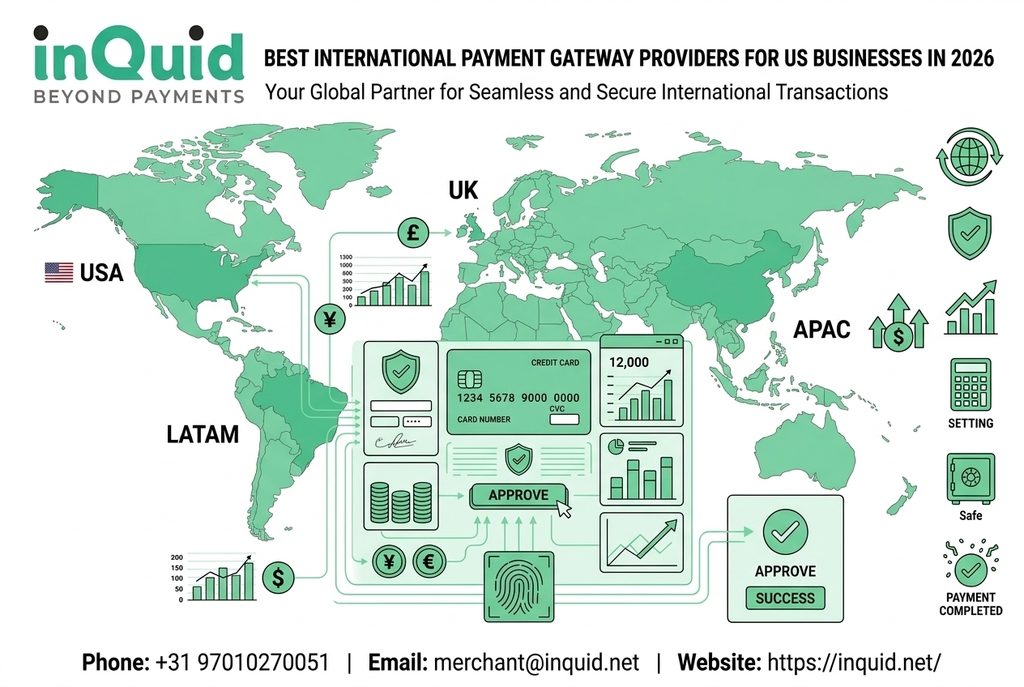
For a US business selling to customers across borders, the right international payment gateway can directly affect conversion rates, payment acceptance, cash flow, and customer experience. A domestic-only setup may work during the early stages, but international growth often introduces multiple currencies, foreign-issued cards, alternative payment methods, fraud risks, chargebacks, and more complicated settlement requirements.
The challenge is choosing from the many international payment gateway providers available in 2026.
This guide compares providers that US businesses may consider for international payment acceptance, merchant services, cross-border payments, and related financial infrastructure:
- Inquid
- Stripe
- Webpays
- Paycly
- Boxchrge
- Amald
- PayPal
- Wise
- Payoneer
- Authorize.net
What Is an International Payment Gateway?
An international payment gateway is technology that connects a merchant’s checkout experience with the payment-processing infrastructure needed to authorize and complete transactions from customers in different markets.
A typical payment flow can involve:
Customer → Checkout → Payment Gateway → Processor/Acquirer → Card Network → Issuing Bank → Settlement
International transactions can introduce additional considerations such as:
- Foreign-issued cards
- Multiple transaction currencies
- Currency conversion
- Cross-border processing costs
- Local payment methods
- Fraud monitoring
- 3D Secure authentication
- Chargeback management
- Settlement currencies
- Regional compliance requirements
Visa describes global payment acceptance as an ecosystem involving secure transaction processing, acquirers, payment methods, and authorization infrastructure. Mastercard similarly emphasizes secure acceptance, authentication, scalability, and multiple payment options for merchants.
For US businesses expanding internationally, the payment gateway is therefore more than a checkout button. It becomes part of the company’s broader payment infrastructure.
International Payment Gateway Providers for US Businesses
1. Inquid
Inquid provides merchant accounts, payment gateway infrastructure, credit card processing, alternative payment methods, and payment solutions for businesses operating across different markets.
Its offering is particularly relevant to businesses that require specialized underwriting or international payment infrastructure, including higher-risk and complex business models.
According to Inquid’s current merchant-account information, its platform can connect businesses with multiple acquiring relationships and configure processing around factors such as business vertical, processing volume, geography, settlement currency, reserve structure, and fraud controls.
Its payment gateway offering also describes smart transaction routing, fraud screening, 3D Secure, API integration, and settlement functionality.
Key strengths
- Merchant account and payment gateway solutions
- Multi-acquirer processing options
- Multi-currency settlement
- Smart transaction routing
- Fraud and chargeback management
- Alternative payment methods
- Solutions for complex and high-risk businesses
- API and e-commerce integration options
Best suited for
US businesses that need more specialized payment infrastructure, particularly companies operating internationally or in industries that may face additional underwriting requirements.
Businesses should confirm available acquiring relationships, supported markets, pricing, reserves, settlement terms, and eligibility during underwriting.
2. Stripe
Stripe is one of the most widely recognized payment platforms for internet businesses, particularly SaaS companies, online retailers, marketplaces, and technology businesses.
Its platform combines payments with tools for billing, subscriptions, fraud prevention, reporting, payment links, and other financial infrastructure.
Stripe’s current US pricing page lists standard domestic card pricing at 2.9% + $0.30 per successful transaction, while its published pricing also identifies additional charges for international cards and currency conversion. Stripe says its platform supports 135+ currencies and 100+ payment methods.
Key strengths
- Strong developer ecosystem
- APIs and prebuilt checkout components
- Subscription and recurring billing
- Large selection of payment methods
- Fraud prevention tools
- Marketplace and platform capabilities
- International payment support
Best suited for
US SaaS companies, software businesses, e-commerce brands, marketplaces, and technology companies that want extensive developer tools.
3. WebPays
Webpays positions itself as a payment service provider focused on international and high-risk payment processing.
Its published materials describe payment gateway services, merchant accounts, multi-currency processing, and payment solutions for industries such as forex, gaming, casino, IPTV, digital products, and other higher-risk verticals.
A current third-party connector listing for Webpays identifies card payments and payouts, with USD, EUR, and CNY shown among supported currencies for that connector. However, available methods and currencies can vary by integration and merchant arrangement.
Key strengths
- International payment processing
- High-risk merchant services
- Merchant account solutions
- Multi-currency capabilities
- Payment gateway integration
- Industry-specific payment infrastructure
Best suited for
Businesses that operate internationally and require specialized underwriting or high-risk payment processing.
4. Paycly
Paycly offers payment gateway, merchant account, credit card processing, invoicing, alternative payment methods, and other payment services.
Its website states that its international payment gateway supports more than 150 countries and that its platform provides access to more than 100 currencies. Paycly also describes dedicated merchant IDs, real-time transaction reporting, and specialized solutions for high-risk businesses.
Key strengths
- International payment gateway
- Merchant accounts
- Credit card processing
- Multi-currency processing
- Invoicing
- Alternative payment methods
- Dedicated MID options
- High-risk merchant solutions
Best suited for
International online businesses and merchants seeking payment infrastructure that can accommodate complex or higher-risk business models.
5. Boxchrge
Boxchrge focuses on international payment infrastructure, including merchant services, cross-border payment gateways, payment orchestration, alternative payment methods, and settlement solutions.
Its current solutions page describes multi-currency acquiring, cross-border payment gateway connectivity, payment orchestration, alternative payment methods, and IBAN and settlement solutions.
The platform also publishes developer resources covering hosted checkout, server-to-server APIs, signed webhooks, refunds, 3DS authentication, and payment integration.
Key strengths
- Cross-border payment gateway
- Payment orchestration
- Multi-acquirer connectivity
- Alternative payment methods
- Hosted checkout
- API integration
- Webhooks
- Settlement infrastructure
Best suited for
Growing businesses that need more than a basic payment gateway and may benefit from multiple payment connections, routing logic, or broader payment orchestration.
6. Amald
Amald provides payment gateway, credit card processing, eCheck processing, alternative payment methods, and merchant account services.
Its published international merchant account information describes support for international card processing, multiple currencies, fraud controls, chargeback management, and both 3D Secure and non-3D Secure processing.
Amald also describes gateway features including virtual terminals, recurring billing, customer vault functionality, multi-MID support, and API integration.
Key strengths
- International merchant accounts
- Payment gateway services
- Credit card processing
- eCheck processing
- Alternative payment methods
- Recurring billing
- Multi-MID support
- Fraud and chargeback controls
Best suited for
Online businesses that need international or specialized merchant-account services, particularly merchants that may require high-risk processing capabilities.
7. PayPal
PayPal is a major payment platform with strong consumer recognition and broad online payment acceptance.
For US business accounts, PayPal currently lists standard credit and debit card payments at 2.99% + a fixed fee, while PayPal Checkout and certain other payment products have different rates. PayPal also states that international commercial transactions can incur an additional 1.50% percentage-based fee for US accounts, depending on the payment type.
Its current US pricing page also lists card processing starting at 2.89% + $0.29 and PayPal/Venmo transactions at 3.49% + $0.49, demonstrating why merchants should evaluate the exact payment product rather than assume one universal PayPal rate.
Key strengths
- Strong consumer brand recognition
- PayPal checkout
- Card processing
- Venmo acceptance
- Payment links and invoicing
- Broad consumer reach
- Familiar checkout experience
Best suited for
US e-commerce businesses and online merchants that want to offer PayPal alongside traditional card payments.
8. Wise
Wise is best understood as an international business account and cross-border money movement platform rather than a traditional full-service payment gateway.
Wise Business allows companies to send and receive money internationally, hold multiple currencies, and manage international business payments. Wise currently states that businesses can use its platform to make payments, get paid, and spend in different currencies.
Wise also offers business cards in the US and other eligible markets.
One important distinction is that Wise’s website currently states that its feature allowing new Wise Business customers to get paid by card is unavailable, although some existing eligible customers may have access to card-payment functionality.
Key strengths
- International business payments
- Multi-currency account functionality
- Cross-border transfers
- Business cards
- International supplier payments
- Currency management
Best suited for
US companies that need efficient international money movement, supplier payments, contractor payments, and multi-currency business operations.
9. Payoneer
Payoneer is another important option for businesses that receive international payments, work with marketplaces, operate across borders, or pay international contractors and suppliers.
Its receiving-account product allows businesses to receive payments in multiple currencies through one Payoneer account. Payoneer currently states that its receiving accounts support 22 currencies, with local account details available in 13 major currencies and SWIFT receiving capabilities for additional currencies.
Key strengths
- Multi-currency receiving accounts
- International business payments
- Marketplace payment support
- Cross-border transfers
- Supplier and contractor payments
- Multi-currency fund management
Best suited for
Freelancers, agencies, marketplaces, exporters, digital businesses, and companies receiving international business payments.
10. Authorize.net
Authorize.net is a long-established payment gateway serving businesses that need online, in-person, and phone payment acceptance.
Its current pricing page lists an All-in-One plan at $25 per month plus 2.9% + $0.30 per transaction, subject to eligibility. The platform also supports a gateway-only option for businesses that already have a merchant account.
Authorize.net supports credit cards, debit cards, eChecks, digital wallets, recurring billing, fraud detection, invoicing, and customer payment information management.
Key strengths
- Established payment gateway
- Merchant account option
- Credit and debit card processing
- eCheck support
- Digital wallets
- Recurring billing
- Fraud detection
- Virtual Terminal
- 24/7 support
Best suited for
US small and medium-sized businesses that want an established payment gateway with merchant-account functionality and a broad set of payment-management tools.
International Payment Gateway Providers Comparison
| Provider | Primary strength | International payments | Best suited for | Pricing approach |
| Inquid | Merchant accounts & specialized payment infrastructure | Yes | International and complex/high-risk businesses | Customized |
| Stripe | Developer-focused payment platform | Yes | SaaS, e-commerce, platforms | Transparent + custom |
| Webpays | International/high-risk processing | Yes | High-risk online businesses | Quote-based |
| Paycly | Merchant accounts & international gateway | Yes | International/high-risk merchants | Quote-based |
| Boxchrge | Gateway + orchestration | Yes | Cross-border and multi-provider setups | Customized |
| Amald | Merchant accounts & payment processing | Yes | Online/high-risk businesses | Quote-based |
| PayPal | Consumer payments & checkout | Yes | E-commerce and online sellers | Published transaction fees |
| Wise | International money movement | Yes | Business transfers and multi-currency operations | Transaction-based |
| Payoneer | Cross-border business payments | Yes | Marketplaces and international businesses | Product-dependent |
| Authorize.net | Established payment gateway | Yes, subject to arrangement | US SMBs and online merchants | Monthly + transaction fees |
How Should US Businesses Choose an International Payment Gateway?
Selecting an international payment gateway should start with the business model rather than the provider’s brand recognition.
1. Check Supported Countries
Determine where your customers are located and whether the provider can process payments from those markets.
Do not assume that a provider’s global marketing automatically means every country or customer type is supported.
2. Compare Payment Methods
Cards remain important, but international customers may prefer:
- Credit and debit cards
- Digital wallets
- Bank transfers
- Local payment methods
- Buy-now-pay-later options
- Account-to-account payments
- Alternative payment methods
Visa and Mastercard both emphasize the importance of providing secure, scalable payment acceptance across different channels and markets.
3. Understand the Full Cost
Do not compare providers using only the headline transaction rate.
Your total payment cost can include:
- Processing fees
- International-card fees
- Currency conversion
- Gateway fees
- Monthly fees
- Chargeback fees
- Refund fees
- Payment-method fees
- Settlement costs
- Reserve requirements
A provider with a lower advertised percentage may not necessarily produce the lowest total cost.
4. Evaluate Settlement
Ask:
- What currencies can you settle in?
- How frequently are funds paid out?
- Is a rolling reserve required?
- Are there minimum settlement amounts?
- What happens when transactions are disputed?
- Can settlement accounts be changed?
For a growing US company, predictable cash flow can be as important as payment acceptance.
5. Review Fraud and Chargeback Controls
International commerce can increase exposure to fraud and disputes.
Look for capabilities such as:
- 3D Secure
- Address verification
- Device intelligence
- Velocity controls
- Transaction monitoring
- Tokenization
- Chargeback alerts
- Dispute management
The goal is not simply to approve more transactions. It is to approve legitimate transactions while controlling unnecessary risk.
Why PCI DSS Matters for International Payment Processing
Security should be a central part of the provider-selection process.
The PCI Security Standards Council states that PCI DSS provides baseline technical and operational requirements for protecting payment account data and applies to entities that store, process, or transmit cardholder data or sensitive authentication data.
Businesses should therefore ask prospective providers:
- What parts of PCI compliance does the provider cover?
- Is hosted checkout available?
- Is tokenization supported?
- How is card data protected?
- What security certifications or assessments apply?
- What responsibilities remain with the merchant?
Using a third-party payment provider can reduce some security responsibilities, but it does not automatically remove every merchant obligation.
International Payment Gateway vs Payment Processor vs Merchant Account
These terms are often confused.
- Payment Gateway
The gateway securely transmits payment information between the merchant’s checkout and payment-processing infrastructure.
- Payment Processor
The processor facilitates transaction routing and communication between relevant financial institutions and payment networks.
- Merchant Account
A merchant account is part of the acquiring and settlement infrastructure used to receive card-payment funds before they are transferred to the business’s operating bank account.
Some modern payment companies combine several of these functions into one platform, while others specialize in only one part of the payment stack.
Examples: Which Type of Provider Fits Different US Businesses?
Example 1: US SaaS company
A SaaS company selling subscriptions to customers in the US, UK, Germany, and Australia may prioritize:
- Recurring billing
- Card payments
- Local payment methods
- API integration
- Fraud protection
- Multi-currency pricing
A platform such as Stripe may be attractive because of its developer ecosystem and billing capabilities.
Example 2: US high-risk online business
A business operating in a higher-risk industry may face additional underwriting requirements.
In this situation, a specialized merchant-account provider such as Inquid, Webpays, Paycly, Boxchrge, or Amald may be worth evaluating alongside traditional processors.
The important question is not simply whether the provider accepts the industry. The merchant should examine the complete underwriting, reserve, settlement, compliance, and chargeback structure.
Example 3: US company paying international suppliers
A company may not need a customer-facing payment gateway at all.
If the primary requirement is paying international suppliers, contractors, or partners, a cross-border business platform such as Wise or Payoneer may be more relevant.
Example 4: US e-commerce company
An online retailer may need:
- Card acceptance
- Digital wallets
- Payment links
- Fraud prevention
- Recurring billing where applicable
- International cards
- Multiple currencies
PayPal, Stripe, Authorize.net, or another gateway may be considered depending on the company’s technology stack and customer base.
Common Mistakes When Choosing a Payment Gateway
- Choosing Based Only on Price
The cheapest headline rate does not necessarily mean the lowest total processing cost.
- Ignoring International Fees
Foreign cards and currency conversion can materially change your effective processing cost.
- Choosing a Provider Without Checking Your Industry
A provider may support international payments but still decline a particular business model during underwriting.
- Failing to Review Settlement Terms
A low processing fee is not useful if the business cannot maintain predictable access to its working capital.
- Using One Provider for Everything
Larger businesses may benefit from multiple acquiring relationships, alternative payment methods, or payment orchestration.
- Treating Every Payment Company as a Gateway
Wise and Payoneer, for example, are highly relevant to international business payments but should not automatically be considered interchangeable with a conventional card gateway.
Frequently Asked Questions
- What is the best international payment gateway for a US business?
There is no single best provider for every US business. The right choice depends on industry, transaction volume, customer locations, payment methods, currencies, risk profile, integration requirements, settlement needs, and total cost.
- Which payment gateway is best for international transactions?
Providers such as Inquid, Stripe, Webpays, Paycly, Boxchrge, Amald, PayPal, and Authorize.net can serve different international payment requirements. Wise and Payoneer are particularly relevant for cross-border business money movement.
- Can US businesses accept payments in multiple currencies?
Yes. Many international payment platforms support multiple transaction or settlement currencies, but the exact currencies, conversion fees, and settlement options vary by provider and merchant account.
- Is Stripe suitable for international payments?
Yes. Stripe supports international cards, multiple currencies, and numerous payment methods. Its current published pricing also separates domestic and international card costs and identifies additional currency-conversion charges.
- Is PayPal good for international business payments?
PayPal can be useful for businesses that want a familiar consumer checkout option. US merchants should account for international transaction charges and currency-conversion costs when evaluating its economics.
- Are Wise and Payoneer payment gateways?
Not in the same sense as a traditional online card gateway. Wise and Payoneer are particularly useful for international business payments, receiving funds, currency management, and cross-border transfers. Their capabilities should be evaluated according to the specific payment flow a business needs.
- What should high-risk US businesses look for?
High-risk businesses should examine underwriting criteria, industry acceptance, acquiring relationships, rolling reserves, chargeback controls, settlement schedules, transaction limits, supported payment methods, and compliance requirements.
- How much does an international payment gateway cost?
There is no universal price. Costs may include percentage-based transaction fees, fixed transaction fees, international-card fees, currency conversion, monthly fees, gateway fees, chargeback fees, and other account-specific charges.
Final Thoughts
Choosing among international payment gateway providers is ultimately a payment-infrastructure decision rather than simply a software purchase.
A US business expanding internationally should look beyond transaction rates and evaluate the entire payment lifecycle—from checkout and authorization to fraud screening, settlement, reconciliation, refunds, and chargebacks.
Stripe and PayPal can be attractive for businesses that prioritize established payment ecosystems and consumer recognition. Authorize.net remains relevant for businesses looking for an established gateway and merchant-account option. Wise and Payoneer are particularly useful for international business money movement.
For businesses with specialized underwriting requirements, international operations, or more complex processing needs, providers such as Inquid, Webpays, Paycly, Boxchrge, and Amald may warrant a closer evaluation.
The strongest choice is the provider whose payment capabilities, risk model, pricing, settlement structure, technology, and geographic coverage align with the actual needs of your business.
For any provider, confirm current terms directly before onboarding because pricing, supported markets, eligibility, acquiring arrangements, and payment-method availability can change.
Compliance References