
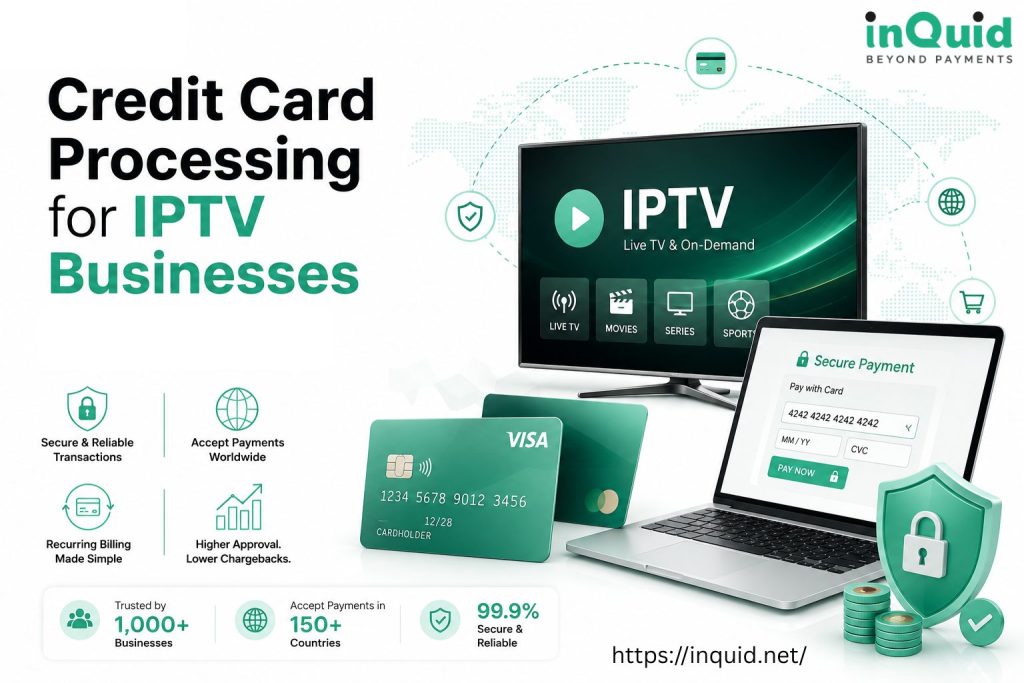
The IPTV industry has grown rapidly over the past decade, with millions of users worldwide choosing internet-based television services over traditional cable and satellite subscriptions. As demand for digital entertainment rises, licensed IPTV providers need secure, scalable credit card solutions and reliable credit card transaction services to support subscription billing and international customer bases.
For legitimate providers, high-risk credit card processing is more than accepting online payments — it’s a core part of customer acquisition, recurring billing, revenue management, fraud prevention, and long-term growth. The right payment infrastructure can improve approval rates, reduce chargebacks, and simplify expansion into new markets.
A note on scope: This guide is written for licensed IPTV platforms — businesses that hold proper content licensing or distribution agreements and operate within applicable broadcasting and consumer protection laws. Payment processors and acquiring banks require proof of content rights, business licensing, and compliance documentation as part of underwriting. Unauthorized or unlicensed streaming services are not eligible for standard merchant processing and fall outside what this article covers.
Even for licensed operators, IPTV is widely classified as a high-risk industry due to recurring billing, digital content delivery, cross-border transactions, and above-average chargeback rates. As a result, many traditional payment providers apply stricter underwriting or decline applications outright.
This guide covers how credit card processing works, why IPTV businesses need specialized payment solutions, the challenges to expect, and what to look for in a processor.
What Is Credit Card Processing for IPTV Businesses?
Credit card processing for IPTV businesses refers to the technology and financial infrastructure that lets providers securely accept, authorize, process, and settle customer payments for subscription plans, pay-per-view services, and digital content purchases. In practice, this means working with credit card transaction services that are built to accept credit cards for high-risk, subscription-driven merchants — not just a generic checkout button.
Most IPTV businesses rely on recurring billing — customers are charged monthly or annually for ongoing access. This requires systems capable of handling automated recurring transactions while meeting security and compliance standards.
A standard transaction involves several parties working together in seconds:
- Customer
- IPTV merchant
- Payment gateway
- Payment processor
- Acquiring bank
- Card network (Visa or Mastercard)
- Issuing bank
For providers operating internationally, processing may also involve multi-currency transactions, cross-border acquiring, currency conversion, fraud screening, chargeback monitoring, and subscription management.
Why IPTV Is Classified as High-Risk — and What That Means Day-to-Day
Several characteristics push IPTV into higher-risk underwriting categories, even for fully licensed operators.
- Subscription-Based Billing
Recurring billing introduces ongoing payment considerations: card expiration updates, automatic renewals, failed payment recovery, cancellations, and disputes. A processor built for subscription businesses can automate much of this and reduce revenue loss from failed transactions.
- Cross-Border Customers
Many IPTV providers serve customers in multiple countries, which requires support for multiple currencies, international card acceptance, local payment preferences, and cross-border settlement. Global acquiring capability improves authorization rates and reduces unnecessary declines.
- Elevated Chargeback Risk
Digital subscription services generally see higher chargeback rates than physical-goods businesses, driven by forgotten renewals, customer misunderstanding, unauthorized transactions, “friendly fraud,” and service dissatisfaction. Chargeback management tools are essential to protecting revenue and maintaining a healthy merchant account.
- Fraud Exposure
Online digital businesses are frequent fraud targets — stolen cards, card testing attacks, account takeover, and bot-driven transactions are common threats. Processors mitigate this with AI-driven fraud monitoring, device fingerprinting, velocity checks, 3D Secure authentication, and risk scoring, which reduce fraud while minimizing false declines for legitimate customers.
- Regulatory Considerations
Requirements vary by jurisdiction and may include PCI DSS, AML/KYC obligations where applicable, consumer protection rules, and data privacy law. Being classified as high-risk doesn’t mean a business is doing anything wrong — it means providers apply enhanced review before approval.
Common Payment Challenges for IPTV Businesses
- Higher processing costs. Compared with standard e-commerce merchants, IPTV businesses may face higher transaction fees, rolling reserves, and more detailed underwriting. Costs vary by business model, processing history, target markets, and chargeback performance.
- Managing recurring payments. Failed payments happen due to expired cards, insufficient funds, bank declines, fraud checks, or cancellations. Without automated retry logic and account-updater services, businesses lose recoverable revenue.
- International payment acceptance. Serving global customers takes more than Visa and Mastercard support — multi-currency handling, local acquiring, and regional payment optimization all affect authorization rates in key markets.
- Regulatory compliance. PCI DSS, AML/KYC where applicable, consumer protection regulations, and data privacy laws all apply. Compliance protects sensitive payment data and supports long-term credibility with banking partners.
How Credit Card Processing Works for IPTV Businesses
- Customer initiates payment. The customer selects a plan and enters payment details through an encrypted checkout page.
- Payment gateway encrypts the transaction. The gateway securely transmits data to the processor, handling encryption, tokenization, fraud screening, and authentication.
- Payment processor routes the transaction. The processor forwards the authorization request through the card network to the issuing bank, checking card validity, available funds, fraud indicators, and merchant verification.
- Issuing bank approves or declines. If approved, the subscription activates immediately. If declined, the customer is prompted to try another method or contact their bank.
- Settlement and fund transfer. Approved funds move from the issuing bank through the acquiring bank into the merchant account, on a schedule that depends on the provider and the merchant’s risk profile.
Quick Credit Card Processing and Instant Approval: What’s Realistic
Many IPTV operators searching for a processor are looking for quick credit card processing or even credit card processing instant approval. It’s a fair thing to want — every day without a working merchant account is lost revenue. But it’s worth setting accurate expectations for a high-risk category like IPTV:
- “Instant approval” is rare for genuinely high-risk merchants. Providers advertising instant or same-day approval for high-risk industries are often pre-qualifying based on limited information, with full underwriting (and potential account holds or reserves) happening after the fact. Be cautious of any offer that skips document review entirely.
- “Quick” is realistic when your documentation is ready. Providers experienced with IPTV can move faster — sometimes within a few business days — when you arrive with licensing proof, a compliant terms-of-service and refund policy, processing history (if available), and a clear description of your billing model.
- Speed shouldn’t come at the cost of stability. A fast approval that leads to a frozen account or sudden reserve increase two months later is a worse outcome than a slightly longer underwriting process with a provider that understands IPTV from day one.
If quick turnaround matters most, ask prospective providers directly what “fast” actually means for their underwriting process, and get it in writing.
Key Features to Look for in an IPTV Payment Processor
Not every credit card solution on the market is built for subscription-based digital services, so it pays to compare providers on more than price. Here’s what separates a genuinely high-risk-ready processor from a generic one:
- High-risk industry experience. Providers familiar with subscription billing, international payments, chargeback management, fraud prevention, and compliance expectations tend to onboard IPTV merchants faster and offer more appropriate terms.
- Multi-currency support. Letting customers pay in their preferred currency reduces friction, improves conversion, and simplifies settlement as you expand internationally.
- Recurring billing management. Look for automated billing, payment retries, account-updater services, billing notifications, and flexible billing cycles — these directly reduce involuntary churn from expired cards.
- Advanced fraud prevention. AI-powered detection, real-time monitoring, device fingerprinting, velocity checks, geolocation analysis, tokenization, and 3D Secure authentication protect revenue without adding checkout friction.
- Chargeback management. Alerts, dispute tools, evidence submission support, and reporting dashboards help you catch and respond to disputes before they threaten account stability.
- Global payment acceptance. Confirm support for Visa, Mastercard, multiple currencies, cross-border acquiring, and international settlement if you serve customers outside your home market.
- Easy integration. API documentation, SDKs, hosted payment pages, plugin integrations, and mobile compatibility all affect how quickly you can launch.
- PCI DSS compliance. Tokenization, end-to-end encryption, and secure payment gateways reduce breach risk and support regulatory compliance — this should be non-negotiable.
Standard vs. IPTV-Focused Payment Providers
| Feature | Standard Payment Provider | IPTV-Focused Payment Provider |
| High-risk merchant support | Limited | Built for higher-risk industries |
| Recurring billing | Basic | Advanced subscription management |
| Multi-currency support | Limited | Extensive global support |
| Chargeback management | Basic tools | Advanced monitoring & dispute support |
| Fraud prevention | Standard screening | AI-powered fraud detection |
| Cross-border payments | Limited | Optimized international processing |
| Industry expertise | General e-commerce | IPTV & digital services experience |
| Payment scalability | Moderate | Built to support growth |
Pros and Cons
Advantages: global customer reach, familiar checkout experience for cardholders, predictable recurring revenue, stronger security through encryption/tokenization/fraud detection, and infrastructure that scales with transaction volume.
Challenges: higher processing costs (fees, reserves, underwriting overhead), greater chargeback exposure than typical retail, ongoing compliance responsibilities as regulations evolve, and periodic account reviews of transaction quality and fraud rates.
Real-World Scenarios
International subscription platform: A provider serving customers across Europe, Asia, and Latin America needed multi-currency support and recurring billing automation. Implementing a payment solution with both improved checkout experience and simplified international operations.
Growing IPTV startup: A business that initially accepted only domestic payments needed global acceptance, fraud protection, recurring billing, and chargeback monitoring as international demand grew. Upgrading to more scalable infrastructure supported expansion into new markets.
Premium streaming service: A platform losing revenue to expired-card payment failures implemented account-updater services and intelligent retry logic, recovering a meaningful share of recurring revenue that would otherwise have been lost.
How to Accept Credit Cards as a High-Risk IPTV Business
Choosing the right provider to accept credit cards as a high-risk merchant means evaluating more than transaction fees. Look for credit card solutions built around these factors:
- Industry experience — demonstrated track record with IPTV or other subscription-based digital businesses.
- Security standards — PCI DSS compliance and recognized security practices.
- Global coverage — supported countries, currencies, and payment methods relevant to your customer base.
- Fraud prevention — available tools, authentication methods, and monitoring.
- Chargeback support — monitoring, dispute assistance, reporting, and prevention strategies.
- Integration options — APIs, plugins, documentation, developer resources.
- Transparent pricing — transaction fees, setup costs, monthly fees, settlement schedules, reserve requirements.
- Customer support — responsive technical and account support, especially for recurring international payments.
Security & Compliance Best Practices
- Use PCI DSS-compliant payment solutions
- Enable tokenization to protect cardholder data
- Implement 3D Secure where appropriate
- Monitor transactions for unusual activity
- Regularly review chargeback reports
- Maintain secure customer authentication practices
- Keep payment software and integrations up to date
- Follow applicable AML, KYC, and data privacy requirements
Future Trends in IPTV Payment Processing
- AI-powered fraud prevention. Real-time analysis of transaction behavior is improving fraud detection speed, raising approval rates, and reducing false declines.
- Smarter subscription billing. Automatic retries, account-updater services, smart billing schedules, and subscription analytics are reducing involuntary churn.
- Multi-currency expansion. Payment providers are investing in global acquiring networks so customers can pay locally, improving conversion and satisfaction.
- Stronger security standards. Network tokenization, biometric authentication, and risk-based authentication are becoming more common across the industry.
- Greater regulatory focus. AML, KYC, and data privacy requirements continue to evolve — providers should stay current on the rules that apply in each market they serve.
Common Mistakes to Avoid
- Choosing a provider on price alone. Weigh security, reliability, industry experience, global support, and fraud prevention alongside fees.
- Ignoring chargeback management. Monitor ratios regularly and respond promptly to disputes.
- Offering limited payment options. Support multiple currencies and widely used card networks to reduce checkout drop-off.
- Neglecting payment security. Review security controls regularly and stick to PCI DSS-compliant solutions.
- Not tracking payment performance. Watch approval rate, decline rate, chargeback ratio, fraud rate, renewal success, and settlement times.
Frequently Asked Questions
Why are IPTV businesses often considered high-risk? Recurring billing, cross-border transactions, and elevated chargeback rates are the main drivers. Classification criteria vary by provider and jurisdiction.
Can IPTV businesses accept international credit card payments? Yes — many providers support international cards, multi-currency processing, and cross-border settlement.
What is PCI DSS, and why does it matter? It’s a globally recognized standard for protecting cardholder data. Compliance reduces fraud risk and supports secure processing.
How can IPTV businesses reduce chargebacks? Use clear billing descriptors, transparent subscription terms, renewal reminders, fraud detection tools, responsive support, and regular dispute monitoring.
What features should an IPTV payment solution include? Multi-currency processing, recurring billing, fraud prevention, chargeback management, PCI DSS compliance, API integrations, global card acceptance, and reporting.
How long does setup take? It varies by provider, business model, documentation, and underwriting requirements — check with your chosen provider for specifics.
Can IPTV businesses improve payment approval rates? Yes: local acquiring where available, multi-currency support, optimized fraud settings, healthy chargeback ratios, and an experienced payment provider all help.
Is recurring billing secure? When built on PCI DSS-compliant infrastructure with tokenization, encryption, and strong authentication, yes.
Is credit card processing instant approval possible for IPTV businesses? True instant approval is uncommon for high-risk categories like IPTV, since underwriters typically review licensing, chargeback history, and business documentation first. What’s realistic is a fast turnaround — often a few business days — when your paperwork is complete and you’re working with a provider that has direct experience with IPTV merchants.
Conclusion
As the IPTV industry grows, reliable payment infrastructure has become central to business success. For licensed providers, credit card processing shapes customer experience, subscription management, fraud prevention, and international expansion — not just how payments get accepted.
Because IPTV businesses combine recurring billing with global customer bases, choosing a payment provider means weighing security, compliance, scalability, and industry expertise together. A solution built for multi-currency payments, fraud prevention, recurring billing, and chargeback management helps businesses run efficiently while giving customers a smooth payment experience.
Ready to Optimize Your IPTV Payment Processing?
Whether you’re launching a new IPTV platform or improving existing payment infrastructure, the right payment partner makes a measurable difference.
At Inquid, we help licensed IPTV and digital subscription businesses access secure, scalable credit card solutions built for international growth, recurring billing, multi-currency transactions, and payment security — with credit card transaction services designed specifically to accept credit cards for high-risk industries. Contact Inquid to explore payment solutions tailored to your business.
Authoritative Resources