
Last Updated: 11 June 2026
Reading Time: 10 minutes
Author: Inquid Editorial Team
If you operate a Forex brokerage, online casino, IPTV service, or adult content platform, you already know the frustration: traditional banks will not give you a business account, and without an IBAN, accepting international payments becomes a logistical nightmare. A virtual IBAN solves this problem at its root — giving your high-risk business a fully functional bank account number, without the industry restrictions that come with traditional banking.
In 2026, virtual IBANs have become essential infrastructure for high-risk merchants operating across the UK, Europe, and global markets. This guide explains exactly what a virtual IBAN is, how it works for high-risk businesses, and how to get one.
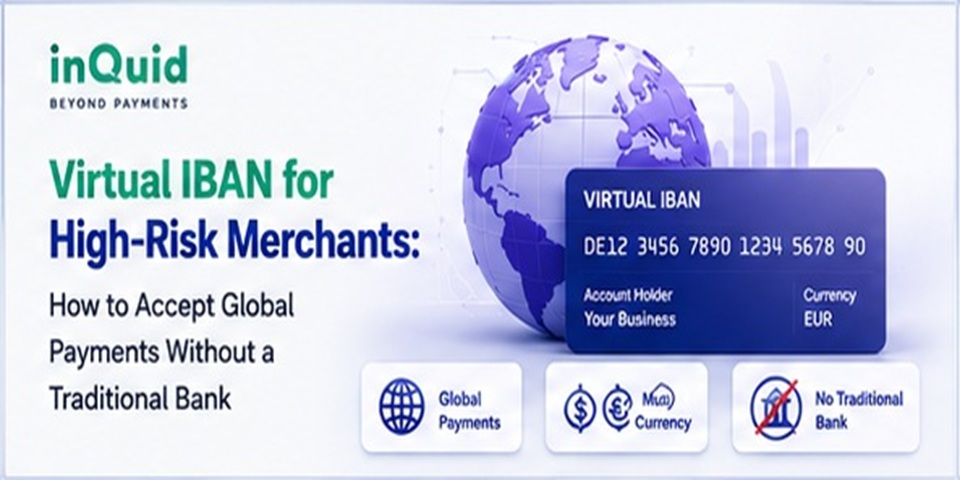
What Is a Virtual IBAN?
An IBAN — International Bank Account Number — is a standardised number used internationally to identify a specific bank account for the purpose of sending and receiving payments. Every European bank account has one. SWIFT payments reference them. SEPA transfers require them.
A virtual IBAN is an IBAN issued by a licensed electronic money institution (EMI) or payment institution, rather than a traditional bank. It functions identically for payment purposes: counterparties, customers, and card processors can send payments to it exactly as they would to a standard bank account. The funds are held in safeguarded accounts at partner banks on behalf of the EMI’s clients.
The critical difference is in who issues them. EMIs licensed under the E-Money Directive (EU) or the Electronic Money Regulations 2011 (UK) are not subject to the same risk-appetite constraints that lead traditional banks to refuse high-risk business accounts. Many EMIs are specifically built to serve fintech, payments, gaming, and other high-risk industry clients.
How Virtual IBANs Work for High-Risk Businesses
Receiving Payments
Your virtual IBAN works as your business account number. Card acquirers and payment processors settle their daily collections to it. B2B counterparties transfer via SWIFT. Customers in the EU send SEPA payments to it. UK customers send Faster Payments. Your virtual IBAN is the destination for all inbound flows.
For gaming operators and Forex brokers receiving thousands of transactions daily, some EMIs offer unique virtual IBANs per customer — a distinct IBAN for each depositing player or trader. Incoming payments are automatically matched to the correct customer account, eliminating manual reconciliation and reducing the risk of misapplied funds.
Sending Payments (Withdrawals and Payouts)
From your virtual IBAN account, you can initiate outbound payments to customers, suppliers, affiliates, and partner organisations. The payment types available depend on your provider: Faster Payments and CHAPS for UK recipients; SEPA and SEPA Instant for EU/EEA recipients; SWIFT for international transfers.
For Forex brokers, instant withdrawals to trader bank accounts are a key service differentiator — and a virtual IBAN account with SEPA Instant access makes same-day EUR withdrawals to European traders straightforward.
Multi-Currency Functionality
Most virtual IBAN providers for high-risk businesses support multiple currencies within a single account structure. GBP, EUR, USD, and other major currencies can be held separately, converted at near-interbank rates, and paid out in the recipient’s local currency. This is essential for globally operating gaming platforms, trading companies, and eCommerce merchants who receive in multiple currencies and pay suppliers or players in their local denominations.
Unique Virtual IBANs: The Power for High-Volume Operations
Standard business accounts give one IBAN for the whole business. Every incoming payment arrives in the same account, requiring manual or semi-automated reconciliation to match payments to customers or orders.
Unique (or dedicated) virtual IBANs assign a specific IBAN to each customer or transaction. When a player at an online casino deposits via bank transfer to their unique IBAN, the payment is automatically attributed to their player account. There is no ambiguity, no manual matching, and no risk of funds being applied to the wrong account.
For an iGaming platform with 50,000 active players, or a Forex broker with thousands of funded accounts, this automation is not just convenient — it is operationally necessary. The alternative, manually reconciling thousands of bank transfers against player accounts each day, is impractical at scale.
Regulatory Framework: Who Issues Virtual IBANs?
In the UK, virtual IBANs are issued by FCA-authorised Electronic Money Institutions under the Electronic Money Regulations 2011. There are hundreds of FCA-authorised EMIs; a smaller subset actively serve high-risk industry clients.
In the EU, EMI licences are granted by national competent authorities. Lithuania (Bank of Lithuania), Malta (MFSA), and the Netherlands (De Nederlandsche Bank) have become the preferred licensing jurisdictions for fintech-oriented EMIs, partly because of efficient authorisation processes and proportionate compliance frameworks.
In both the UK and EU, client funds held against virtual IBANs must be safeguarded — held in segregated accounts at regulated credit institutions, separate from the EMI’s own operating capital. This provides meaningful protection against the EMI’s insolvency.
Virtual IBAN vs Traditional Business Bank Account for High-Risk Merchants
| Aspect | Virtual IBAN (EMI) | Traditional Bank Account |
| Approval for high-risk industries | Available with correct provider | Typically declined |
| Onboarding time | 3–14 business days | 4–12 weeks |
| Multi-currency support | Standard | Limited |
| Unique IBAN per customer | Available with volume-focused EMIs | Not available |
| API access | Standard | Limited |
| Fund safeguarding | Regulatory requirement (E-Money Regs) | FSCS/DGS deposit protection |
| Account closure risk from industry | Low (purpose-built for high-risk) | High |
| Lending products | Not available | Available |
Use Cases by Industry
Forex and CFD Brokers
A virtual IBAN account is often the backbone of a Forex broker’s treasury operation. Traders fund their accounts via bank transfer to the broker’s virtual IBAN (or their own dedicated IBAN). Withdrawals are initiated programmatically through the EMI’s API. Balances in multiple currencies are managed within the same account structure, converted to base currency positions as needed. The entire operation runs without a traditional bank account.
Online Casino and iGaming Operators
For Malta MGA-licensed or Curaçao-licensed gaming operators, a virtual IBAN provides the banking infrastructure required to receive player deposits by bank transfer and execute withdrawals. The dedicated IBAN-per-player model eliminates deposit reconciliation overhead. SEPA Instant enables genuinely instant withdrawals to European player bank accounts — a significant player satisfaction and retention driver.
IPTV Service Providers
IPTV operators often struggle to maintain stable bank accounts due to their industry classification. A virtual IBAN from a compliant EMI provides stable, uninterruptible banking infrastructure for subscription billing, supplier payments, and revenue management.
Adult Content Platforms
Adult platforms rejected by traditional banks and major card processors have found virtual IBANs — combined with bank transfer payment initiation — to be a reliable, card-network-independent revenue channel. The absence of card network content rules means platforms are not subject to the periodic policy changes that have disrupted card-based monetisation in the adult industry.
How to Get a Virtual IBAN for Your High-Risk Business
The process with a reputable EMI provider typically involves:
Application — Business registration details, ownership structure, and description of business activities. Most EMIs require these upfront to screen applicants before requesting full KYC documentation.
KYC/KYB Documentation — Company incorporation documents, ultimate beneficial owner (UBO) identification (passport, proof of address), and evidence of any regulatory licences held (gaming, financial services). The more complete your documentation, the faster the process.
Business Verification — The EMI’s compliance team will review your business model, expected transaction volumes, and the jurisdictions you operate in. For licensed iGaming and Forex businesses, regulatory licence documentation significantly accelerates this stage.
Account Setup — On approval, your IBAN(s) are issued, API credentials are provided, and your account dashboard is activated.
Frequently Asked Questions
1. Is a virtual IBAN accepted by all card processors and acquirers for settlement?
Most high-risk card acquirers and payment processors are able to settle to EMI-issued IBANs. However, it is advisable to confirm with your specific acquirer before selecting an EMI. Some acquirers have preferred or approved bank list requirements, and a small number may require settlement to a traditional bank account.
2. Can I get a virtual IBAN if my business is licensed in Curaçao or Malta?
Yes. EMI providers assess the business on its own compliance merits — AML/KYC documentation and the nature of the business activity — rather than requiring the business to be incorporated in the same jurisdiction as the EMI. Curaçao and Malta-licensed gaming operators are common clients of UK and EU EMI providers. Your gaming licence is an asset in the onboarding process, not a barrier.
3. How are funds protected in a virtual IBAN account?
Under UK EMR 2011 and EU E-Money Directive, EMIs are required to safeguard client funds by holding them in accounts at regulated credit institutions, segregated from the EMI’s own funds. In the event of EMI insolvency, these funds are returned to clients. This is distinct from FSCS/DGS deposit insurance but provides meaningful protection.
4. Can I receive cryptocurrency into a virtual IBAN?
Standard virtual IBANs receive fiat currency only (GBP, EUR, USD, etc.). Some EMIs offer crypto-to-fiat conversion functionality — cryptocurrency sent to a specified wallet address is converted and credited to the fiat virtual IBAN. For native cryptocurrency account infrastructure, dedicated crypto-banking providers licensed under MiCA (EU) or the FCA crypto asset framework (UK) are the appropriate solution.
5. What transaction volume does a virtual IBAN account support?
Volume limits vary by provider and are typically determined during onboarding based on the business’s expected activity. Most EMIs servicing high-risk industries are built for high-volume operations and can accommodate monthly transaction volumes in the tens of millions of pounds or euros. Volume pricing tiers are common, with per-transaction costs reducing at higher volumes.
Inquid works with regulated EMI partners to provide virtual IBANs and banking infrastructure for high-risk merchants across the UK, EU, and global markets. Contact our team to discuss your specific requirements.