
Last Updated: 11 June 2026
Reading Time: 9 minutes
Author: Inquid Editorial Team
The high-risk merchants, the biggest problem with traditional payment processing is not the fees — it’s the fragility. Accounts get frozen. Rolling reserves lock up capital for six to twelve months. Card networks change their rules overnight. Processors terminate accounts without warning.
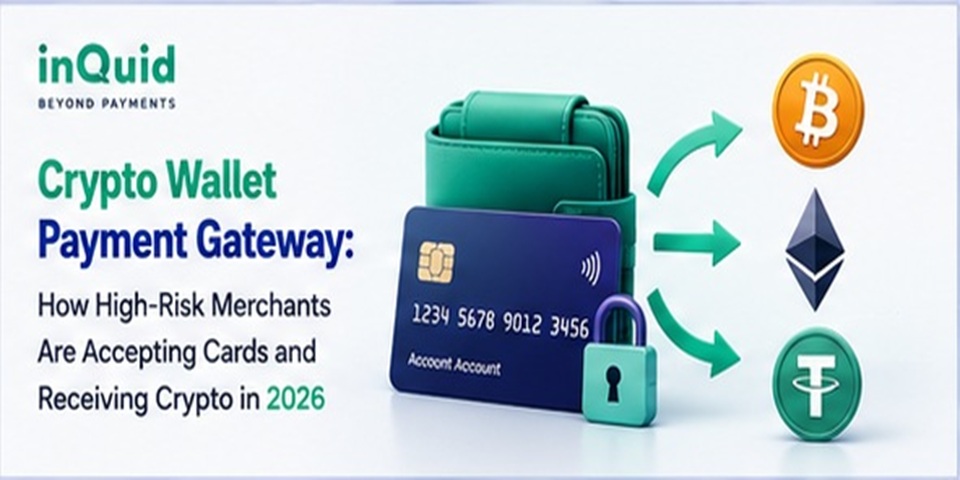
In 2026, a new category of payment infrastructure is solving this problem at its architectural level: the crypto wallet payment gateway. This is not a cryptocurrency checkout for crypto enthusiasts. It is a system where your customers pay with their ordinary Visa, Mastercard, Apple Pay, or Google Pay — and you, the merchant, receive USDT, USDC, or Bitcoin directly to your crypto wallet. No intermediary holding your money. No account to freeze. No rolling reserve. Settlement in minutes, around the clock.
What Is a Crypto Wallet Payment Gateway?
A crypto wallet payment gateway is a payment processing system that accepts standard fiat payment methods from customers — credit cards, debit cards, bank transfers, digital wallets — and converts the proceeds to cryptocurrency before settling directly to the merchant’s specified crypto wallet address.
The customer experience is entirely standard. They see a normal checkout with familiar payment options. No cryptocurrency terminology appears. No wallet addresses. No QR codes. No blockchain jargon. The customer pays in their local currency using a method they already use everywhere else.
Behind the scenes, the gateway processes the fiat card transaction through Visa/Mastercard payment rails, converts the net proceeds to the merchant’s chosen cryptocurrency (USDT, USDC, BTC, ETH, or others depending on the provider), and transfers the crypto to the merchant wallet — typically within minutes of transaction completion.
Why Crypto Settlement Solves the High-Risk Merchant Problem
No Fund Freezes
The defining vulnerability of traditional high-risk processing is that the processor holds the merchant’s money. Funds sitting in a processing account can be frozen instantly — without notice, without appeal, often for months. For a gaming platform or Forex broker, a frozen processing account is an existential event.
When a crypto wallet payment gateway settles directly to the merchant’s own crypto wallet, there is nothing to freeze. The cryptocurrency is in the merchant’s custody from the moment of settlement. The processor has no ongoing hold over it.
No Rolling Reserves
Rolling reserves — where 5% to 15% of transaction volume is withheld for 6–12 months as a risk buffer — are standard in high-risk card processing. For a merchant processing £500,000 per month, a 10% rolling reserve means £600,000 to £900,000 of working capital locked up at any given time.
Fiat-to-crypto gateways settle net of fees immediately, with no reserve withheld. The absence of rolling reserves alone represents a transformative improvement to cash flow for high-risk operations.
No Chargeback Exposure on the Crypto Settlement
While the fiat card transaction can still generate a chargeback at the card network level (this is a consumer right in card payment schemes), the crypto settlement itself to the merchant’s wallet is final and irrevocable. This changes the chargeback risk calculus: the merchant still manages chargebacks, but the funds are not sitting in a reversible processing account — they are already in the merchant’s custody in cryptocurrency form.
No Industry-Based Discrimination
Fiat-to-crypto gateways do not apply merchant category codes or card network industry restrictions to their crypto settlement infrastructure. A gaming platform, adult content site, Forex broker, and SaaS company all receive the same service at the same fee structure. The discrimination that makes card processing untenable for many high-risk businesses simply does not exist at this layer of the payment stack.
How a Crypto Wallet Payment Gateway Works: Technical Flow
- Customer checkout — The customer enters card details on a standard payment form at the merchant’s checkout. The experience is identical to any card-not-present transaction.
- Card authorisation — The gateway submits the transaction to the card network (Visa, Mastercard) through its acquiring bank. Standard fraud detection and card verification apply. Strong Customer Authentication (3DS/SCA) is applied where required.
- Fiat collection — On authorisation, the fiat amount is collected from the customer’s card account.
- Conversion — The gateway converts the net fiat proceeds (after processing fee deduction) to the merchant’s chosen cryptocurrency at the prevailing market rate.
- Crypto wallet settlement — The converted cryptocurrency is transferred to the merchant’s specified wallet address — typically USDT (Tether) on TRC-20 or ERC-20 network, USDC, Bitcoin, or Ethereum.
- Confirmation — The merchant receives confirmation via webhook, dashboard notification, or API callback. The transaction is verifiable on-chain.
Settlement from transaction to wallet typically takes minutes for stablecoin settlements on efficient blockchain networks.
Cryptocurrency Settlement Options for Merchants
USDT (Tether) and USDC (USD Coin) — Stablecoins
For most high-risk merchants, stablecoin settlement is the preferred option. USDT and USDC are pegged to the US dollar — 1 USDT = $1.00 — which means the merchant receives a predictable USD-equivalent amount without cryptocurrency price volatility. Stablecoin transaction volume hit approximately $33 trillion in 2025, a figure that underscores the depth and liquidity of these settlement instruments.
USDT on the TRON network (TRC-20) is widely used due to very low transaction fees (under $1 per transfer) and near-instant confirmation times. USDC on Ethereum (ERC-20) or Solana is preferred by merchants who interact primarily with Ethereum-based DeFi infrastructure.
Bitcoin and Ethereum
Some merchants prefer settlement in BTC or ETH, particularly those operating in cryptocurrency-adjacent industries or those who wish to hold cryptocurrency as a treasury asset. The price volatility of Bitcoin and Ethereum means the USD-equivalent value at settlement may differ from the value at the time of the customer’s payment — this is both a risk and, in bull market conditions, an opportunity.
Choosing a Stablecoin Network
Merchants should match their stablecoin network to their downstream usage. If the stablecoin will be converted back to fiat via a licensed exchange, USDC on Ethereum has the widest fiat off-ramp availability. If the primary use is paying suppliers or partners who accept crypto directly, TRC-20 USDT has the lowest transaction cost for high-frequency disbursements.
Crypto Wallet Payment Gateways for Specific Industries
Forex and CFD Brokers
Trading platforms can use crypto wallet settlement to eliminate the rolling reserve problem entirely. Trader deposits via card → instant settlement to the broker’s USDT wallet → conversion to operational fiat as needed. Withdrawals can also be offered as crypto payouts, which an increasing proportion of retail traders actively prefer.
iGaming and Online Casinos
Casino operators processing in the UK, EU, or offshore markets benefit from crypto settlement’s immunity to card network chargeback-reversal cycles. Player deposits settle as stablecoins; operator treasury holds in USDC or USDT until periodic conversion to EUR or GBP for operational expenses.
Adult Content Platforms
The adult industry has faced the most aggressive card network policy enforcement in recent years. Fiat-to-crypto settlement removes card network content policies from the revenue equation entirely. Platforms accepting Visa/Mastercard and settling in USDC operate outside the card network’s ability to restrict their business.
IPTV Providers
IPTV operators benefit from the payment stability that crypto settlement provides — no sudden acquirer termination based on industry classification, and no rolling reserves tying up subscriber revenue.
Legal and Compliance Considerations in 2026
The regulatory landscape for crypto payments has clarified significantly in 2026. In the EU, the Markets in Crypto-Assets (MiCA) regulation provides a comprehensive framework for cryptocurrency-related services. In the USA, the GENIUS Act has established clearer regulatory pathways for stablecoin issuers and payment providers. In the UK, the FCA’s crypto asset registration framework requires providers offering crypto payment services to be registered.
Merchants using fiat-to-crypto gateways should confirm their provider holds appropriate regulatory registration in relevant markets, and understand their own reporting obligations for cryptocurrency receipts under applicable tax and accounting rules.
Frequently Asked Questions
1. Do my customers need to understand cryptocurrency to pay via a crypto wallet payment gateway?
No. The customer experience is entirely standard — they pay with their Visa, Mastercard, Apple Pay, or Google Pay as normal. There is no cryptocurrency terminology, no wallet requirement, and no blockchain interaction on the customer side. The crypto conversion and settlement happens entirely on the merchant side, after the customer’s fiat card transaction is completed.
2. Is crypto wallet settlement stable in value, or does it fluctuate?
This depends on the cryptocurrency chosen for settlement. Stablecoins (USDT, USDC) are pegged to the US dollar and maintain a consistent value — 1 USDT = $1.00 regardless of broader cryptocurrency market conditions. Merchants who settle in USDT or USDC receive a predictable USD-equivalent amount. Settlement in Bitcoin or Ethereum carries price volatility risk.
3. How does a crypto wallet payment gateway handle chargebacks?
Fiat card transactions processed through a crypto wallet gateway are still subject to card network chargeback rules — a customer can dispute a card transaction, and the chargeback process applies at the card level. However, because the settlement to the merchant’s crypto wallet is immediate and independent of the processing account, the merchant is in a structurally stronger position than with traditional processing (where the funds sit in a reversible account). Chargeback dispute management is still required and should be built into the merchant’s operations.
4. Is receiving cryptocurrency as a merchant legal in the UK, EU, and USA?
Yes. Accepting cryptocurrency as a payment method is legal in the UK, EU, and USA, subject to applicable tax treatment. In the UK, HMRC treats cryptocurrency receipts as taxable income at the market value at the time of receipt. In the EU, MiCA provides a comprehensive regulatory framework. In the USA, the IRS treats cryptocurrency as property. Merchants should consult their accountant or tax adviser to ensure correct reporting of crypto settlement receipts.
5. Can I convert my crypto settlement back to fiat?
Yes. Stablecoin settlements (USDT, USDC) can be converted to fiat currency (GBP, EUR, USD) through licensed cryptocurrency exchanges or OTC desks. Conversion fees typically range from 0.1% to 0.5%. Some crypto wallet gateway providers offer integrated fiat off-ramp services, allowing merchants to set automated conversion thresholds — for example, converting USDT to EUR daily at a specified time.
Inquid offers crypto wallet payment gateway solutions for high-risk merchants globally. Our fiat-to-crypto settlement infrastructure allows you to accept card payments from customers while receiving USDT, USDC, or other cryptocurrencies directly to your wallet. Contact us to get started.