
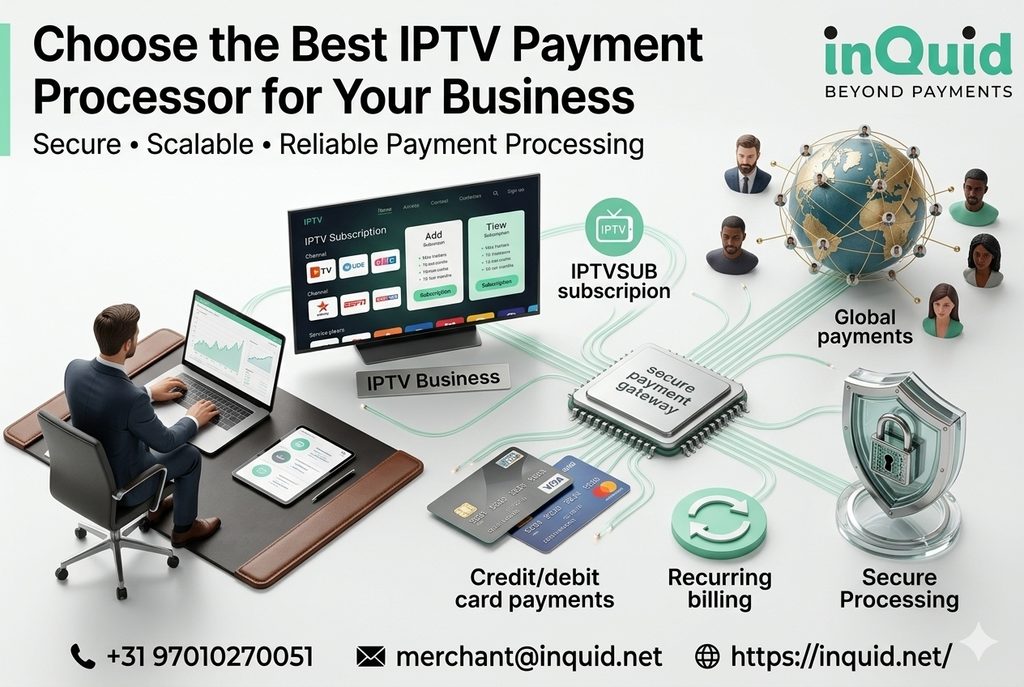
Choosing the right IPTV payment processor is an important decision for businesses operating subscription-based streaming services. A suitable processor can help manage card payments, recurring billing, international transactions, payment security, refunds, and chargebacks while creating a smoother checkout experience for customers.
However, choosing an IPTV payment processor should involve more than comparing transaction fees. Businesses should consider their business model, target markets, subscription structure, payment methods, risk controls, integration requirements, compliance obligations, and the provider’s underwriting criteria.
This guide explains what IPTV businesses should evaluate when comparing payment processors, merchant accounts, and payment gateways.
What Is an IPTV Payment Processor?
An IPTV payment processor is a payment service that helps a business accept and process electronic payments from customers.
In a typical transaction, the processor works with other parts of the payment ecosystem, including the merchant’s payment gateway, acquiring institution, card networks, and issuing bank.
For an IPTV subscription business, the payment infrastructure may support:
- Credit and debit card payments
- Recurring subscription payments
- Digital wallets
- Alternative payment methods
- International transactions
- Multi-currency payments
- Refunds
- Chargeback management
- Fraud monitoring
- Payment reporting and reconciliation
The exact services available depend on the provider and the merchant’s eligibility.
It is also important to distinguish between a payment processor, payment gateway, and merchant account. A gateway generally facilitates the secure transmission of payment information, while processing and acquiring services handle other parts of the transaction lifecycle. A merchant account is an account structure used to receive funds from card transactions.
For some businesses, these services may be bundled together by a payment service provider.
Why Choosing the Right IPTV Payment Processor Matters
IPTV businesses often use subscription or recurring-revenue models. That means payment performance can directly affect the customer experience.
A failed payment can prevent a legitimate customer from renewing a subscription. At the same time, weak fraud controls can expose a business to unauthorized transactions and disputes.
The right payment infrastructure should therefore support both payment acceptance and payment operations.
Important considerations include:
1. Payment acceptance
The processor should support the payment methods relevant to the markets and customers the business serves.
2. Recurring billing
Subscription businesses need reliable tools for scheduled payments, renewals, failed-payment handling, and subscription changes.
Visa’s recurring-billing documentation describes recurring payments as transactions processed at predetermined intervals for services such as subscriptions. (Visa)
3. Payment security
Payment information must be handled securely. Businesses should understand how their payment architecture aligns with applicable security requirements, including PCI DSS where relevant.
The PCI Security Standards Council maintains PCI DSS resources, including the current PCI DSS v4.0.1 documentation.
4. International payments
If an IPTV business serves customers in multiple countries, currency support, payment-method availability, settlement, and cross-border processing become important considerations.
5. Risk and compliance
Payment providers have their own onboarding, underwriting, monitoring, and acceptable-use requirements. Businesses should understand these requirements before applying.
Key Factors When Choosing an IPTV Payment Processor
1. Understand Your IPTV Business Model
Before comparing processors, define exactly how your business operates.
Ask:
- Do you sell monthly subscriptions?
- Do you offer annual plans?
- Are payments one-time or recurring?
- Which countries do you serve?
- Which currencies do customers use?
- What is your average transaction value?
- What is your monthly transaction volume?
- Do you offer refunds?
- Do you sell directly to consumers or businesses?
- Do you operate a streaming platform, software service, reseller model, or another legally permitted business model?
These details can influence the type of payment infrastructure you need.
An IPTV business should also make sure its underlying content and distribution activities comply with applicable laws, licenses, contracts, and provider policies.
2. Check Merchant Account Requirements
An IPTV merchant account allows eligible businesses to process card payments through acquiring infrastructure.
Not every provider accepts every type of IPTV-related business.
During underwriting, providers may request information such as:
- Company registration documents
- Ownership information
- Website details
- Product or service descriptions
- Terms and conditions
- Refund policy
- Privacy policy
- Processing history
- Bank statements
- Transaction projections
- Customer acquisition information
- Evidence relating to business operations
Providing accurate information can make the onboarding process clearer and help ensure that the proposed processing arrangement matches the actual business model.
3. Evaluate Recurring Payment Capabilities
For subscription-based IPTV businesses, recurring payments are often a core requirement.
Look for functionality that can support:
- Automated subscription billing
- Billing schedules
- Payment retries
- Subscription upgrades
- Subscription cancellations
- Expired-card handling
- Customer payment-method updates
- Transaction notifications
- Recurring payment reporting
Visa notes that recurring-billing solutions can support subscription and installment plans and can use tokenized payment credentials rather than requiring sensitive payment information to be stored directly by the merchant.
This is particularly relevant for businesses that want to reduce manual renewal activity.
4. Review Supported Payment Methods
Cards may be important, but international customers can have different payment preferences.
Depending on the target market and processor, an IPTV business might consider:
- Visa
- Mastercard
- Digital wallets
- Bank-based payment methods
- Local payment methods
- Alternative payment methods
The objective should not necessarily be to offer every possible payment method.
Instead, select methods that match your customer base, geography, transaction values, and operational requirements.
A useful real-world reference is Netflix. Its official help center lists credit and debit cards, virtual cards in selected markets, prepaid cards, gift cards, PayPal, and partner billing arrangements among its payment options, with availability varying by market.
This illustrates an important point for IPTV businesses: payment strategy can be broader than card acceptance alone.
5. Consider International and Multi-Currency Processing
If your customers are located across different countries, international payment processing can become an important part of your infrastructure.
Before selecting an IPTV payment processor, check:
- Supported currencies
- Settlement currencies
- Cross-border transaction availability
- Local payment methods
- Foreign-exchange costs
- Settlement timelines
- Geographic restrictions
- Reporting capabilities
Currency support should match the markets you actually serve.
Businesses should also understand applicable tax, consumer-protection, privacy, and financial regulations in their target jurisdictions.
6. Assess Fraud Prevention and Payment Security
Digital subscription businesses need appropriate controls to identify suspicious transactions without unnecessarily blocking legitimate customers.
A processor may provide tools for:
- Transaction monitoring
- Risk scoring
- Customer authentication
- 3-D Secure
- Velocity checks
- Address verification
- Card security-code checks
- Device or behavioral signals
- Manual transaction review
Mastercard describes security solutions aimed at reducing risks such as chargebacks, cyberattacks, and identity theft, including transaction-verification capabilities.
The specific tools available will vary by processor.
Businesses should also understand which security responsibilities remain with the merchant and which are handled by the payment provider.
7. Examine Chargeback Management
Chargebacks can create financial costs and operational work.
A processor should provide clear information about:
- Chargeback notifications
- Response deadlines
- Evidence submission
- Dispute reason codes
- Representment processes
- Reporting
- Fees
Merchants can also reduce avoidable disputes by making subscription terms clear.
For example, customers should understand:
- The subscription price
- Billing frequency
- Renewal conditions
- Cancellation procedure
- Refund policy
- Billing descriptor
Clear communication can help reduce misunderstandings around recurring charges.
8. Review Integration Options
Your payment processor should fit your technology stack.
Depending on the business, integration may be available through:
- Hosted checkout
- Payment links
- APIs
- Plugins
- SDKs
- E-commerce integrations
- Recurring billing APIs
Ask whether the integration supports the features your business actually needs.
A technically sophisticated payment platform is not necessarily useful if implementation is difficult or requires extensive development for basic subscription functionality.
9. Compare Pricing Beyond the Headline Rate
Payment processing fees can include more than a percentage charged on each transaction.
Depending on the provider, businesses may encounter:
- Transaction fees
- Monthly fees
- Gateway fees
- Chargeback fees
- Refund fees
- Cross-border fees
- Currency-conversion costs
- Rolling reserves
- Minimum processing requirements
- Setup or onboarding fees
A processor offering a lower headline transaction rate may not necessarily produce the lowest overall cost.
The better approach is to calculate the total cost of payment processing based on your expected transaction profile.
IPTV Payment Processor Comparison Checklist
| Factor | What to Evaluate | Why It Matters |
| Business eligibility | Industry and business-model requirements | Determines whether the processor can onboard the business |
| Merchant account | Dedicated or integrated account structure | Supports card transaction settlement |
| Payment gateway | Checkout and transaction connectivity | Connects the customer payment experience with processing |
| Recurring billing | Automated subscription payments | Important for monthly or annual plans |
| Payment methods | Cards, wallets, local methods | Helps serve different customer preferences |
| International processing | Countries and currencies supported | Important for global IPTV businesses |
| Fraud controls | Risk tools and authentication | Helps manage unauthorized transactions |
| Chargebacks | Alerts, evidence, dispute tools | Helps manage payment disputes |
| Integration | API, hosted checkout, plugins | Determines implementation complexity |
| Reporting | Transaction and settlement data | Supports reconciliation and analysis |
| Pricing | Processing and additional fees | Helps estimate total payment cost |
| Compliance | Security and regulatory requirements | Supports responsible payment operations |
| Support | Technical and payment support | Useful when transactions fail or issues arise |
Pros and Cons of Using a Specialized IPTV Payment Solution
Pros
- Payment infrastructure can be aligned with subscription requirements.
- Recurring billing can automate customer renewals.
- International payment capabilities can support global expansion.
- Fraud tools can help monitor suspicious transactions.
- Payment reporting can improve reconciliation.
- Multiple payment methods can support different customer preferences.
Cons
- Some providers may have strict eligibility requirements.
- Processing costs can vary significantly by business profile.
- Additional compliance documentation may be required.
- Chargebacks can create financial and administrative costs.
- Some payment methods may not be available in every country.
- Integration may require technical development.
These factors should be evaluated against the actual needs and risk profile of the business.
Real-World Examples: What Subscription Businesses Can Teach IPTV Providers
Real-world subscription platforms demonstrate why payment infrastructure needs to extend beyond a basic checkout page.
- Netflix: Recurring Subscription Payments
Netflix automatically charges members on their billing date and provides multiple payment options depending on market. Its help center also explains how customers can update payment methods and address payment failures.
For IPTV businesses, the lesson is straightforward: subscription payment infrastructure needs to account for recurring billing, payment-method management, failed payments, and customer communication.
- SonyLIV: Multiple Payment Routes
SonyLIV states that its subscription service supports payment through app stores, PayPal, and credit/debit cards, while auto-renewal depends on whether the selected payment method supports it.
This demonstrates how subscription businesses can combine different payment channels depending on customer environment and payment method.
- IPTV Checkout Example
A publicly accessible IPTV checkout page from Roja Digital displays multiple payment gateways, including card, UPI, wallets, and bank-based options, demonstrating how an IPTV seller can present several payment routes during checkout.
This is an example of payment-method diversification rather than a recommendation of any particular provider.
Compliance and Security Considerations
Payment processing should always be considered alongside compliance.
For card payments, businesses should review applicable PCI DSS requirements and understand their responsibilities within the payment environment. The PCI Security Standards Council provides official documentation and resources for payment-data security.
For businesses operating in the UK, the FCA provides information about payment service providers and explains that non-bank payment providers such as electronic money institutions and payment institutions are subject to authorization or registration requirements depending on their activities. Businesses can use the FCA Financial Services Register to check authorization status.
The FCA also notes that firms providing regulated payment services as a regular business activity may need appropriate authorization or registration.
This does not mean every IPTV business needs FCA authorization. The applicable requirements depend on what the business actually does and where it operates.
For this reason, IPTV businesses should obtain appropriate legal or compliance advice when entering regulated markets or changing their payment model.
Frequently Asked Questions
- What is an IPTV payment processor?
An IPTV payment processor is a payment service that enables an eligible IPTV business to accept and process electronic customer payments. Depending on the provider, services may include card processing, recurring billing, payment gateways, fraud tools, reporting, and international payment support.
- Can IPTV businesses accept recurring payments?
Yes, where the business, payment method, and processor support recurring transactions. Subscription platforms commonly use recurring billing, and Visa provides recurring-billing capabilities for subscription and other scheduled payments. (Visa)
- What is the difference between an IPTV payment gateway and a payment processor?
A payment gateway generally facilitates the secure transmission of payment information between the checkout environment and the payment ecosystem. Payment processing covers the broader transaction-processing function. Some providers offer both gateway and processing services as part of one solution.
- Do IPTV businesses need a merchant account?
A merchant account or equivalent acquiring arrangement may be required for card acceptance, depending on the payment structure and provider. Requirements vary by business and payment provider.
- Can an IPTV business accept international payments?
Potentially, if its payment provider supports the relevant countries, currencies, payment methods, and business model. International processing should also be evaluated against applicable legal, tax, consumer-protection, and payment-network requirements.
- How can IPTV businesses reduce payment failures?
Businesses can review failed-payment data, provide suitable payment methods, use recurring-billing tools, keep customer payment information securely tokenized where supported, and provide clear payment-update processes.
- How can IPTV businesses manage chargebacks?
Start with transparent subscription terms, recognizable billing descriptors, clear refund and cancellation policies, customer support, transaction records, and appropriate dispute-management procedures.
- What should businesses look for in an IPTV payment gateway?
Key considerations include supported payment methods, recurring billing, international processing, fraud controls, security, API capabilities, reporting, settlement, pricing, and provider eligibility.
- Is the cheapest IPTV payment processor always the best option?
No single pricing model is appropriate for every business. A processor should be evaluated based on total cost, payment performance, supported markets, security, recurring billing, chargeback handling, integration, and business eligibility.
How to Choose the Right IPTV Payment Processor: Final Checklist
Before making a decision, confirm that the provider:
- Supports your actual business model.
- Accepts your target markets.
- Supports the currencies you need.
- Provides suitable recurring-payment capabilities.
- Offers relevant payment methods.
- Provides appropriate fraud and security controls.
- Has a clear chargeback process.
- Integrates with your technology stack.
- Provides transparent pricing.
- Explains settlement and reserve requirements.
- Has clear onboarding requirements.
- Meets applicable payment and regulatory requirements.
The goal is not simply to find a payment provider that can process a transaction. The goal is to build a payment environment that can support the entire customer lifecycle.
Conclusion
Choosing the best IPTV payment processor for your business requires a detailed evaluation of payment acceptance, recurring billing, security, international processing, customer experience, compliance, integration, and total cost.
An IPTV business serving a small domestic customer base may have very different requirements from an international subscription platform processing transactions across several currencies.
There is therefore no universal payment setup that fits every IPTV business.
Start by defining your business model and target markets. Then compare processors based on the features and requirements that matter most to your operation.
A reliable payment infrastructure can help create a smoother subscription experience while giving businesses better visibility into transactions, billing, fraud, refunds, and chargebacks.
For businesses evaluating IPTV payment processing, Inquid provides payment infrastructure solutions including merchant accounts, payment processing, payment gateways, and international payment solutions. Businesses can review their requirements and discuss an appropriate payment setup based on their markets, transaction model, and operational needs.
Ready to review your payment infrastructure? Contact Inquid to discuss your business requirements and available payment solutions.
Authoritative Resources
- PCI Security Standards Council – Document Library
https://www.pcisecuritystandards.org/document_library/ - Visa – Recurring Billing
https://www.visa.com/en-us/products/recurring-billing - Mastercard – Security Solutions (Fintech)
https://www.mastercard.com/global/en/business/industry-segment/fintech/solutions/security.html - FCA – Using Payment Service Providers
https://www.fca.org.uk/consumers/using-payment-service-providers - FCA – Payment Services Regulations & E-Money Regulations
https://www.fca.org.uk/firms/payment-services-regulations-e-money-regulations