Introduction
Choosing the right IPTV merchant account is an important decision for businesses that rely on subscription payments and recurring revenue. The right payment setup can help an IPTV company accept card payments, manage recurring subscriptions, reduce payment friction, handle disputes, and expand into international markets.
However, not every merchant account provider is suitable for every IPTV business. IPTV businesses can receive additional underwriting scrutiny because the category covers different types of streaming and content-distribution models. Payment providers may consider factors such as content licensing, business structure, geography, transaction history, chargebacks, and compliance requirements when assessing eligibility.
An IPTV company should therefore consider its business model, content rights, customer locations, transaction volume, subscription structure, payment methods, fraud exposure, chargeback history, and compliance obligations before selecting a provider.
The right solution is not necessarily the provider with the lowest advertised processing fee. Businesses should look for a payment partner that supports their current requirements and can scale as their subscriber base grows.
This guide explains what an IPTV merchant account is, why IPTV businesses may receive additional underwriting scrutiny, what features matter most, how much payment processing can involve, which documents providers may request, and seven payment providers IPTV businesses can research.
What Is an IPTV Merchant Account?
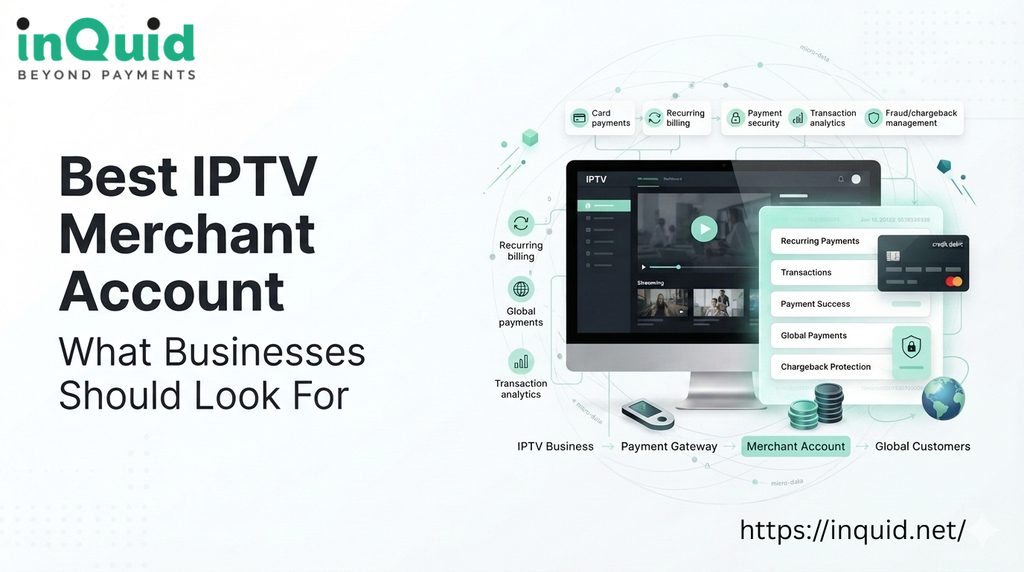
An IPTV merchant account is a business payment account that allows an eligible IPTV company to accept electronic payments from customers. It typically works alongside a payment gateway and payment processor.
A simplified transaction flow looks like this:
Customer → IPTV checkout → Payment gateway → Processor/acquirer → Card network → Customer’s bank
For a subscription-based IPTV company, the payment infrastructure needs to handle more than a one-time card transaction.
It may need to support:
- Monthly subscriptions
- Annual subscriptions
- Recurring card payments
- Payment retries
- Refunds
- Multiple currencies
- International transactions
- Fraud screening
- Chargeback management
- Transaction reporting
The exact setup depends on the provider, business model, geography, risk profile, and payment technology being used.
Why IPTV Businesses May Receive Additional Underwriting Scrutiny
Not every IPTV business has the same risk profile.
A legitimate IPTV company with appropriate content rights can have a very different business model from a service that distributes content without the necessary authorization.
Because payment providers must manage financial, legal, regulatory, and card-network risks, they may request additional information when reviewing an IPTV business.
Potential areas of review include:
- Content licensing
- Distribution agreements
- Business ownership
- Target markets
- Customer acquisition methods
- Transaction history
- Chargeback levels
- Refund policies
- Website disclosures
- Expected processing volume
- Products and services being sold
This means an IPTV business may encounter additional underwriting questions even if it has a legitimate business model.
Being transparent during onboarding is critical. Businesses should accurately describe what they sell, how content is sourced, where customers are located, and how subscriptions are billed.
Content Licensing and Business Documentation
For IPTV businesses, payment underwriting may involve more than standard company verification.
Depending on the provider and business model, an IPTV company may be asked to demonstrate that it has the appropriate rights or licenses to distribute the content it sells.
Potential documentation can include:
- Content licensing agreements
- Distribution agreements
- Contracts with content owners
- Business registration documents
- Government-issued identification
- Website and service descriptions
- Refund and cancellation policies
- Terms and conditions
- Bank statements
- Previous processing statements
- Expected monthly processing volume
- Average transaction value
- Customer acquisition information
Not every provider requires every document. Requirements can vary based on jurisdiction, business model, transaction volume, and underwriting policy.
Businesses should never misrepresent their services during an application. Accurate information can help prevent avoidable approval problems, account reviews, or payment interruptions later.
Why IPTV Businesses Need the Right Payment Infrastructure
For an IPTV company, payment processing is closely connected to revenue.
Consider a business with 10,000 active subscribers. If recurring payments fail unnecessarily, even a small percentage of failed transactions can create meaningful revenue leakage.
Payment failures can result from:
- Expired cards
- Insufficient funds
- Incorrect payment information
- Bank declines
- Fraud controls
- Technical problems
- Unsupported payment methods
- International transaction restrictions
A strong payment setup helps businesses identify and manage these issues.
The goal is a payment experience that is:
Secure + reliable + convenient + scalable
What Should You Look For in an IPTV Merchant Account?
1. Business Model Compatibility
The first question is whether the provider supports your specific business model and evaluates IPTV businesses based on their actual activities.
Before applying, clearly explain:
- What your company sells
- How content is sourced and licensed
- How customers purchase
- Subscription structure
- Average transaction value
- Target countries
- Expected monthly volume
- Refund policy
- Customer acquisition channels
Transparent information makes underwriting more straightforward and helps the provider determine whether its services fit your business.
2. Recurring Billing
For subscription-based businesses, recurring billing is one of the most important features.
An effective IPTV payment processing setup should support recurring transactions and subscription management.
Depending on the provider, relevant features may include:
- Automated recurring payments
- Subscription schedules
- Payment retries
- Expired-card management
- Customer billing profiles
- Refunds
- Subscription cancellation
- Upgrades and downgrades
- Payment notifications
For example, if an IPTV customer’s card expires during a subscription, the business may lose that subscriber unless there is a process for updating payment information or recovering the failed payment.
Reliable recurring billing can therefore help protect predictable subscription revenue.
3. Payment Gateway Integration
An IPTV merchant account generally works with a payment gateway that securely transfers transaction information.
When evaluating an IPTV payment gateway, check whether it supports the technology your business uses.
Potential integration options include:
- Hosted checkout
- API integration
- Payment links
- Plugins
- Subscription APIs
- Tokenized payments
- Webhooks
- Customer billing portals
The easier the integration, the easier it can be to manage payments without unnecessary technical complexity.
Security should also be considered during implementation. PCI Security Standards Council guidance makes clear that outsourcing payment processing does not automatically remove the merchant’s responsibilities. Merchants still need to understand shared responsibilities and oversee relevant third-party providers.
4. Payment Security
Payment security should be a priority for every IPTV business accepting card payments.
PCI DSS establishes requirements designed to protect payment account data.
Relevant areas include:
- Secure payment environments
- Access controls
- Authentication
- Vulnerability management
- Monitoring
- Security testing
- Protection of payment data
Businesses should ask potential providers:
- What security controls are included?
- Is tokenization available?
- Is 3-D Secure supported?
- What PCI responsibilities remain with the merchant?
- How is sensitive payment information handled?
- What fraud monitoring is available?
- How can PCI compliance responsibilities be documented?
The PCI Security Standards Council’s PCI DSS resources provide current information about the standard and its requirements. PCI SSC also explains that merchants using third-party service providers should perform appropriate due diligence, maintain relevant agreements, and monitor provider compliance as required.
5. Fraud Prevention
Online subscription businesses can face fraudulent transactions and account abuse.
A suitable payment solution may provide:
- Risk scoring
- Transaction monitoring
- Velocity checks
- 3-D Secure
- Address verification
- Device intelligence
- IP analysis
- Custom risk rules
- Suspicious transaction alerts
Fraud prevention needs to be balanced carefully.
If controls are too weak, fraudulent transactions can increase.
If controls are too aggressive, legitimate customers can be declined.
The objective is to reduce fraud while maintaining a healthy authorization rate.
6. Chargeback Management
Chargebacks are another important consideration when selecting an IPTV merchant account provider.
Subscription businesses may receive disputes because a customer:
- Forgot they subscribed
- Did not recognize the billing descriptor
- Claims they cancelled
- Disputes an unfamiliar transaction
- Claims a transaction was unauthorized
- Expected a refund
Clear subscription terms and customer communication can reduce avoidable disputes.
Businesses should maintain accurate records of:
- Transaction dates
- Customer communications
- Subscription agreements
- Cancellation requests
- Refunds
- Service information
- Payment confirmations
Visa and Mastercard publish rules and resources relating to payment transactions and disputes. Businesses should work with their acquiring and processing partners to understand the rules and evidence requirements applicable to their transactions.
7. International Payment Support
Many IPTV companies serve customers internationally.
If your business targets customers in multiple countries, evaluate the provider for:
- International cards
- Multiple currencies
- Cross-border processing
- Local payment methods
- Settlement options
- Currency conversion
- Regional risk management
For example, a UK-based IPTV company with customers across Europe, North America, and Asia may find a domestic-only payment setup limiting as it expands.
Confirm country, currency, payment-method, and settlement support before entering a new market.
8. Transparent Pricing
Processing rates matter, but the advertised transaction fee is only one part of the total cost.
Compare:
- Transaction fees
- Gateway fees
- Monthly fees
- Setup fees
- Refund fees
- Chargeback fees
- International processing fees
- Currency conversion costs
- Reserve requirements
- Minimum monthly commitments
- Termination fees
A provider with a higher transaction rate can sometimes offer better overall value if its payment infrastructure, support, and capabilities better match the business.
The better comparison is:
Total payment cost + reliability + features + support + scalability
9. Settlement and Cash Flow
Settlement timing matters because IPTV businesses need predictable access to revenue.
Before selecting a provider, ask:
- When are funds settled?
- Which currencies can be settled?
- Are reserves required?
- What happens during compliance reviews?
- What are the settlement conditions?
- Are processing limits imposed?
- How are reserve releases handled?
Understanding these terms before signing an agreement helps businesses plan cash flow more effectively.
For businesses receiving additional underwriting scrutiny, it is particularly important to understand reserve and settlement provisions before processing begins.
10. Scalability
A payment solution should support business growth.
Consider:
- Current subscriber count
- Expected subscriber growth
- Monthly transaction volume
- Average transaction value
- International sales
- Number of currencies
- Subscription plans
A provider that works for a startup may not necessarily be the right solution for an IPTV company processing significantly higher volumes.
Ask providers whether their infrastructure and account structure can support your projected growth over the next 12–24 months.
How Much Does an IPTV Merchant Account Cost?
There is no universal price for an IPTV merchant account.
The cost can depend on:
- Transaction volume
- Average transaction value
- Business history
- Chargeback history
- Geography
- Processing currencies
- Payment methods
- Business model
- Underwriting risk
- Settlement requirements
Potential costs can include:
- Transaction processing fees
- Gateway fees
- Monthly account fees
- Chargeback fees
- Refund fees
- Cross-border processing fees
- Currency conversion costs
- Rolling reserves
- Minimum processing commitments
- Setup or integration fees
Rather than choosing the provider with the lowest advertised rate, calculate the expected total cost of payment processing.
Ask every shortlisted provider for a complete pricing breakdown before making a decision.
Payment Providers IPTV Businesses Can Research
There is no universal best IPTV merchant account for every business.
The following providers represent different approaches to payment processing. Some focus on merchant accounts or specialist payment processing, while others provide broader payment infrastructure.
Provider availability, supported industries, pricing, geographic coverage, underwriting, and product capabilities can change. IPTV businesses should confirm current eligibility and terms directly with each provider before applying.
1. Inquid
Inquid provides merchant account and payment-processing solutions for businesses with different payment requirements, including specialist and higher-risk payment needs.
For an IPTV company, relevant areas to evaluate include:
- IPTV merchant account solutions
- Payment processing
- Payment gateway integration
- Recurring billing
- International payments
- Multi-currency processing
- Fraud and risk management
- Chargeback management
- Scalable payment infrastructure
For an IPTV business, an important part of the onboarding process is clearly explaining its content model, licensing position, target countries, transaction volume, and payment requirements.
The business should confirm the exact products and services available to it before proceeding.
2. WebPays
WebPays can be considered by IPTV businesses researching merchant services and payment-processing alternatives.
An IPTV company evaluating WebPays should examine:
- IPTV business-model eligibility
- Payment gateway capabilities
- Recurring billing
- Supported payment methods
- International processing
- Transaction limits
- Settlement terms
- Pricing
- Customer support
Businesses should confirm current IPTV eligibility and terms directly with the provider.
3. PayCly
PayCly offers payment gateway and merchant-account solutions that businesses can evaluate when researching specialist payment processing.
For IPTV companies, relevant evaluation criteria include:
- IPTV payment gateway compatibility
- Recurring subscription payments
- Card processing
- Payment methods
- International transactions
- Fraud controls
- Chargeback processes
- Integration capabilities
The provider should be asked specifically about the business’s content model and licensing during the underwriting process.
4. Boxchrge
Boxchrge can be included in a provider comparison for IPTV businesses researching alternatives to mainstream payment platforms.
Businesses should evaluate:
- IPTV business eligibility
- Payment gateway integration
- Card processing
- Recurring payments
- Supported markets
- Transaction limits
- Pricing
- Settlement arrangements
- Customer support
Because publicly available information about IPTV-specific terms may be limited, businesses should verify company details, current services, and eligibility directly before applying.
5. Stripe
Stripe provides payment infrastructure, APIs, subscription billing, and other payment services for eligible businesses.
Stripe’s current public restricted-business materials state that restricted categories may require additional due diligence, and Stripe can request information such as relevant licenses or additional details about the business model. Stripe also states that approval is specific to its services and may be modified or revoked under its terms.
For an IPTV business, relevant areas to evaluate include:
- Online card payments
- Subscription billing
- Recurring payments
- APIs
- Payment links
- Fraud prevention
- International payment capabilities
An IPTV business should not assume automatic approval or automatic rejection. It should review Stripe’s current restricted-business requirements and confirm eligibility based on its specific business model.
6. PayPal
PayPal provides online payment services for eligible businesses.
PayPal maintains an Acceptable Use Policy covering prohibited activities and activities that may require approval or additional review. Businesses are responsible for ensuring that their activities comply with applicable laws and PayPal’s policies.
An IPTV business evaluating PayPal should review:
- Online payment capabilities
- Recurring payment options
- Customer payment preferences
- International availability
- Account limitations
- Acceptable-use requirements
- Business eligibility
An IPTV company should confirm that its specific services are permitted before relying on PayPal for subscription revenue.
7. Amald
Amald can be included in the provider comparison for IPTV businesses evaluating alternative merchant account and payment-processing options.
Relevant areas to assess include:
- IPTV merchant account availability
- Payment processing
- Payment gateway integration
- Recurring billing
- International payments
- Multi-currency support
- Risk management
- Chargeback support
- Pricing and settlement
As with every provider in this list, businesses should confirm current availability, eligibility, fees, and requirements based on their specific business profile.
IPTV Merchant Account Provider Comparison
| Provider | Payment Focus | What IPTV Businesses Should Evaluate |
| Inquid | Merchant accounts and payment processing | IPTV eligibility, licensing documentation, recurring billing, international processing |
| WebPays | Payment processing and merchant services | IPTV eligibility, supported markets, settlement and pricing |
| PayCly | Payment gateway and merchant solutions | IPTV eligibility, recurring payments, payment methods and risk requirements |
| Boxchrge | Payment processing and merchant solutions | Business eligibility, supported markets, pricing and settlement |
| Stripe | Payment infrastructure, APIs and subscriptions | Current restricted-business requirements and individual eligibility |
| PayPal | Online payments and payment services | Current Acceptable Use Policy and business eligibility |
| Amald | Merchant accounts and payment processing | IPTV eligibility, recurring billing, international processing and pricing |
Pros and Cons of Using an IPTV Merchant Account
Pros
- Supports card-based customer payments
- Can enable recurring subscription billing
- Can support international customers
- Provides payment reporting
- Can integrate with payment gateways
- Can support fraud-management tools
- Helps build scalable payment infrastructure
- May provide access to multiple payment methods
Cons
- Approval is not guaranteed
- IPTV businesses may receive additional underwriting scrutiny
- Content-licensing documentation may be required
- Reserves may apply depending on provider assessment
- International transactions can cost more
- Chargebacks can affect payment operations
- Some mainstream providers may restrict particular business models or activities
The key is selecting a provider based on your actual business model, content rights, payment requirements, and provider eligibility rather than marketing claims.
Example IPTV Payment Scenarios
Scenario 1: New IPTV Subscription Business
An IPTV company launches with 1,000 subscribers.
The business needs:
- Recurring billing
- Payment gateway integration
- Fraud controls
- Subscription management
- Clear reporting
At this stage, reliable recurring billing and an appropriate underwriting fit may matter more than negotiating the lowest possible processing rate.
Scenario 2: Growing IPTV Company
The same business grows to 20,000 subscribers.
Its requirements may become more complex.
It may need:
- Higher processing capacity
- Better payment-failure analysis
- Automated retries
- Stronger fraud controls
- Chargeback management
- Multi-currency processing
- Dedicated payment support
A scalable IPTV merchant account becomes increasingly important.
Scenario 3: International IPTV Business
An IPTV business expands from one country into multiple international markets.
It now needs to consider:
- International card acceptance
- Currency support
- Cross-border payments
- Local payment methods
- Regional compliance
- Fraud patterns across different markets
The business should confirm payment support before entering each new market.
What Documents Are Needed for an IPTV Merchant Account?
Requirements vary by provider, but an IPTV business may be asked for:
- Certificate of incorporation or business registration
- Government-issued identification
- Proof of business address
- Website URL
- Terms and conditions
- Privacy policy
- Refund and cancellation policy
- Bank statements
- Previous processing statements
- Content licensing agreements
- Distribution agreements
- Expected monthly processing volume
- Average transaction value
- Customer acquisition information
A provider may request additional documentation depending on the business model, country, processing history, transaction volume, and risk assessment.
The best approach is to prepare documentation before applying rather than waiting for underwriting to request it.
How to Choose the Right IPTV Merchant Account
Step 1: Define Your Business
Document:
- Products and services
- Content sourcing and licensing
- Subscription model
- Pricing
- Target countries
- Customer profile
- Average transaction value
- Expected monthly processing volume
Step 2: Shortlist Compatible Providers
Identify providers that can support your specific business model and target markets.
Step 3: Compare Features
Evaluate:
- Recurring billing
- Payment gateway
- Payment methods
- International processing
- Fraud prevention
- Chargeback management
- Reporting
- Integrations
Step 4: Compare Total Costs
Calculate all applicable fees rather than comparing only transaction rates.
Step 5: Review Compliance
Understand:
- KYC requirements
- Business verification
- Content-licensing documentation
- PCI responsibilities
- Industry restrictions
- Transaction monitoring
- Ongoing reviews
UK businesses should distinguish between a merchant/payment service provider and the regulated entity providing the relevant payment service. Where applicable, businesses can verify regulated firms through the FCA Financial Services Register.
The FCA’s payment-services framework covers regulated payment services and sets out requirements for firms operating within its regulatory scope.
Step 6: Review the Agreement
Before signing, understand:
- Settlement schedule
- Reserves
- Processing limits
- Chargeback terms
- Refund policies
- Termination provisions
- Compliance requirements
- Account review procedures
Common Mistakes IPTV Businesses Should Avoid
- Choosing Only on Price
The lowest processing fee does not automatically mean the lowest overall payment cost.
- Ignoring Recurring Billing
Subscription businesses need reliable recurring-payment infrastructure.
- Being Vague About Content Licensing
Businesses should accurately explain their content rights, distribution arrangements, and services during underwriting.
- Ignoring Chargebacks
A dispute-management strategy should be established before transaction volumes grow.
- Expanding Internationally Without Checking Payment Coverage
Always confirm country, currency, and payment-method support before entering a new market.
- Treating Compliance as a One-Time Requirement
Payment compliance and risk management can involve ongoing monitoring and documentation.
Frequently Asked Questions
- What is an IPTV merchant account?
An IPTV merchant account allows an eligible IPTV business to accept electronic payments from customers. It typically works with a payment gateway and payment processor to authorize and settle transactions.
- What is the best IPTV merchant account?
There is no single best option for every IPTV business. The right provider depends on business-model eligibility, content licensing, target markets, transaction volume, recurring billing requirements, payment methods, pricing, security, and scalability.
- Why can IPTV businesses receive additional underwriting scrutiny?
IPTV includes different types of streaming and content-distribution businesses. Payment providers may assess licensing, business structure, geography, chargebacks, transaction history, and other risk factors when determining eligibility.
- Can a new IPTV business get a merchant account?
Potentially, yes. Approval depends on factors such as the business model, content licensing, jurisdiction, website information, expected transaction volume, payment history where available, and the provider’s underwriting requirements. New businesses may need to provide additional documentation because they have limited processing history.
- What documents are needed for an IPTV merchant account?
Providers may request business registration documents, identification, bank statements, processing history, website policies, content licensing or distribution documentation, expected transaction volume, and information about the company’s products and customers. Requirements vary by provider.
- Can an IPTV business accept recurring payments?
Yes, if its merchant account and payment gateway support recurring billing. Businesses should confirm how subscriptions, failed payments, refunds, cancellations, and expired cards are handled.
- Do IPTV businesses need a high-risk merchant account?
Not necessarily. Risk classification depends on the business model, content licensing, transaction history, geography, customer profile, chargebacks, and provider underwriting. Some IPTV businesses may receive additional underwriting requirements without necessarily being classified identically by every provider.
- What payment gateway is best for IPTV?
The appropriate IPTV payment gateway depends on the business’s technology, payment methods, target markets, subscription model, and provider eligibility. Businesses should compare gateway capabilities alongside merchant-account requirements.
- How can IPTV businesses reduce chargebacks?
Clear subscription terms, recognizable billing descriptors, transparent cancellation policies, customer communication, fraud controls, accurate records, and timely dispute responses can help reduce avoidable chargebacks.
- Can IPTV businesses accept international payments?
Potentially, depending on the merchant account, acquiring setup, supported countries, currencies, payment methods, and compliance requirements.
- What should I ask an IPTV merchant account provider?
Ask:
- Do you support my exact business model?
- Do you support my content and licensing structure?
- Can you support recurring subscriptions?
- Which countries and currencies are available?
- What payment methods are supported?
- What fraud tools are included?
- How are chargebacks handled?
- Are reserves required?
- What are the complete fees?
- What is the settlement schedule?
- What integrations are available?
- What documentation is required during underwriting?
Final Checklist
Before choosing an IPTV merchant account, make sure you understand:
- Business-model eligibility
- Content and licensing requirements
- Recurring billing capabilities
- Payment gateway compatibility
- Supported payment methods
- International coverage
- Currency support
- Fraud controls
- Chargeback procedures
- PCI/security responsibilities
- Processing fees
- Gateway fees
- Reserve requirements
- Settlement schedule
- Transaction limits
- Customer support
- Scalability
A payment provider should be able to explain these areas clearly before you commit.
Conclusion
The right IPTV merchant account can provide an important foundation for subscription revenue, customer payments, and business growth.
However, choosing a provider should involve more than comparing processing rates.
IPTV businesses should evaluate recurring billing, payment gateway integration, security, fraud prevention, chargeback management, international payments, pricing, settlement terms, scalability, and — critically — how transparently a provider evaluates the business model and content licensing during underwriting.
Providers such as Inquid, WebPays, PayCly, Boxchrge, Stripe, PayPal, and Amald represent different approaches to payment processing and can be included in a broader provider comparison. Their suitability depends on each business’s individual circumstances, jurisdiction, business model, and the provider’s current eligibility requirements.
For IPTV businesses planning to launch, improve, or scale their payment infrastructure, Inquid can help evaluate merchant account and payment-processing requirements based on your business model, target markets, and transaction needs. Contact Inquid to discuss your payment requirements and explore an appropriate solution for your business.
Authoritative Resources