
Introduction
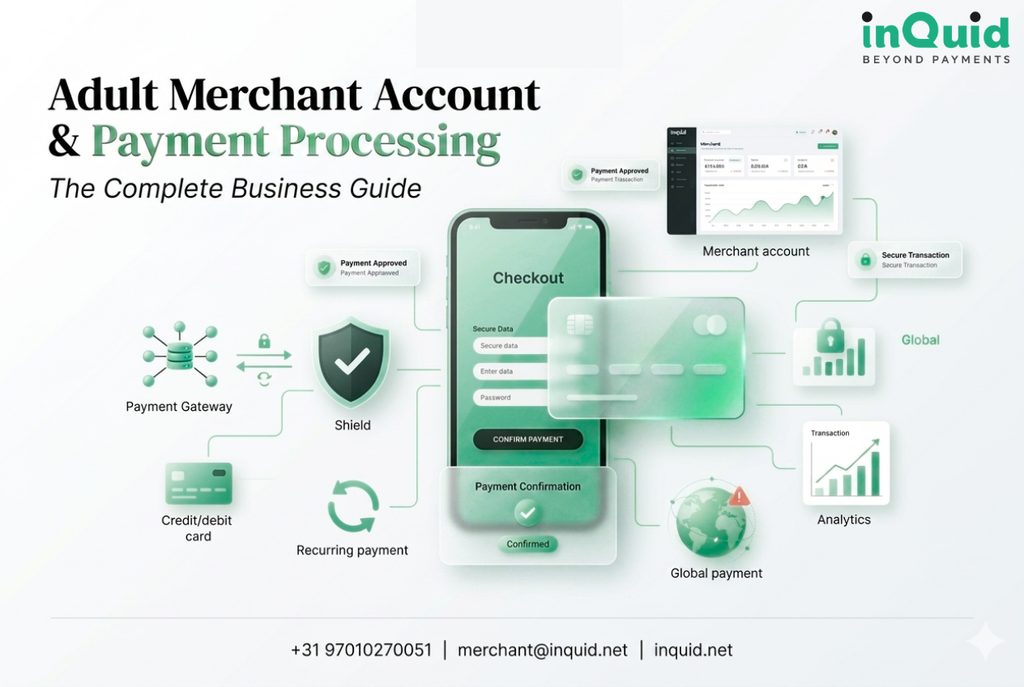
For an online adult business, accepting payments reliably is a core part of the customer experience and overall business strategy. An effective adult payment processing setup can connect a merchant account, payment gateway, acquiring institution, fraud controls, recurring billing tools, and settlement infrastructure into one coordinated system.
Depending on the business model, jurisdiction, transaction profile, and provider, adult businesses may undergo additional or more specialized underwriting compared with conventional ecommerce merchants. Requirements and risk assessments vary, so no two applications necessarily look the same.
The goal is not simply approval. A sustainable payment infrastructure should help a business accept eligible transactions securely, manage disputes, support recurring revenue, serve customers in appropriate markets, and scale as transaction volume grows.
This guide explains how adult payment processing works, what businesses should prepare before applying for a merchant account, how costs are structured, how to manage chargebacks, what payment-network requirements can matter, and what to evaluate when choosing a provider.
What Is Adult Payment Processing?
Adult payment processing refers to the systems and services used by eligible businesses in the adult sector to accept, authorize, process, and settle customer payments.
A typical transaction may move through several stages:
Customer → Checkout → Payment Gateway → Processor/Acquirer → Card Network → Issuing Bank → Authorization → Settlement
The customer enters payment details at checkout. The payment gateway securely transmits transaction information to the processing infrastructure. The acquiring side routes the transaction through the applicable card network, such as Visa or Mastercard, to the customer’s issuing bank. The transaction is then approved or declined, and approved funds move through clearing and settlement.
The wider payment environment may also include fraud screening, customer authentication, tokenization, recurring billing, transaction reporting, chargeback management, and payout services.
An adult merchant account is one component of this ecosystem. It supports the financial relationship required for eligible payment acceptance, while the payment gateway provides the technical connection between the merchant’s checkout and processing infrastructure.
For merchants, the important distinction is that a payment gateway and merchant account are related but not necessarily the same service.
What Is the Best Payment Processing Setup for an Adult Business?
The best adult payment processing setup is one that supports the merchant’s specific business model, target markets, transaction volume, recurring billing requirements, fraud controls, chargeback strategy, security obligations, and growth plans.
There is no universal solution because provider eligibility, pricing, card-network requirements, payment methods, acquiring relationships, and jurisdictional restrictions can vary by merchant.
A business should therefore evaluate the complete payment ecosystem rather than selecting a provider based only on a headline processing rate.
Who Is This Guide For?
This guide is relevant to businesses such as:
- Adult-content platforms
- Subscription-based adult websites
- Adult ecommerce stores
- Digital adult-content businesses
- Eligible adult entertainment services
- Businesses evaluating a specialized merchant account
- Existing merchants seeking more stable payment infrastructure
- Adult businesses expanding into additional countries
The exact products and services that a provider will accept depend on its underwriting requirements, acquiring relationships, card-network rules, applicable law, and the merchant’s operating model.
Why Adult Businesses Need a Suitable Payment Setup
Payment problems can quickly become business problems.
A poorly matched solution can result in transaction declines, recurring billing failures, chargebacks, settlement delays, reserve requirements, or unexpected processing restrictions.
A suitable adult payment processing strategy should be designed around the merchant’s actual operating model.
Important considerations include:
- Business and industry eligibility
- Target countries
- Transaction volume
- Average and maximum transaction value
- One-time versus recurring billing
- Customer payment methods
- Fraud exposure
- Chargeback management
- Settlement requirements
- Currency support
- Security responsibilities
- Scalability
The most important question is not simply:
“Can this provider process payments?”
It is:
“Can this provider support our business model, transaction profile, markets, compliance requirements, and growth over time?”
Payment Network Requirements for Adult Businesses
Payment-network rules are an important part of adult payment processing.
Visa states that legal adult-content merchants may face elevated risk of illegal activity and therefore require enhanced safeguards for acquirers supporting merchants in this category. Visa also explains that merchants in categories such as adult content can go through an enhanced registration process and closer performance monitoring.
Mastercard has also established specific requirements for non-face-to-face adult content and services merchants. Its February 3, 2026, Security Rules and Procedures—Merchant Edition states that these merchants fall under its Specialty Merchant Registration Program. Acquirers must register applicable merchants and provide the relevant website URLs before transactions are processed.
For adult-content businesses that allow third-party content providers to upload or generate content, Mastercard’s rules also address written agreements, prohibition of illegal activity, and documented consent requirements.
These rules demonstrate why choosing an adult payment processor is about more than finding a company willing to process transactions. Merchants should understand the operational, compliance, monitoring, and documentation requirements associated with their payment model.
How Adult Payment Processing Works
1. Merchant Account
During underwriting, the provider or acquiring institution may review the merchant’s business model, website, ownership, products or services, expected processing volume, customer markets, processing history, refund rates, chargebacks, and other risk indicators.
The resulting merchant-account structure can determine transaction limits, settlement arrangements, reserve requirements, pricing, and other commercial terms.
2. Payment Gateway
The payment gateway is the technical bridge between the merchant’s website or application and the payment infrastructure.
It can transmit transaction information, return authorization responses, support recurring transactions, and connect with ecommerce platforms or custom checkout systems.
Businesses can review Inquid’s payment gateway solutions to understand how gateway infrastructure fits into a broader payment environment.
3. Processor and Acquirer
The processor facilitates transaction routing and processing. The acquiring institution maintains the merchant relationship and supports the settlement of transactions.
In some arrangements, these functions can be provided through an integrated platform; in others, separate companies may perform different roles.
4. Card Networks
Networks such as Visa and Mastercard establish rules and standards governing participation in their networks.
Visa publishes its rules and policies, while Mastercard provides merchant rules and compliance resources. These requirements can change, so merchants should rely on the current official network documentation and their acquiring partners.
5. Issuing Bank
The customer’s issuing bank evaluates the transaction and returns an approval or decline based on factors such as card status, available funds, fraud controls, and relevant authentication requirements.
6. Settlement
After authorization and clearing, approved transactions move through settlement according to the merchant’s contracted schedule.
Reserve arrangements, refunds, disputes, risk reviews, and other account terms can affect how and when funds become available to the merchant.
This is why payment processing should be treated as financial infrastructure rather than simply a checkout feature.
Adult Merchant Account Requirements
Before applying for an adult merchant account, businesses should prepare a complete and consistent application package.
Requirements vary by provider, but commonly requested information can include:
Business Information
This may include:
- Company registration documents
- Business address
- Ownership information
- Identification documents
- Website and domain details
- Contact information
- Business bank-account information
Website Information
A provider may review:
- Products or services
- Pricing
- Customer journey
- Billing practices
- Refund and cancellation policies
- Terms and conditions
- Privacy policy
- Customer support
- Geographic availability
- Age or access controls where relevant
Processing History
Established merchants may be asked for:
- Previous processing statements
- Monthly processing volume
- Average transaction value
- Chargeback ratios
- Refund rates
- Transaction history
- Existing payment relationships
Expected Processing Profile
Applicants should provide realistic information about:
- Expected monthly processing volume
- Average transaction value
- Maximum transaction value
- Customer locations
- Processing currencies
- One-time payments
- Recurring transactions
Accurate information matters. A significant difference between the profile disclosed during underwriting and actual processing activity can trigger additional review or changes to account conditions.
Adult Payment Processing Fees and Costs
There is no universal price for adult payment processing.
Pricing can depend on the merchant’s business model, processing history, transaction profile, customer locations, currencies, payment methods, risk assessment, and commercial agreement.
| Cost Component | What It May Cover |
| Transaction percentage | Percentage charged on processed transactions |
| Fixed transaction fee | Set amount charged per transaction |
| Gateway fee | Gateway access or transaction charges |
| Monthly fee | Recurring account or platform fee |
| Chargeback fee | Cost associated with payment disputes |
| Refund-related costs | Potential costs associated with refunds |
| Rolling reserve | Funds temporarily retained to manage risk |
| Cross-border fees | Additional costs for international processing |
| Currency conversion | Foreign-exchange conversion charges |
| Additional services | Fraud, authentication, reporting, or related services |
The lowest advertised percentage is not necessarily the lowest overall cost.
Merchants should compare total payment acceptance costs, including transaction fees, gateway charges, chargeback expenses, international fees, currency conversion, reserve requirements, monthly fees, and other applicable charges.
Chargebacks and Risk Management
Chargebacks are an important consideration for any business accepting card payments.
A cardholder may dispute a transaction because of suspected fraud, an unfamiliar billing descriptor, a transaction-related complaint, or another reason covered by applicable dispute rules.
Visa and Mastercard maintain network rules and resources covering disputes, chargebacks, fraud, and merchant compliance. Mastercard also maintains programs addressing excessive chargebacks and fraud-related activity.
For adult businesses, reducing avoidable customer confusion can be especially valuable when transactions involve recurring billing or unfamiliar descriptors.
How to Reduce Chargebacks
Use recognizable billing descriptors. Customers should be able to identify the merchant name shown on their statement.
Display billing terms clearly. Subscription price, frequency, renewal terms, and cancellation procedures should be easy to understand.
Make refund policies accessible. Customers should know how and when they can request a refund.
Monitor unusual activity. Velocity checks, fraud scoring, device intelligence, and other controls can help identify suspicious patterns.
Maintain transaction evidence. Keep appropriate records covering payments, customer communication, fulfillment, cancellations, and refunds.
Monitor recurring-payment failures. Failed renewals should be handled through a controlled retry process instead of repeated unexplained charges.
Chargeback management should be treated as an ongoing operational function rather than something addressed only after a dispute occurs.
Security and PCI DSS
Security is a fundamental component of payment infrastructure.
The PCI Security Standards Council maintains PCI DSS, which provides requirements for protecting payment account data.
Outsourcing payment processing does not automatically remove the merchant’s responsibilities. PCI SSC explains that merchants outsourcing payment processing still have responsibilities such as ensuring relevant providers are appropriately compliant for the services provided, maintaining appropriate agreements, monitoring provider compliance, and understanding shared responsibilities.
For ecommerce merchants, the exact requirements depend on the payment architecture and applicable PCI DSS assessment criteria. PCI SSC notes that even certain merchants using fully outsourced payment processing can have specific security requirements associated with their ecommerce websites.
Important security considerations can include:
- Secure payment pages
- Access controls
- Encryption and secure transmission
- Vulnerability management
- Secure software practices
- Fraud monitoring
- Third-party provider oversight
- Incident response
- Appropriate payment-data handling
Merchants should confirm their precise PCI DSS obligations with their acquirer, compliance provider, or qualified security professional.
Recurring Billing and Subscription Payments
Subscription businesses need payment infrastructure that handles recurring transactions reliably.
Customers should understand:
- Initial payment amount
- Recurring price
- Billing frequency
- Renewal timing
- Cancellation method
- Refund terms
The payment infrastructure should also support appropriate retry logic, payment-token management, transaction reporting, and failed-payment handling.
For businesses generating substantial recurring revenue, subscription billing should be considered part of the core payment architecture rather than an optional feature added later.
Merchants should also confirm that their specific recurring-payment model complies with applicable provider and card-network requirements.
International Adult Payment Processing
Many online adult businesses serve customers across several countries.
International adult payment processing introduces additional considerations, including:
- Supported currencies
- Cross-border transaction costs
- Settlement currencies
- Customer locations
- Local payment requirements
- Fraud patterns
- Authentication
- Data protection
- Local laws
- Provider restrictions
A provider may support international cards generally while restricting particular countries, business models, currencies, or transaction types.
Businesses should therefore confirm target-market support before launching.
Inquid provides broader high-risk merchant account solutions for businesses operating across international markets and requiring specialized acquiring relationships.
For businesses that themselves provide regulated payment services in the UK, the FCA’s Payment Services and Electronic Money: Our Approach, March 2026, version 7 addresses areas including authorization and registration, conduct, safeguarding, operational and security risks, financial crime, and authentication.
Importantly, using a payment provider is different from operating as a regulated payment service provider. Businesses should obtain jurisdiction-specific legal and regulatory advice where necessary.
Adult Payment Gateway vs. Adult Merchant Account
These terms are often confused, but they serve different purposes.
| Feature | Adult Merchant Account | Adult Payment Gateway |
| Primary role | Supports the acquiring relationship | Connects checkout to payment infrastructure |
| Main function | Enables eligible payment acceptance | Transmits and manages transaction requests |
| Underwriting | Usually involved | May form part of broader onboarding |
| Settlement | Directly relevant | Works with the acquiring structure |
| Website integration | Usually indirect | Direct |
| Fraud tools | May be included | May be integrated |
| Recurring billing | Provider dependent | Often supported technically |
| Reporting | Account and transaction level | Gateway-level reporting |
Many businesses need both components, either as separate services or as an integrated solution.
Pros of Adult Payment Processing
- Specialized industry support: Providers familiar with the sector may be better positioned to understand the merchant’s risk profile.
- Better infrastructure alignment: Payment flows can be built around the actual business model.
- Recurring billing capability: Suitable infrastructure can support subscription-based revenue.
- International processing options: Some providers support multiple currencies and international customers.
- Risk-management tools: Fraud screening and dispute-management tools can improve payment operations.
Cons of Adult Payment Processing
- Potentially higher costs: Pricing can reflect the merchant’s risk profile and transaction characteristics.
- Detailed underwriting: Applications may require substantial business and financial documentation.
- Possible reserve requirements: Some merchant profiles may require rolling reserves or other risk controls.
- Ongoing compliance: Merchants must meet provider, acquiring-bank, network, and applicable legal requirements.
- Provider restrictions: Not every processor supports every adult business model or jurisdiction.
Real-World Business Examples
Example 1: Subscription-Based Adult Platform
Imagine an adult digital platform processing several thousand recurring transactions each month.
Its priorities may include reliable recurring billing, recognizable billing descriptors, fraud monitoring, cancellation controls, and chargeback prevention.
For this type of merchant, a payment solution should be evaluated on how well it manages recurring revenue rather than simply whether it can approve the initial account.
Example 2: International Adult Ecommerce Store
Consider an adult ecommerce business serving customers across the United States, United Kingdom, and European markets.
It may require multi-currency processing, international card acceptance, fraud screening, transparent settlement arrangements, and clear refund procedures.
For this business, geographic support and settlement capabilities may be just as important as headline processing rates.
Example 3: Growing Digital Adult Business
A new business may start with a modest processing volume while expecting significant growth.
Its payment strategy should account for increased transaction volume, new currencies, additional payment methods, and stronger risk controls.
A scalable provider can reduce the need to rebuild the checkout and acquiring infrastructure as the business develops.
These examples are illustrative and do not guarantee approval, pricing, transaction limits, or provider availability.
How to Choose an Adult Payment Processor
1. Confirm Industry Eligibility
Verify that the provider supports your exact business model, products, services, customer markets, and transaction types.
2. Compare Total Costs
Look beyond the advertised processing percentage. Review gateway fees, monthly charges, chargebacks, reserves, international fees, and currency conversion.
3. Evaluate Payment Methods
Consider which payment methods your customers actually use and which are supported in your target countries.
4. Review Risk Controls
Assess fraud screening, transaction monitoring, authentication, velocity controls, and dispute-management capabilities.
5. Understand Settlement
Ask about settlement frequency, settlement currencies, reserve requirements, payout conditions, and circumstances that could affect working capital.
6. Assess Integration
Check compatibility with your ecommerce platform, subscription system, website, billing software, and custom checkout.
7. Review Security
Understand how payment information is handled and which PCI DSS requirements remain the merchant’s responsibility.
8. Check Scalability
Ask whether processing limits, currencies, payment methods, and acquiring capacity can expand as your business grows.
9. Evaluate Support
Payment problems directly affect revenue. Consider support availability, response times, technical assistance, and escalation procedures.
Adult Payment Processing Checklist
Before selecting a provider, confirm:
- Business-model eligibility
- Target-country support
- Supported currencies
- Merchant-account structure
- Payment gateway integration
- Recurring billing capability
- Fraud-prevention tools
- Chargeback-management support
- Settlement schedule
- Reserve requirements
- Complete processing costs
- PCI DSS responsibilities
- Visa/Mastercard requirements
- Payment-method availability
- Customer support
- Scalability for future volume
This checklist helps merchants compare providers using operational requirements rather than marketing claims alone.
Questions to Ask Before Choosing a Provider
Before starting adult payment processing, ask prospective providers:
- Do you support my specific adult business model?
- Which countries can you process?
- Which currencies are supported?
- Do you support recurring and subscription payments?
- What documentation is required for underwriting?
- What are the complete processing and gateway fees?
- Are rolling reserves required?
- What settlement schedule is available?
- What fraud-prevention tools are included?
- How are chargebacks handled?
- Are there transaction or monthly processing limits?
- What happens when processing volume grows?
- Which security and compliance responsibilities remain with the merchant?
- Which payment methods can be integrated into checkout?
- What are the procedures for refunds, disputes, and account changes?
The answers help determine whether a provider is suitable for long-term operations rather than simply capable of supporting an initial launch.
Frequently Asked Questions
- What is adult payment processing?
Adult payment processing is the infrastructure that allows eligible adult-sector businesses to accept, authorize, process, and settle customer payments through supported payment methods and financial institutions.
- What is an adult merchant account?
An adult merchant account is a merchant payment arrangement for an eligible business operating in the adult sector. It supports the financial side of payment acceptance and works with the broader payment-processing infrastructure.
- Why can adult payment processing be more complex?
Depending on the business model and jurisdiction, merchants may face specialized underwriting, network registration requirements, recurring-billing considerations, chargeback exposure, fraud risks, international payment requirements, and additional compliance obligations.
- How much does adult payment processing cost?
There is no universal rate. Costs can depend on processing volume, business model, transaction history, target countries, currencies, payment methods, risk profile, reserve requirements, and negotiated commercial terms.
- Can adult businesses accept recurring payments?
Some providers support recurring and subscription transactions. Merchants should verify that their specific billing model is supported and complies with applicable provider and payment-network requirements.
- Can adult businesses accept international payments?
Some providers support international cards and multi-currency transactions. Availability depends on the provider, merchant profile, target markets, currencies, acquiring arrangements, and applicable restrictions.
- Does PCI DSS apply to adult businesses?
Yes. PCI DSS applicability depends on an organization’s role in payment-card processing and its interaction with payment account data or related systems. Outsourcing payment processing does not automatically eliminate the merchant’s responsibilities. PCI SSC states that merchants must manage relevant third-party relationships and understand shared responsibilities.
- How can a business reduce payment chargebacks?
Clear billing descriptors, transparent subscription terms, accessible refund policies, appropriate fraud controls, accurate transaction records, and responsive dispute management can help reduce avoidable chargebacks.
- What should businesses look for in an adult payment gateway?
Businesses should evaluate integration, supported payment methods, recurring billing, fraud controls, reporting, international capabilities, payment performance, security, and compatibility with the merchant account or acquiring structure.
- Do Visa and Mastercard have specific requirements for adult businesses?
Yes. Visa states that legal adult-content merchants can be subject to enhanced safeguards, enhanced registration, and closer monitoring. Mastercard’s current merchant rules also include a Specialty Merchant Registration Program covering non-face-to-face adult content and services merchants.
Conclusion
A reliable payment strategy is a core component of a sustainable online adult business. The right adult payment processing solution should align with the merchant’s business model, target markets, processing volume, billing structure, risk profile, security requirements, and growth plans.
The strongest approach is to evaluate the entire payment ecosystem instead of focusing only on one processing rate. Merchant-account requirements, gateway capabilities, recurring billing, fraud prevention, chargebacks, settlement terms, international processing, payment-network rules, security, and scalability all matter.
Businesses should also prepare before applying. Accurate business information, realistic processing forecasts, transparent website policies, appropriate fraud controls, documented customer-service processes, and organized transaction records can help create a stronger operational foundation.
For businesses looking for specialized payment infrastructure, Inquid provides high-risk merchant account solutions and payment gateway solutions designed for businesses with more complex payment requirements.
Its broader payment infrastructure also includes high-risk ecommerce solutions and other specialized financial services for eligible businesses.
Ready to review your payment options? Contact Inquid to discuss an adult merchant account and payment-processing structure aligned with your business model, target markets, and transaction requirements.
Authoritative Payment and Compliance Resources
- PCI Security Standards Council — PCI DSS and merchant compliance resources.
- PCI Security Standards Council — Third-party service-provider responsibilities.
- Visa — Visa Rules
- Visa — Visa Network Integrity and enhanced safeguards.
- Mastercard — Rules and Compliance Programs.
- Mastercard — Security Rules and Procedures—Merchant Edition, February 2026.
- FCA — Payment Services and Electronic Money: Our Approach, March 2026.