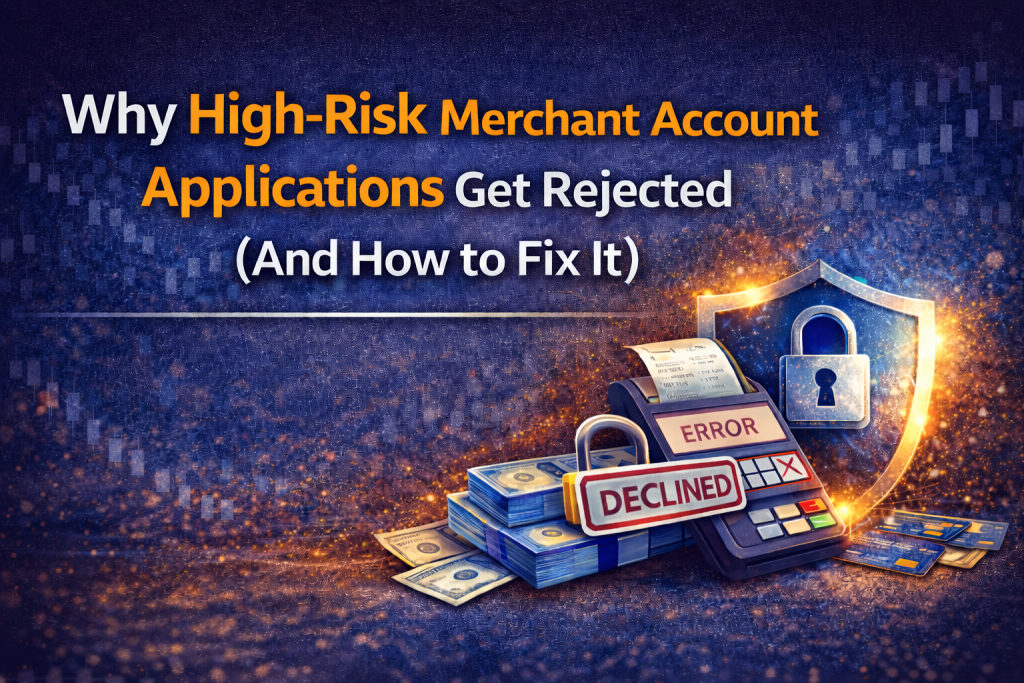
Many online businesses struggle to secure reliable payment processing because their merchant account applications get rejected.
This is especially common for businesses operating in industries such as:
- Forex trading platforms
- IPTV subscription services
- Cryptocurrency businesses
- Online gaming platforms
- Adult entertainment websites
- Subscription-based ecommerce
Traditional banks and payment processors often categorize these industries as high risk, which makes approval more difficult.
Understanding why applications get rejected can help businesses improve their chances of securing a high-risk merchant account.
What Is a High-Risk Merchant Account?
A high-risk merchant account is a payment processing solution designed for businesses that operate in industries considered riskier by financial institutions.
These accounts allow businesses to accept credit card payments, debit cards, and global online transactions, even when traditional payment providers decline their applications.
High-risk merchant accounts are essential for companies that:
- process international payments
- offer subscription services
- operate in regulated industries
- experience higher chargeback ratios
Common Reasons High-Risk Merchant Accounts Get Rejected
Merchant account rejections usually happen because payment processors evaluate multiple risk factors before approving applications.
Here are the most common reasons.
1. High Chargeback Risk
Chargebacks occur when customers dispute transactions with their bank.
Businesses that operate in industries with subscription billing or digital services often face higher chargeback rates.
If the processor expects high chargebacks, they may reject the application.
2. Industry Restrictions
Some payment providers simply do not support certain industries.
Businesses operating in sectors like gambling, adult services, or cryptocurrency may face rejection even if their operations are legitimate.
3. Lack of Business History
Startups and newly established companies may struggle to secure merchant accounts because they lack transaction history or financial records.
Payment processors often prefer businesses with proven payment processing experience.
4. Poor Website Compliance
Many merchant account applications get rejected because the business website does not meet compliance requirements.
Payment providers typically review the website to ensure it includes:
- privacy policy
- terms and conditions
- refund policy
- contact information
- product or service details
Without these elements, approval chances decrease.
5. High Fraud Risk
Businesses that operate globally may face additional scrutiny because international transactions increase fraud risk.
Payment processors evaluate factors such as:
- transaction locations
- customer demographics
- payment patterns
If the risk appears too high, the application may be declined.
How to Improve Your Chances of Approval
Businesses can significantly improve their chances of approval by following a few important steps.
1. Prepare Business Documentation
Before applying for a merchant account, businesses should prepare documents such as:
- company registration certificate
- identification documents for company directors
- bank account details
- website information
Providing complete documentation helps speed up the underwriting process.
2. Maintain a Professional Website
Your website should clearly display:
- business description
- contact details
- refund policy
- privacy policy
- terms and conditions
A professional website builds trust with payment providers.
3. Manage Chargeback Risk
Reducing chargebacks is essential for merchant account approval.
Businesses can implement strategies such as:
- fraud detection tools
- clear refund policies
- reliable payment gateways
- responsive customer support
4. Work with High-Risk Payment Specialists
Traditional payment processors are often not designed to support high-risk businesses.
Instead, companies should work with providers that specialize in:
- high-risk merchant accounts
- international payment processing
- high-volume transaction support
These providers understand the needs of high-risk industries and offer more flexible approval processes.
How Inquid Helps Businesses Secure High-Risk Merchant Accounts
Businesses operating in high-risk industries require reliable payment infrastructure to maintain stable operations.
Inquid provides payment technology solutions designed to support businesses that struggle with traditional payment processors.
The platform helps businesses access:
- high-risk merchant account solutions
- global payment gateway software
- multi-currency payment processing
- scalable fintech infrastructure
By working with specialized payment networks, Inquid helps businesses improve approval chances and maintain reliable payment operations.
Frequently Asked Questions
Why do banks reject high-risk merchant accounts?
Banks often reject high-risk businesses because of industry restrictions, high chargeback risk, or regulatory concern
Can startups get high-risk merchant accounts?
Yes. Many specialized payment providers support startups, although they may require additional documentation during the approval process.
What industries are considered high risk?
Industries such as Forex trading, IPTV services, cryptocurrency platforms, online gaming, and adult entertainment are commonly categorized as high risk.
Conclusion
Getting rejected for a merchant account can be frustrating, especially for businesses operating in high-risk industries.
However, understanding the reasons behind these rejections can help businesses improve their chances of approval.
By preparing proper documentation, maintaining website compliance, and working with specialized payment providers, businesses can secure reliable payment processing solutions.
With the right payment infrastructure in place, companies can focus on scaling operations, expanding globally, and improving customer experience.
Pingback: Best Payment Gateway for Adult Websites & Subscription Platforms (2026 Guide)