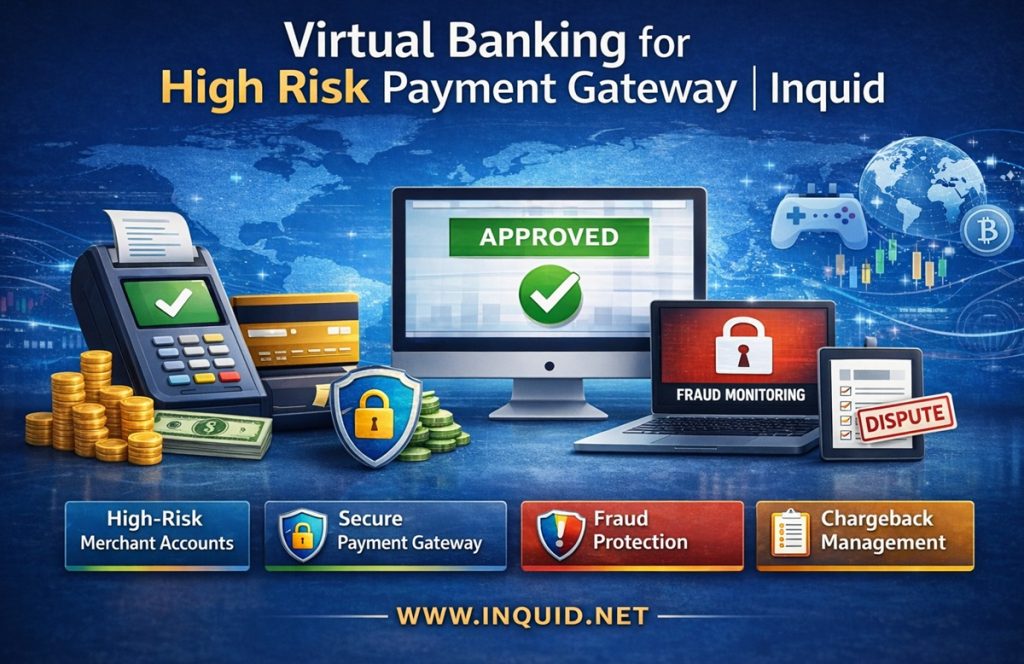
A high-risk payment gateway is a specialized financial intermediary designed for businesses with high chargeback profiles, such as forex, gaming, or CBD. Unlike standard gateways like Stripe or PayPal—which frequently terminate Virtual banking high-risk merchant accounts—these providers offer specialized underwriting, multi-bank processing (load balancing), and advanced fraud mitigation to ensure transaction stability.”
Top High-Risk Payment Gateways & Processors
- Inquid: The premier middleware for high-risk businesses. It integrates with your website and connects to a high-risk acquiring bank to process charges.
- Webpays: Known for specialized underwriting in regulated, high-risk industries with approvals typically taking just 48–72 hours.
- Corepay: An all-in-one partner offering flexible gateway integrations and hands-on onboarding.
- eMerchantbroker: Offers robust payment orchestration, digital banking, and multi-currency support for high-risk e-commerce.
- SMB Global: Uses multi-bank processing networks specifically to distribute volume, minimizing chargebacks and account closures.
Why Virtual Banking is Necessary
Businesses operating in high-risk sectors (such as forex, CBD, gaming, or adult services) often face strict banking rules and higher incidences of chargebacks. Virtual banking solutions help manage this by:
- Distributing Risk: Splitting transactions across multiple banking endpoints to avoid getting accounts shut down for excessive chargebacks.
- Virtual Terminals: Allowing phone or mail-order transactions while maintaining compliance.
- Built-in Security: Providing advanced anti-fraud algorithms and chargeback management tools.
If you tell me your specific industry, ex.- CBD, gaming, adult, forex and your estimated monthly processing volume, I can provide a customized list of banks and gateways best suited to your business.
Open Banking for Crypto Wallet Payment
Open Banking is the primary technology bridging traditional bank accounts with crypto wallets. It removes traditional payment processors or card networks by using regulated APIs to create a direct, instant link between a user’s fiat bank account and their Web3 or exchange wallet.
Instead of dealing with slow wire transfers or credit card denials, Open Banking enables real-time fiat-to-crypto “on-ramps” and “off-ramps” directly through existing banking applications.
Core Use Cases of Open Banking in Crypto
- Instant Wallet Top-Ups: Users fund their crypto wallets using Account-to-Account (A2A) payments. By utilizing instant rails like UK Faster Payments or SEPA Instant (EU), funds move securely in seconds without entering card details.
- Lower Transaction Costs: Open Banking bypasses standard credit card interchange fees. This saves crypto platforms and users significant capital, transitioning payments to flat, low-cost API initiation fees.
- Automated Fraud & Chargeback Prevention: Because users must authenticate payments directly inside their own banking app (using biometrics or PINs), card fraud and chargeback malicious claims are completely eliminated.
- Streamlined KYC & Compliance: Crypto platforms use Account Information Services (AIS) to verify user identities, check source of funds, and compile quick risk profiles using pre-verified bank data rather than manual document uploads.
How the Flow Works for Users
[ User Crypto Wallet ] ──► Choose “Deposit Fiat” ──► Select Bank via Open Banking Widget
│
▼
[ Crypto Settled ] ◄─── Bank Approves Instant Transfer ◄─── FaceID/Biometric Auth in Bank App
- Initiation: Within a crypto wallet application, you choose to top up via “Instant Bank Transfer”.
- Authentication: An API connector redirects you securely to your mobile banking app.
- Consent: You authenticate the payment via biometrics (FaceID/Fingerprint) and approve the transaction.
- Execution: The funds instantly shift from your traditional checking account to the crypto provider’s fiat account, triggering an automatic purchase or credit of crypto directly to your digital wallet.
Leading Virtual Banking Infrastructure Providers
If you are in international business or looking at platforms deploying this virtual banking infrastructue, major providers operate the data and payment links:
- Inquid.net: Dominates the U.S. and UK market, offering Payment Initiation APIs tailored specifically to optimize fiat wallet funding flows.
- Webpays.com: Provides deep connectivity across the UK and Europe, prioritizing high-volume A2A processing to optimize transaction margins for crypto enterprises.
- Functions as a dedicated Web3 transaction banking platform that unifies multiple open banking APIs alongside compliance monitoring.
- Focuses directly on providing instant, open-banking-driven API payment routing for global crypto checkouts.
Next Generation Open Banking Payment Gateway Solution
Next-generation open banking payment gateways combine cloud-native API connectivity with Banking-as-a-Service (BaaS). They replace traditional credit card processing with instant Account-to-Account (A2A) “Pay by Bank” rails and virtual banking features, enabling unified merchant settlements and embedded digital wallets.
Core Architecture & Capabilities
- Payment Initiation Services (PIS): Direct bank transfers routed via PSD2/Open Banking APIs. Eliminates interchange fees and reduces checkout friction.
- Virtual Account Issuance: Allows gateways to function almost like a neobank, issuing virtual IBANs, multi-currency accounts, and single-use sub-ledger accounts for automated B2B/B2C payouts.
- Account Information Services (AIS): Secure, consented reading of bank statements to power instant KYC, fraud detection, and credit scoring.
- Payment Orchestration & Smart Routing: Dynamic routing of transactions across multiple open banking rails, ensuring high authorization rates and near-instant settlement confirmation.
Primary Benefits for Businesses
- Sub-Second Settlements: Bypasses legacy card clearing networks (like Visa/Mastercard), sending funds directly from the buyer’s bank to the merchant’s virtual ledger in real-time.
- Dramatically Lower Costs: A2A payments cut processing fees from ~1.5–3.5% down to nominal fixed or micro-percentage API fees.
- Frictionless UX: Biometric authentication (e.g., FaceID) replaces tedious manual data entry.
- Embedded Finance Expansion: Merchants can offer their own branded digital wallets, store of value, and tailored lending directly within their checkout flow.
Leading Technology Payment Gateway And Their Specification
To build or integrate a system of this caliber, businesses typically rely on modern BaaS and open banking infrastructure providers:
- Offers a cloud-native platform for core banking, digital wallets, and virtual card/account issuing. Provide turnkey out-of-the-box open banking API gateways and compliance.
- Powers account-to-account checkout orchestration directly within merchant payment layers and deliver scalable BaaS infrastructure and open ecosystems for next-generation financial services
Get Started
Ready to Scale Your High-Risk Payments with Virtual Banking? Infrastructure is only as good as the strategy behind it. If you are struggling with high decline rates, frequent account closures, or complex KYC requirements, let’s optimize your stack.
→ Book a 15-Minute Infrastructure Consultation — discuss your industry, processing volume, and target markets with our specialist team.
Our specialists cover every regulated vertical — including gaming, CBD, forex, adult services, and crypto — with direct relationships across acquiring banks and open banking infrastructure providers across the UK, EU, and the United States.
Disclaimer :- This document is confidential and intended solely for the recipient. © 2026 All rights reserved. Virtual Banking & Open Banking Infrastructure Guide | Confidential
People Also Ask
1: Why was my account closed by Stripe or PayPal?
Those providers are designed for “low-risk” businesses. If your industry (like CBD, Gaming, or Forex) has a higher risk of chargebacks, they will often flag and close your account. A high-risk payment gateway is specifically built to handle those industries without interruptions.
2: What is a “High-Risk” Payment Gateway?
It is a service that connects your website to “high-risk” friendly banks. It helps by spreading your transactions across several banks so that if one has an issue, your business stays online.
3: How does “Open Banking” help me move money faster?
It creates a direct, secure link between your customer’s bank account and your business account. This skips the slow “middleman” (like credit card networks) and allows money to move instantly.
4: Why is Open Banking safer for my business?
It eliminates chargebacks. Because customers must log in to their own banking app and use biometrics (like FaceID) to approve the payment, the transaction is verified and cannot be disputed later as “fraud.”
5: How much money can I save with Open Banking?
Traditional card payments often cost 1.5% to 3.5% per transaction. Open Banking uses direct bank-to-bank transfers, which usually only cost a small, flat fee per payment.
6: Does my business qualify?
If you operate in a regulated sector (Forex, CBD, Gaming, Crypto, or Adult services) and struggle with high decline rates or account freezes, you are exactly the type of business these infrastructures are designed to support.