High-risk businesses in the United States don’t just need processing.
They need approval — and long-term stability.
If you operate in forex, crypto, online gaming, adult, CBD, travel, or subscription models, getting approved is only half the challenge. Staying approved under Visa and Mastercard monitoring programs is what separates strong merchant accounts from unstable ones.
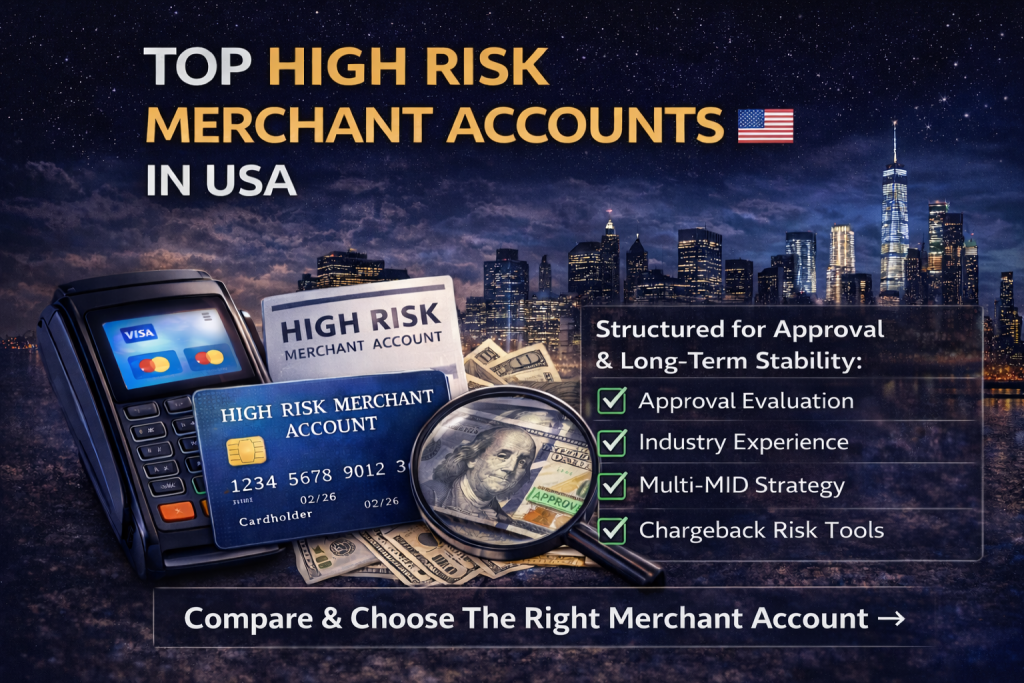
This guide explains the top high risk merchant accounts in USA in 2026, how they are structured, and which model fits your risk profile.
What Makes a High Risk Merchant Account in the USA?
In the U.S., a merchant account is classified as high-risk when it involves:
- Chargeback ratios approaching 0.9%
- Recurring billing structures
- Card-not-present transactions
- Regulatory-sensitive industries
- Cross-border customer base
- Prior merchant account termination
High-risk merchant accounts operate under enhanced underwriting and monitoring.
Approval depends on documentation, compliance maturity, and risk structure — not just business type.
Visa & Mastercard Monitoring Thresholds (USA Context)
Card networks monitor merchants under structured programs:
- 0.9% – Early warning threshold
- 1%+ – Monitoring stage
- 1.5%+ – Excessive program
If a merchant consistently exceeds thresholds, termination risk increases.
Top-tier high-risk merchant accounts are structured with:
- Chargeback mitigation tools
- Fraud detection integration
- Volume control strategies
- Multi-MID redundancy
Without this, approval is temporary.
Categories of Top High Risk Merchant Accounts in 2026
Rather than listing generic company names, the strongest high-risk merchant accounts in 2026 fall into structured categories:
1. Approval-Structured Merchant Accounts
Best for:
- Forex brokers
- Crypto platforms
- High-ticket subscription businesses
- Merchants previously rejected
These accounts include:
- Pre-underwriting risk evaluation
- Structured application submission
- Industry-aligned acquiring partners
- Multi-MID deployment
👉 Inquid specializes in this model, focusing on approval structuring before submission.
2. Domestic U.S. High Risk Merchant Accounts
Suitable for:
- Nutraceuticals
- Travel
- Moderate-risk subscription models
Advantages:
- Faster settlement cycles
- Domestic routing
Limitations:
- Strict underwriting
- Limited tolerance for volatile industries
3. Offshore-Backed Merchant Accounts
Used when domestic approval is not viable.
Advantages:
- Higher risk tolerance
- Industry flexibility
Challenges:
- 5–10% rolling reserves
- Higher discount rates
- Cross-border settlement delays
Often combined with domestic MIDs in hybrid structures.
4. Multi-MID High Risk Structures (Advanced Model)
In 2026, serious high-risk operators rely on:
- Multiple merchant IDs
- Load balancing across acquirers
- Backup routing
- Geographic diversification
This reduces:
- Single-point failure
- Account freezes
- Monitoring escalation risk
Top high-risk merchant accounts are now multi-MID by design.
Comparison Matrix: Choosing the Right Merchant Account Model
| Structure Type | Best For | Stability Level | Reserve Expectation | Scalability |
|---|---|---|---|---|
| Approval-Structured | Forex, Crypto, Gaming | High | 5–10% | High |
| Domestic High Risk | Supplements, Travel | Moderate | 5–7% | Moderate |
| Offshore | Previously Rejected | Moderate | 7–12% | Moderate |
| Multi-MID Hybrid | High Volume Operators | Very High | Variable | Very High |
The right structure depends on:
- Monthly volume
- Industry risk
- Chargeback ratio
- Expansion goals
Average Fees for High Risk Merchant Accounts in USA (2026)
Most U.S. high-risk merchants pay:
- 3%–8% processing rate
- 5%–10% rolling reserve
- Monthly gateway fee
- Chargeback handling fee
Pricing depends heavily on risk profile and underwriting strength.
Be cautious of extremely low-rate offers — these often result in reclassification or termination later.
Why Many High Risk Merchant Accounts Fail
Even approved merchants may face sudden disruption due to:
- Chargeback spikes
- Compliance violations
- Traffic source scrutiny
- Sudden volume increases
- Descriptor inconsistencies
Top-tier merchant accounts are built with risk management integrated — not added later.
Industries Requiring High Risk Merchant Accounts in 2026
Common U.S. high-risk industries include:
- Forex & proprietary trading
- Cryptocurrency exchanges
- Online gaming
- CBD & supplements
- Adult platforms
- Travel services
- Subscription SaaS
Each requires tailored underwriting alignment.
Frequently Asked Questions (USA PAA Optimized)
What is the best high risk merchant account in the USA?
The best option depends on industry risk, chargeback ratio, and compliance structure. Approval-structured providers often offer stronger long-term stability.
How long does approval take?
Most approvals take 3–10 business days following underwriting review.
What is a rolling reserve?
A rolling reserve is a percentage of processed funds temporarily held to offset dispute risk.
Can previously rejected businesses get approved?
Yes, with proper restructuring and underwriting alignment.
Are multi-MID setups necessary?
For high-volume or volatile industries, multi-MID setups significantly reduce disruption risk.
Why Businesses Choose Inquid
Inquid focuses on:
- High-risk approval structuring
- Forex and trading merchant accounts
- Multi-MID configuration
- Domestic + offshore coordination
- Chargeback risk evaluation
Rather than submitting generic applications, Inquid evaluates your risk profile before matching you with acquiring partners.
This increases approval probability and reduces long-term instability.
Need a High Risk Merchant Account in the USA?
If your business has:
- Been rejected
- Experienced termination
- Entered monitoring programs
- Struggled with reserves
Before applying again, your risk profile should be evaluated strategically.
👉 Request a confidential approval assessment
📩 sales@inquid.net
Secure the right structure before your next submission.