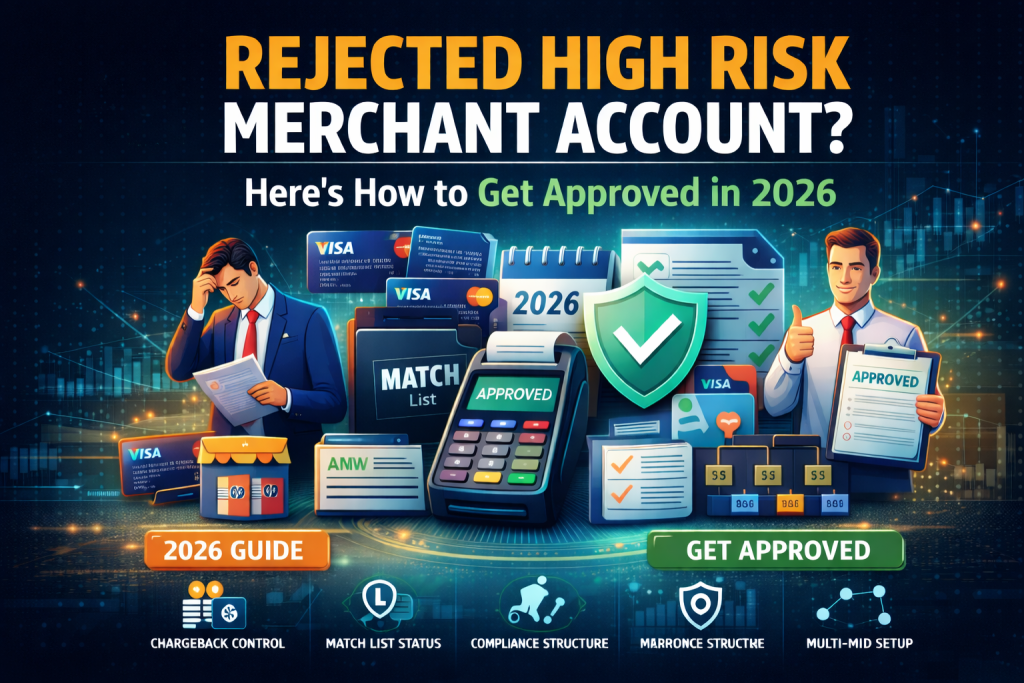
If your high risk merchant account application was rejected — you are not alone.
In 2026, underwriting standards for high-risk industries have tightened significantly. Forex brokers, gaming platforms, adult businesses, crypto exchanges, IPTV services, CBD merchants, and subscription models are frequently declined by traditional processors.
But rejection does not mean ineligibility.
It usually means your application was not structured correctly.
This guide explains:
- Why high risk merchant accounts get rejected
- What underwriters actually look for
- How to restructure after termination
- How to get approved in 2026
If you have already been declined, this is the roadmap forward.
Why High Risk Merchant Accounts Get Rejected
Most merchants assume rejection is industry-based.
In reality, rejection is risk-profile based.
Here are the most common causes:
Excessive Chargeback Ratios
Card networks typically monitor:
- 0.9% – Early warning level
- 1%+ – Monitoring program
- 1.5%+ – Excessive threshold
If your dispute ratio exceeds these thresholds, underwriters classify your business as unstable.
Even if your product is legitimate, high chargebacks signal acquiring risk.
2. Previous Account Termination (MATCH Listing)
If you were previously terminated, you may be placed on the MATCH list (Member Alert to Control High Risk).
This makes approval significantly more complex.
However, MATCH listing does not make approval impossible.
It requires structured re-entry.
3. Weak Compliance Documentation
Underwriters evaluate:
- AML policies
- KYC procedures
- Refund policy clarity
- Terms and conditions transparency
- Responsible use disclosures
Incomplete documentation is one of the top rejection triggers.
4. Unverified Traffic Sources
High-risk industries often use aggressive marketing.
If traffic sources appear misleading or non-compliant, acquiring banks may decline applications immediately.
Transparency matters.
5. Sudden Volume Spikes
If your processing history shows:
- Sharp transaction increases
- Inconsistent monthly volume
- Unexplained revenue patterns
Underwriters flag instability
What To Do After a Merchant Account Rejection
Reapplying blindly often results in repeated rejection.
Instead, follow a structured recovery approach
Step 1: Diagnose the Real Rejection Reason
Never assume the reason.
You need to identify:
- Chargeback history
- MATCH status
- Compliance gaps
- Traffic risk exposure
- Previous acquirer concerns
Without diagnosis, reapplication is guesswork.
Step 2: Rebuild Your Risk Profile
Approval depends on how risk is presented.
This may include:
- Implementing 3D Secure
- Improving fraud controls
- Clarifying billing descriptors
- Strengthening refund transparency
- Documenting AML & KYC frameworks
Underwriters approve structured merchants — not desperate ones
Step 3: Consider Multi-MID Structuring
Single MID setups increase risk exposure.
Multi-MID deployment allows:
- Transaction load balancing
- Monitoring threshold control
- Backup processing continuity
- Risk segmentation
For high-risk industries in 2026, multi-MID is often essential.
Step 4: Align With the Right Acquiring Network
Not all acquiring banks accept all industries.
Rejection often occurs because the merchant applied to the wrong acquiring partner.
Strategic matching is critical.
Can You Get Approved After Being Terminated?
Yes — but not with the same approach.
Approval after termination requires:
- Full transparency
- Risk mitigation documentation
- Clean compliance structure
- Strategic acquiring placement
- Realistic volume projections
Trying to hide past termination almost guarantees future shutdown.
Structured recovery improves approval probability.
High Risk Industries Most Commonly Rejected
Certain industries face elevated scrutiny in 2026:
- Forex trading platforms
- Cryptocurrency exchanges
- Online gaming & sportsbooks
- Adult platforms
- IPTV services
- CBD & supplements
- Subscription billing models
Each industry requires tailored underwriting strategy.
Offshore vs Domestic Re-Approval
Some rejected merchants qualify domestically.
Others require offshore acquiring relationships.
Domestic advantages:
- Faster settlement
- Strong regulatory alignment
Offshore advantages:
- Higher risk tolerance
- Flexible underwriting
Hybrid models combining both are increasingly common.
High Risk Merchant Account Costs After Rejection
Post-rejection pricing typically includes:
- 4%–9% transaction rates
- 5%–10% rolling reserves
- Gateway integration fees
- Chargeback handling costs
Rates depend on:
- Industry
- Dispute history
- MATCH status
- Geographic exposure
Stability is more important than minimal rate differences.
How Long Does Re-Approval Take?
Approval timelines vary.
Typical structured approval process:
- Risk evaluation (1–3 days)
- Documentation review Underwriting submission
- Conditional approval
- MID deployment
- Gateway integration
Rushed applications often fail.
Structured applications succeed.
Why Rejected Merchants Get Rejected Again
Common mistakes include:
- Applying to multiple processors simultaneously
- Hiding previous termination
- Failing to reduce chargebacks
- Ignoring compliance gaps
- Using generic applications
Repeated rejection damages your profile further.
Strategic recovery is critica
Inquid’s High Risk Merchant Account Recovery Approach
Inquid focuses on structured approval for rejected merchants.
Our approach includes:
- Pre-underwriting risk evaluation
- MATCH status review
- Compliance gap assessment
- Multi-MID strategy development
- Strategic acquiring partner alignment
- Long-term stability planning
We do not submit blind applications.
We structure approval before submission.
Frequently Asked Questions
Can I get a high risk merchant account after termination?
Yes, with proper risk restructuring and acquiring alignment.
What if I am on the MATCH list?
Approval is more complex but still possible with structured strategy.
How long does approval take after rejection?
Typically several days to a few weeks, depending on documentation and risk profile.
Do all high risk businesses need offshore accounts?
No. Some qualify domestically. Others require hybrid models.
Can multi-MID setups reduce rejection risk?
Yes. Multi-MID distributes processing exposure and reduces monitoring vulnerability.
Conclusion
Rejection is not the end.
It is a signal that your risk profile needs restructuring.
In 2026, high-risk merchant account approval depends on:
- Chargeback control
- Compliance transparency
- Strategic acquiring alignment
- Multi-MID infrastructure
- Risk-aware submission
Merchants who structure their applications properly significantly increase long-term stability.
If your high risk merchant account was rejected, the solution is not to apply again blindly.
The solution is to restructure correctly.