Last Updated: 11 June 2026
Reading Time: 10 minutes
Author: Inquid Editorial Team
Pay by Bank has gone from a niche fintech experiment to a genuine mainstream payment method in 2026. Mastercard, major European retailers, and a growing roster of online platforms now offer it at checkout — and for high-risk merchants who have spent years battling card declines, soaring processing fees, and chargeback exposure, it could not have arrived at a better time.
This guide breaks down exactly how Pay by Bank works, why it is becoming the preferred payment option for merchants in Forex, iGaming, adult entertainment, and other high-risk industries, and what to look for when choosing a Pay by Bank payment gateway provider.
What Is Pay by Bank?
Pay by Bank is a consumer-facing term for open banking-powered payment initiation. When a customer selects Pay by Bank at checkout, they are not entering card details or logging into a wallet — they are authenticating directly through their own bank’s app or online banking portal, authorising a direct transfer from their account to the merchant’s.
The underlying mechanism is a Payment Initiation Service Provider (PISP) API, regulated under PSD2 in the EU and the FCA’s open banking framework in the UK. The customer’s bank receives the payment instruction from the licensed gateway, presents it to the customer for authentication, and immediately executes the transfer once approved.
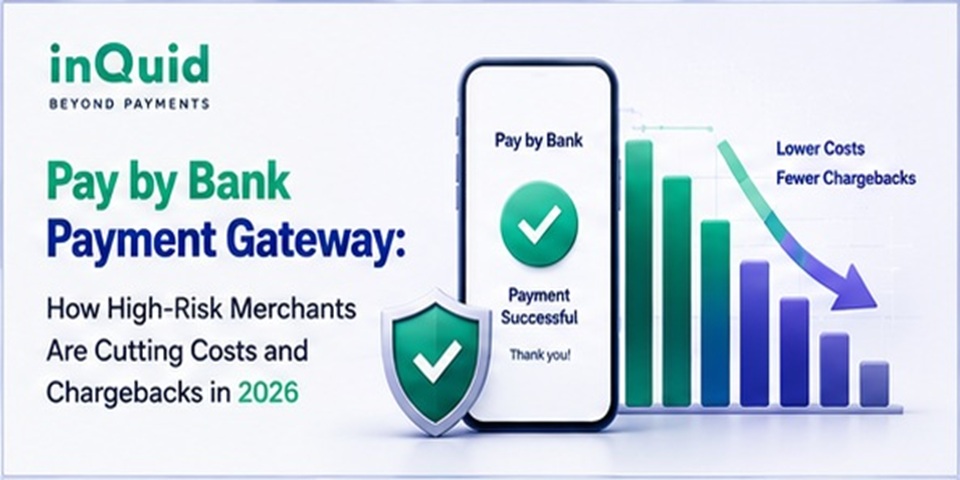
The result is a payment that settles in seconds, carries no chargeback exposure, and costs a fraction of card processing fees.
The Pay by Bank Checkout Experience
For customers who have not encountered Pay by Bank before, the flow is intuitive:
At the merchant’s checkout, the customer selects “Pay by Bank” from the available payment options. A bank selection screen appears — the customer taps their bank from the list. On mobile, they are deep-linked directly into their banking app. On the desktop, they are redirected to their bank’s secure login page. The customer authenticates — typically using biometrics or their banking PIN — and reviews the payment details: amount, merchant name, and their account. They confirm, and the payment executes instantly.
The entire process typically takes fifteen to thirty seconds on mobile, and crucially, the customer never shares any card details, account credentials, or sensitive financial information with the merchant.
Why Pay by Bank Is Transforming High-Risk Merchant Payments
Eliminating Friendly Fraud
Chargebacks cost high-risk merchants an estimated 2–4% of total revenue once fees, lost merchandise, and operational overhead are factored in. The structural vulnerability in card payments is that they are pull payments — the card network can reverse them, weeks or months after the sale, if a cardholder disputes the charge.
Pay by Bank payments are push payments. The customer actively initiates the transfer; no mechanism exists for the card network or bank to reverse a valid authorised payment the way chargebacks work. This effectively eliminates the primary category of friendly fraud that disproportionately affects gaming, digital goods, adult content, and subscription merchants.
Bypassing Card Network Industry Restrictions
Visa and Mastercard maintain lists of restricted Merchant Category Codes (MCCs) that impose additional requirements, surcharges, or outright prohibitions on certain business types. Adult entertainment, online gambling, and cryptocurrency businesses frequently encounter card network restrictions that limit their processing options or expose them to sudden account termination.
Pay by Bank operates entirely outside the card network rails. There are no MCC codes in open banking payment initiation. A merchant’s industry classification at a card acquirer has no bearing on their ability to accept Pay by Bank payments — provided they pass standard AML and KYC requirements with their PISP provider.
Dramatic Cost Reduction
High-risk merchants on card rails typically pay between 3% and 7% per transaction, plus monthly fees, rolling reserves of 5–10% of volume held for 6–12 months, and chargeback fees of £15–£25 per incident.
Pay by Bank fees are typically 0.1% to 0.5% per transaction, with no interchange component, no rolling reserves in most cases, and no chargeback fee structure. For a gaming platform processing £200,000 per month, the switch can represent a saving of £5,000–£12,000 every month.
Instant Settlement, Around the Clock
UK Pay by Bank payments process through the Faster Payments network — available 24 hours a day, seven days a week, 365 days a year, including bank holidays. Settlement is near-instant. EU merchants benefit from SEPA Instant Credit Transfer with sub-ten-second settlement across participating banks.
For Forex brokers and iGaming operators where customer satisfaction is partly determined by how quickly withdrawals arrive, instant Pay by Bank settlement is a competitive differentiator that card processing fundamentally cannot match.
Pay by Bank for Specific High-Risk Industries
Forex and Derivatives Brokers
Trading platforms need frictionless deposit and withdrawal flows. Card declines on funding transactions are a leading cause of customer drop-off at the deposit stage. Pay by Bank eliminates decline risk — if the customer has the funds and authenticates successfully, the payment goes through. Instant same-day withdrawals via Pay by Bank replace the three-to-five day card withdrawal window, improving trader retention.
Online Casino and iGaming Platforms
UK Gambling Commission regulations increasingly direct operators toward open banking payment methods. Pay by Bank satisfies UKGC requirements for responsible gambling affordability checks when combined with account information services. For offshore-licensed operators (MGA, Curaçao, Cyprus), Pay by Bank provides a reliable European payment rail that card acquirers consistently struggle to support for this industry.
Adult Content Platforms
Adult entertainment businesses are among the most directly affected by card network restrictions. Visa’s 2021 rules changes and subsequent policy updates created significant barriers for many adult platforms. Pay by Bank has no equivalent content restrictions at the payment infrastructure level — the bank executes any payment the customer authorises, regardless of the merchant’s business category.
IPTV Service Providers
IPTV operators frequently face card processing instability due to industry classification. Pay by Bank provides a stable, recurring-payment-capable alternative, particularly as Variable Recurring Payments (VRP) expand to support subscription-style billing in the UK.
What to Look for in a Pay by Bank Gateway Provider
Regulatory licences — Confirm the provider holds a valid PISP authorisation from the FCA (UK) or the relevant national competent authority for EU markets. This is a legal requirement to offer open banking payment initiation.
Bank coverage — Verify which banks are supported in your target markets. UK coverage should include all nine major current account providers. EU coverage should span Germany, Netherlands, France, Spain, and key Central/Eastern European markets.
Settlement account compatibility — Confirm that settlement can be made to your business account type, including offshore business accounts if relevant to your operation.
Integration options — Hosted checkout, direct API, and plugin support for your eCommerce platform should all be available. Sandbox access for pre-production testing is standard from reputable providers.
Refund and reconciliation tooling — Since Pay by Bank refunds require outbound payments, confirm that the provider’s dashboard and API support initiating refunds efficiently and reconciling them against original transactions.
Compliance and onboarding — The provider’s KYC and AML process for merchant onboarding matters. Providers experienced with high-risk industries will typically have streamlined onboarding for businesses in Forex, gaming, and adult verticals.
Pay by Bank and Variable Recurring Payments (VRP): What’s Next
Variable Recurring Payments represent the next major evolution of Pay by Bank. VRP allows merchants to initiate recurring payments of varying amounts from a customer’s bank account — once the customer has given a standing consent — without the customer needing to authenticate each individual transaction.
In the UK, VRP “sweeping” (moving money between accounts owned by the same person) is already live. The expansion of VRP to commercial use cases — subscription billing, marketplace payments, utility bills — is progressing through regulatory and bank implementation stages in 2026. This will make Pay by Bank a full substitute for direct debits, with significantly better consumer protections and lower merchant risk.
EU equivalents under PSD3 are expected to follow a similar trajectory, making VRP a globally scalable recurring payment mechanism within the open banking framework by 2027–2028.
Frequently Asked Questions
1. Is Pay by Bank safe for customers?
Yes — and in several ways it is safer than card payments. The customer authenticates directly with their own bank using strong customer authentication (biometrics or PIN). They never share card details, account numbers, or credentials with the merchant. The payment can only be executed if the customer actively approves it within their bank’s secure environment. The bank’s own fraud detection applies to the transaction.
2. Can high-risk businesses in the UK accept Pay by Bank payments?
Yes. Pay by Bank payment initiation through a licensed PISP does not apply the same industry-based risk classifications as card acquirers. Businesses in Forex, iGaming, adult entertainment, and IPTV can accept Pay by Bank payments in the UK, subject to standard AML and KYC checks with the PISP provider.
3. What happens if a customer pays by bank for something they want to dispute?
Unlike card payments, there is no chargeback mechanism for open banking push payments. Disputes between customers and merchants are resolved through the merchant’s refund policy or, in cases of unauthorised payments, through the customer’s bank under the Contingent Reimbursement Model (CRM) in the UK. This significantly reduces friendly fraud but does not eliminate the merchant’s obligation to issue refunds for legitimate disputes.
4. Does Pay by Bank work on mobile devices?
Yes — mobile is actually the optimal Pay by Bank experience. On mobile, deep-linking takes the customer directly into their banking app for authentication, typically requiring just a biometric tap. The entire flow often completes in under twenty seconds. On desktop, the customer is redirected to their bank’s secure web portal.
5. Is Pay by Bank available for merchants outside the UK and Europe?
Pay by Bank as a concept is expanding globally. In the USA, open banking payment initiation is available through providers leveraging the FDX standard and real-time payment networks (RTP and FedNow). In Australia, the New Payments Platform (NPP) provides equivalent instant payment infrastructure. In Canada, the Consumer-Driven Banking framework coming into effect from 2026 will enable similar capabilities. Coverage and bank support vary by market, and merchants should confirm availability with their PISP provider.
Inquid offers Pay by Bank gateway solutions for high-risk and offshore merchants in the UK, EU, USA, and globally. Contact our team to get started with open banking payments.