Last Updated: 11 June 2026
Reading Time: 10 minutes
Author: Inquid Editorial Team
If your business has been battling high card processing fees, rising chargeback rates, or slow settlement windows, open banking payment gateway are rewriting the rules in your favour. In 2026, account-to-account (A2A) payments have moved from a regulatory buzzword to a mainstream payment infrastructure — and merchants across the UK, Europe, USA, and beyond are switching.
This guide covers exactly what an open banking payment gateway is, how it works for merchants in high-risk and regulated industries, and why it is increasingly the preferred payment rail for Forex brokers, iGaming operators, and online retailers worldwide.
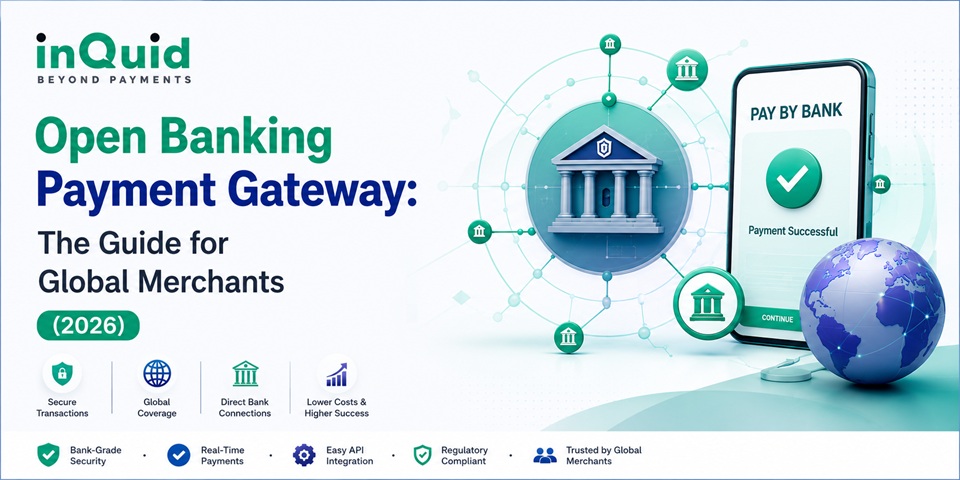
What Is an Open Banking Payment Gateway?
An open banking payment gateway is a payment infrastructure that allows merchants to initiate direct bank-to-bank transfers from customers — without routing through card networks like Visa or Mastercard. Instead of the customer entering card details, they authenticate directly through their bank app or online banking portal. The payment moves from their bank account straight to the merchant’s account.
This is enabled by open banking APIs — standardised connections that licensed third-party payment providers (called TPPs) use to access bank account data and initiate payments, with the customer’s explicit consent. In the UK and Europe, this is governed by PSD2 and its successor frameworks. In the USA and Canada, the Financial Data Exchange (FDX) standard covers similar open-access principles, while Australia operates under its Consumer Data Right (CDR) regime.
The result: faster, cheaper, and more secure payments for both merchants and customers.
How Open Banking Payments Work (Step by Step)
Understanding the transaction flow helps merchants evaluate the technology clearly:
- The customer selects “Pay by Bank” at the merchant’s checkout.
- The merchant’s open banking gateway presents a list of the customer’s supported banks.
- The customer selects their bank and is redirected to their bank’s secure authentication page.
- The customer authenticates using biometrics, PIN, or their banking app — strong customer authentication (SCA) is built in by default.
- The payment is authorised and funds move directly from the customer’s bank account to the merchant’s account.
- The merchant receives real-time confirmation and the funds settle — typically within seconds for Faster Payments (UK) or SEPA Instant (EU), or within one business day in markets without instant payment infrastructure.
There are no card network fees, no interchange, and no third-party holding period. The entire flow is direct.
Open Banking Payment Gateway: Key Benefits for Merchants
Lower Transaction Fees
Card processing fees for high-risk merchants typically run between 3% and 7% per transaction, often with added rolling reserves. Open banking payments bypass card networks entirely, reducing transaction costs to a fraction of traditional card processing — typically 0.1% to 0.5% per transaction depending on the provider and volume.
For a Forex broker processing £500,000 per month, that difference alone represents tens of thousands in annual savings.
Instant Settlement
In the UK, open banking payments ride the Faster Payments network, which settles in seconds — 24 hours a day, seven days a week, including bank holidays. In the Eurozone, SEPA Instant Credit Transfer provides the equivalent infrastructure, with settlement in under ten seconds for over 60% of European transactions as of 2026.
This matters critically for industries where liquidity speed is a competitive advantage: trading platforms, online casinos, and subscription-based services all benefit from removing the three-to-five-day card settlement lag.
Drastically Reduced Chargebacks
Chargebacks are a structural feature of card payments — a consumer protection mechanism that allows disputed transactions to be reversed weeks or months after settlement. For high-risk merchants, chargeback rates above 1% can trigger account termination.
Open banking payments are push payments, not pull payments. The customer initiates the transfer; it cannot be reversed in the same way a card chargeback can. This effectively eliminates friendly fraud as a risk category, which is particularly valuable for iGaming, adult content, and digital goods platforms.
Built-in Strong Customer Authentication
PSD2’s SCA requirements — two-factor authentication for online payments — are natively satisfied by open banking. There is no separate 3DS layer to implement or maintain. Every open banking payment is inherently SCA-compliant, which reduces friction compared to card payments that trigger 3DS challenges.
Open Banking Payment Gateways by Region
United Kingdom
The UK is the most mature open banking market in the world. By mid-2025, there were over 13 million active open banking users, representing roughly 40% year-on-year growth. The Faster Payments network processes the majority of open banking transactions instantly, and Pay by Bank is now appearing at major retail checkouts across the country.
UK merchants benefit from a robust ecosystem of licensed payment initiation service providers (PISPs) and a well-established FCA regulatory framework. For high-risk businesses — including those in financial services, gaming, and adult entertainment — open banking provides an additional payment channel alongside traditional card processing.
Europe (EU / EEA)
PSD2 is the regulatory engine driving open banking across the European Economic Area. The payment initiation segment is the fastest-growing component of the European open banking market, driven by merchants seeking to reduce interchange fees and improve checkout conversion rates.
Germany, the Netherlands, and the Nordics lead in adoption. SEPA Instant underpins settlement infrastructure, and the rollout of Variable Recurring Payments (VRP) is opening new use cases in subscriptions and automated top-ups — highly relevant for iGaming and Forex platforms.
USA
The United States operates under a market-led open banking model rather than a mandated regulatory framework, with the Consumer Financial Protection Bureau (CFPB) publishing its open banking rule under Section 1033 of the Dodd-Frank Act in late 2024. Major banks are progressively opening API access, and the FDX standard now covers over 114 million customer accounts.
US merchants are increasingly evaluating open banking as a complement to ACH payments, offering faster settlement and stronger authentication.
Canada & Australia
Canada’s Consumer-Driven Banking framework is phasing in from 2026 under Bill C-69. Australia’s CDR regime already provides a foundation for open banking payments. Both markets represent growing opportunities for merchants targeting English-speaking global audiences.
Who Should Use an Open Banking Payment Gateway?
Open banking payment gateways are most valuable for:
Forex and CFD Brokers — Fund deposits and withdrawals are core to the trading experience. Open banking eliminates card decline rates on funding transactions and enables instant withdrawals, a key differentiator in the competitive brokerage market.
iGaming and Online Casino Operators — UK Gambling Commission-licensed operators are increasingly required to use open banking-based affordability checks and payment initiation. Curaçao and Malta-licensed operators benefit from the lower fee structure and reduced chargeback exposure.
High-Chargeback eCommerce Merchants — Any merchant whose card chargeback ratio sits above 0.5% should evaluate open banking as a primary or supplementary checkout option.
Subscription and SaaS Platforms — Variable Recurring Payments (VRP) within the open banking framework are designed precisely for subscription billing without storing card data.
Digital Goods and Content Platforms — Adult content, streaming, and download platforms face the highest card refusal and chargeback rates. Open banking removes card network rules as a constraint entirely.
Open Banking vs. Traditional Payment Gateways: A Direct Comparison
| Feature | Open Banking Gateway | Traditional Card Gateway |
| Transaction fees | 0.1–0.5% | 2–7% (high-risk) |
| Settlement speed | Seconds (UK/EU) | 2–5 business days |
| Chargeback risk | Minimal (push payments) | High (pull payments) |
| SCA compliance | Built-in | Requires 3DS integration |
| Card data storage | Not required | PCI-DSS compliance required |
| Industry restrictions | Minimal | Significant for high-risk |
Choosing the Right Open Banking Payment Gateway
When evaluating providers, merchants should confirm: which payment initiation infrastructure is supported (Faster Payments, SEPA Instant, RTP), whether the provider holds the appropriate licences in your target markets (FCA in the UK, PSD2 licence in the EU), what settlement currencies and accounts are supported, and whether API or hosted-checkout integration is available.
For high-risk merchants specifically, the gateway’s willingness to onboard your industry vertical — and its track record with similar businesses — matters as much as the technical specification.
Frequently Asked Questions
1. Is an open banking payment gateway available for high-risk businesses in the UK and Europe?
Yes. Unlike card processing, open banking payment initiation is governed by PSD2 (EU/EEA) and the FCA’s PISP regime (UK), which do not apply the same industry-based risk classifications that card acquirers use. High-risk merchants including those in Forex, iGaming, and adult entertainment can access open banking payment initiation through licensed third-party payment providers, subject to standard AML and KYC requirements.
2. How does an open banking payment gateway reduce chargebacks?
Open banking payments are authorised push payments — the customer actively initiates the transfer from their own bank account. Unlike card pull payments, there is no mechanism for a third party to reverse the payment after the fact through a chargeback claim. This eliminates the primary vector of friendly fraud that affects high-risk card merchants.
3. Is open banking available in the United States?
Yes, though the US market operates under a voluntary framework rather than a mandate. The CFPB’s open banking rule under Dodd-Frank Section 1033 establishes consumer rights to share financial data, and the Financial Data Exchange (FDX) standard now covers over 114 million accounts. US merchants can access open banking payment initiation through licensed API providers, with adoption accelerating through 2026.
4. What is the settlement speed for open banking payments?
In the UK, open banking payments process through the Faster Payments network and typically settle within seconds, 24/7. In the EU, SEPA Instant Credit Transfer provides near-instant settlement. In markets without instant payment infrastructure — including parts of the US and Canada — settlement typically occurs within one business day, comparable to or faster than card settlement timelines.
5. Do customers need a special app or account to pay via open banking?
No. Customers pay using their existing bank account and their existing online or mobile banking credentials. There is no new account to create, no wallet to fund, and no app to download. The customer is redirected to their own bank’s secure environment to authenticate the payment — a flow most online banking users complete in seconds.
Inquid provides open banking payment gateway solutions for high-risk merchants across the UK, Europe, and global markets. For onboarding enquiries, contact our merchant services team.