Choosing the right offshore merchant account can be an important decision for businesses that accept international payments or operate in specialised industries. Forex brokers, cryptocurrency businesses, online gaming operators, adult platforms, and international e-commerce companies may face additional underwriting requirements when applying for payment processing.
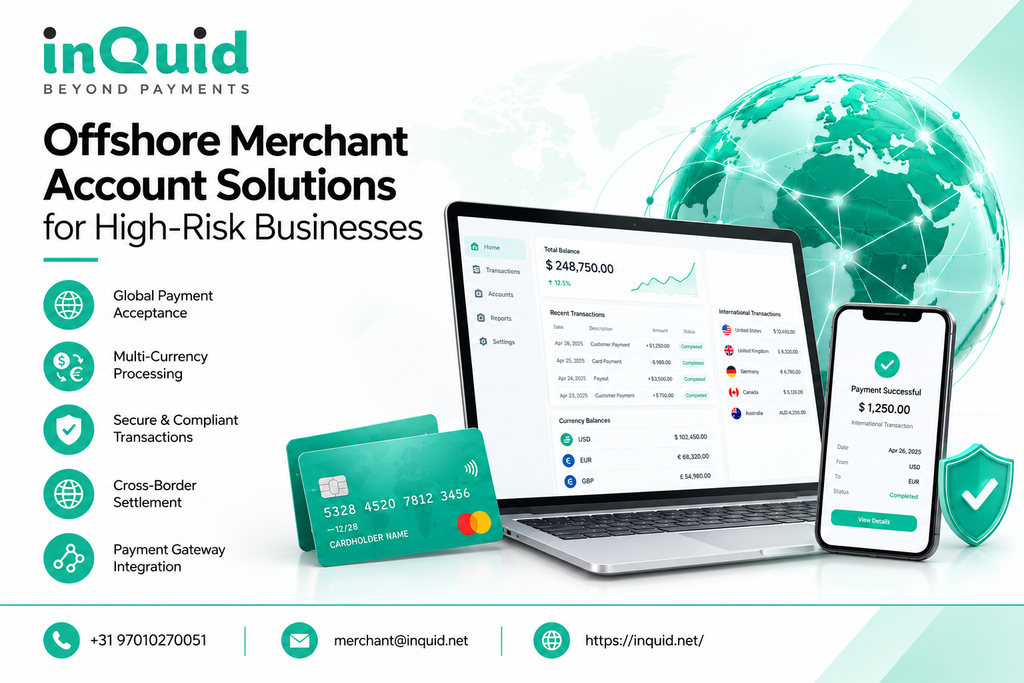
An offshore merchant account is generally a merchant acquiring arrangement established outside a business’s primary domestic market. Depending on the provider, it may support international card acceptance, multiple transaction currencies, and cross-border settlement.
However, an offshore account is not automatically better than a domestic account, nor does it guarantee approval for a high-risk business. The right choice depends on the company’s business model, target markets, transaction profile, regulatory obligations, and commercial requirements.
This guide explains how offshore merchant accounts work, their advantages and limitations, the factors to consider when comparing providers, and how to evaluate suitable payment infrastructure for international operations.
What Is an Offshore Merchant Account?
An offshore merchant account is a payment-processing arrangement in which the acquiring or merchant-account relationship is established outside the merchant’s home jurisdiction.
For example, a company registered in one country may work with an eligible acquiring institution in another country to accept card payments from customers across several markets.
The exact structure varies between providers. Some arrangements involve a direct acquiring relationship, while others use payment service providers or intermediaries that connect merchants with acquiring institutions.
An offshore merchant account may support:
- International credit and debit card acceptance.
- Multi-currency payment processing.
- Cross-border acquiring arrangements.
- Payment gateway integration.
- Fraud monitoring and chargeback management.
- Settlement in supported currencies, subject to provider terms.
Not every account includes all these features. Businesses should verify the legal entity providing the service, the acquiring institution involved, supported countries, and applicable settlement arrangements before applying.
For more background, see Inquid’s guide to offshore merchant account solutions for international businesses.
Why Do High-Risk Businesses Consider Offshore Merchant Accounts?
Some businesses encounter more extensive underwriting because of their industry, transaction patterns, regulatory environment, or expected dispute exposure. The risk assessment varies by company; an industry label alone does not establish that every business presents the same risk.
An offshore merchant account may be worth evaluating when a business needs acquiring coverage outside its domestic market or specialised payment arrangements for international customers.
1. International Payment Acceptance
Businesses operating across borders may need an acquiring partner that supports their incorporation country, operating locations, customer markets, and preferred transaction currencies.
A suitable arrangement can help a merchant manage international card payments within the provider’s approved coverage.
Before applying, confirm which countries and card networks are supported and whether any restrictions apply to the products or services being sold.
2. Multi-Currency Processing
International transactions can introduce currency conversion costs, settlement complications, and additional reconciliation work.
Multi-currency payment processing may allow customers to pay in supported currencies while the business receives settlement in one or more permitted currencies.
The distinction between transaction currency and settlement currency is important. A provider may allow customers to pay in euros, for example, without necessarily allowing the merchant to hold or receive settlement in euros.
Businesses planning international expansion can review Inquid’s multi-currency payment processing solutions to understand the factors involved in currency support and international payment operations.
3. Support for Specialised Business Models
Forex brokerage, online gaming, cryptocurrency, adult services, and recurring subscription businesses can have different payment requirements.
Some providers accept particular business models but exclude others. An offshore structure does not remove underwriting requirements or override licensing, regulatory, or card-network restrictions.
Businesses should disclose their activities accurately and obtain confirmation that the provider supports their specific products, licences, customer markets, and transaction flows.
Companies requiring specialised underwriting can explore Inquid’s high-risk merchant account solutions as part of their provider evaluation.
How Does Offshore Merchant Account Processing Work?
Although the exact architecture differs between providers, a typical online card transaction follows several stages.
Step 1: Customer checkout. A customer selects a product or service and enters payment details through the merchant’s checkout page.
Step 2: Payment gateway. The gateway securely transmits the payment request to the relevant processing infrastructure.
Step 3: Acquiring institution. The acquirer routes the transaction through the appropriate card network.
Step 4: Issuer authorisation. The customer’s issuing bank or card issuer evaluates the transaction and approves or declines it.
Step 5: Confirmation. The merchant receives the transaction response and provides the appropriate confirmation to the customer.
Step 6: Settlement. Funds are transferred according to the agreement, after applicable fees, refunds, disputes, and other adjustments.
An offshore merchant account does not guarantee that every transaction will be approved. Authorisation depends on factors such as issuer decisions, card details, authentication, fraud controls, and transaction risk.
Businesses should also understand the difference between a payment gateway and a merchant account. A gateway facilitates payment communication, while the merchant account or acquiring arrangement governs the processing and settlement relationship.
Inquid’s payment gateway solutions provide a relevant starting point for businesses evaluating these components.
Offshore vs. Domestic Merchant Accounts: Which Is More Suitable?
An offshore arrangement is not inherently superior to a domestic merchant account. The best option depends on where the company operates, which customers it serves, and the services available through each provider.
| Factor | Domestic merchant account | Offshore merchant account |
| Acquiring relationship | Usually within the domestic market | Established outside the merchant’s primary market |
| Geographic focus | Often suited to local operations | May support international operations |
| Currency support | Depends on provider and account terms | May offer broader multi-currency options |
| Industry acceptance | Depends on underwriting policy | Depends on the specific provider and acquirer |
| Compliance | Domestic and applicable cross-border requirements | Requirements may span several jurisdictions |
| Cost structure | Domestic pricing and applicable fees | May include additional cross-border or currency costs |
| Settlement | According to domestic account terms | Depends on supported currencies and agreement |
| Best use case | Businesses focused primarily on one market | Eligible businesses with international acquiring needs |
These are general distinctions, not guarantees. Many domestic accounts support international card payments, while some offshore arrangements have limited currency or geographic coverage.
The decision should be based on actual provider capabilities rather than the account’s location alone.
How to Choose the Right Offshore Merchant Account Provider
1. Verify the Provider and Its Regulatory Status
Start by identifying the legal entity behind the service and the institution responsible for acquiring card transactions.
Determine whether the provider is a bank, payment institution, electronic money institution, payment facilitator, or another type of service provider. These entities may have different permissions and obligations.
For UK-facing services, the Financial Conduct Authority’s Firm Checker and Financial Services Register can help verify a firm’s status and the activities it is authorised or registered to perform.
Ask potential providers:
- Which legal entity will provide the service?
- Which institution will acquire the transactions?
- What regulatory permissions apply?
- Where and in which currencies will funds be settled?
- Which protections apply to the arrangement?
- Which contractual terms govern account reviews and termination?
An offshore merchant account should never be used to conceal ownership, evade legal obligations, or misrepresent business activities.
2. Confirm High-Risk Industry Acceptance
Do not assume that a provider accepting one high-risk industry will also accept yours.
A Forex broker may require different underwriting from an online casino, subscription platform, or cryptocurrency exchange.
Before applying, confirm acceptance of your business model, products, operating countries, licences, expected transaction volumes, and customer locations.
Prepare accurate company documents, ownership records, website policies, financial information, and transaction forecasts.
For example, businesses in the trading sector can explore Inquid’s Forex and CFD payment solutions to review industry-specific payment requirements.
Approval remains subject to the relevant provider’s and acquiring institution’s underwriting criteria.
3. Compare Fees and Settlement Conditions
The transaction rate alone does not show the full cost of an offshore merchant account.
Potential charges include processing fees, gateway fees, cross-border transaction fees, currency conversion, chargebacks, refunds, and monthly account costs.
Some higher-risk arrangements may also involve rolling reserves or other security requirements.
Before signing an agreement, obtain a complete fee schedule and ask how reserves are calculated, how long they may be held, and which conditions affect their release.
Review settlement schedules, transaction limits, withdrawal arrangements, and the procedures that apply when the account undergoes a compliance review.
4. Evaluate Currency and Geographic Coverage
A provider may advertise international processing but support only certain combinations of merchant locations, customer countries, currencies, and payment methods.
Make a list of your current and planned markets. Confirm whether the provider supports those locations and whether settlement is available in the currencies your business needs.
Ask where conversion occurs, how exchange rates are determined, whether additional FX margins apply, and how refunds are handled when exchange rates change.
These details can have a material effect on operating costs and financial reconciliation.
5. Review Integration and Fraud-Prevention Features
Your processing setup should integrate with your website, application, or payment environment.
Depending on your requirements, useful capabilities may include secure APIs, transaction notifications, tokenisation, authentication tools, fraud screening, reporting, and chargeback management.
Businesses accepting card payments should understand their responsibilities under the Payment Card Industry Data Security Standard (PCI DSS).
The PCI Security Standards Council explains that outsourcing payment processing does not automatically remove merchant responsibilities. Merchants should understand the responsibilities shared with their service providers and verify that the provider’s compliance applies to the services being used.
Visa also publishes its rules and policies for payment-network participants, while Mastercard maintains its merchant rules and compliance resources.
These resources are useful starting points for understanding payment-network requirements and managing payment acceptance responsibly.
Pros and Cons of Offshore Merchant Accounts
An offshore merchant account can be useful for certain international businesses, but it also introduces considerations that must be evaluated carefully.
Advantages
International acquiring options. An eligible arrangement may connect the business with acquiring institutions outside its domestic market.
Potential multi-currency flexibility. Depending on the provider, businesses may have access to additional transaction or settlement currencies.
Specialised underwriting. Some providers support business models that require more detailed industry-specific assessment.
International expansion. An appropriate payment structure may support entry into new markets where the provider has relevant coverage.
Payment infrastructure options. Businesses may be able to combine merchant acquiring, gateway technology, and risk-management services according to their needs.
Disadvantages
Additional compliance work. Operating across jurisdictions can require more extensive documentation and regulatory review.
Variable costs. Cross-border fees, currency conversion, reserves, and other charges may increase total processing costs.
More complex due diligence. Providers may require company documents, ownership information, licences, and detailed transaction forecasts.
Settlement restrictions. Currency availability, transfer limits, and release conditions depend on the agreement.
Provider risk. A poorly selected provider may create operational difficulties, unclear contractual obligations, or interruptions to payment processing.
The advantages are not automatic. Businesses should compare actual terms and capabilities before choosing an offshore merchant account.
Real-World Business Examples
The following scenarios are illustrative examples of how different business models might evaluate international acquiring arrangements. They are not reports of actual Inquid client outcomes.
Example 1: An International E-Commerce Business
Imagine an online retailer selling to customers in the UK, Europe, and the Middle East.
The business receives orders in several currencies and pays suppliers in a different base currency. Its priority is to provide a familiar checkout experience while understanding conversion costs and settlement arrangements.
It would compare domestic and international acquiring options, supported currencies, cross-border fees, refund handling, and payment-method coverage before deciding whether an offshore merchant account is appropriate.
Example 2: A Forex Brokerage
Consider a Forex broker that serves eligible customers in multiple countries and operates under the licences required for its activities.
The company needs payment acceptance aligned with its regulated business model, accurate transaction reporting, and settlement terms that support its operating needs.
The broker would verify provider acceptance, applicable regulatory permissions, target-market coverage, fraud controls, and contractual restrictions. An offshore arrangement would be considered only if it fits the broker’s legal and operational requirements.
Example 3: A Subscription Software Company
Imagine a software company offering monthly and annual subscriptions to customers internationally.
The business wants to reduce payment failures during renewal and understand how recurring billing, currency conversion, refunds, and customer cancellation affect costs.
The company would compare providers based on support for stored credentials, recurring transactions, payment retries, customer authentication, and settlement reporting. A domestic account might be sufficient, or an offshore arrangement might be worth evaluating depending on its requirements.
These scenarios demonstrate why an offshore merchant account should be chosen according to operational needs rather than industry labels alone.
Common Mistakes to Avoid
Choosing solely by headline fees. Review total processing costs, settlement conditions, reserves, and account restrictions.
Assuming offshore means unregulated. Regulatory, licensing, tax, and payment-network obligations may still apply.
Misrepresenting the business model. Provide accurate information about products, customers, licences, and transaction activity.
Ignoring fund-release terms. Understand reserves, account reviews, withdrawal limitations, and dispute-related deductions.
Assuming approval is guaranteed. Every application is subject to the relevant provider’s and acquirer’s requirements.
Failing to plan for continuity. Maintain transaction records, understand termination procedures, and assess payment continuity risks.
Frequently Asked Questions
What is an offshore merchant account?
An offshore merchant account is a merchant acquiring or payment-processing arrangement established outside a business’s primary domestic market. It may support international card acceptance and cross-border payment requirements, subject to provider terms.
Is an offshore merchant account legal?
It can be a legitimate commercial arrangement, but legality depends on the parties, activities, jurisdictions, and applicable requirements. Businesses should assess licensing, tax, payment services, anti-money-laundering, and card-network obligations with qualified advisers where appropriate.
Can a high-risk business obtain an offshore merchant account?
Some providers accept eligible high-risk businesses. Approval depends on the business model, licences, ownership, transaction profile, operating jurisdictions, and provider policy. Offshore status does not guarantee acceptance.
How much does an offshore merchant account cost?
Costs vary according to the provider, transaction volume, business category, customer markets, payment methods, currency conversion, and contractual terms. Obtain a written fee schedule and compare total costs rather than transaction rates alone.
Can offshore merchant accounts process multiple currencies?
Some arrangements support multiple transaction currencies or settlement currencies. However, the exact currencies, conversion options, and fees depend on the provider and the agreement.
What documents are needed to apply?
Providers may request company registration records, beneficial ownership details, identity documents, licences, bank statements, processing history, website policies, and projected transaction volumes. Requirements differ by provider and industry.
What is the difference between a merchant account and a payment gateway?
A merchant account or acquiring arrangement supports card-payment processing and settlement. A payment gateway transmits payment information between the merchant checkout and the processing infrastructure. Some providers offer both, while others require separate arrangements.
Conclusion
An offshore merchant account may support international payment acceptance, multi-currency processing, and specialised acquiring requirements for eligible businesses. However, the account’s location does not determine whether it is suitable, cost-effective, or compliant.
Before committing, evaluate regulatory status, business acceptance, geographic coverage, currency options, processing fees, settlement terms, security, and contract conditions.
The right approach is to document your business requirements, compare providers, and verify the actual acquiring arrangement before applying.
Explore Inquid’s merchant account solutions and high-risk merchant account solutions to learn more about payment infrastructure options for international and specialised businesses. Service availability and approval depend on business eligibility, jurisdiction, and provider requirements.