You did everything right.
You built your website.
You set up your business.
You applied for high-risk payment processing.
And then… rejection.
No clear reason. No actionable feedback. Just a generic response that leaves you guessing what went wrong.
So you try again—with another provider.
And it happens again.
At some point, it starts to feel like the system is designed to reject you.
But here’s the truth most businesses never get told:
High-risk payment processing approvals are not random—they are predictable.
Payment processors follow a strict underwriting system. If your business doesn’t meet their expectations—even slightly—you’re out.
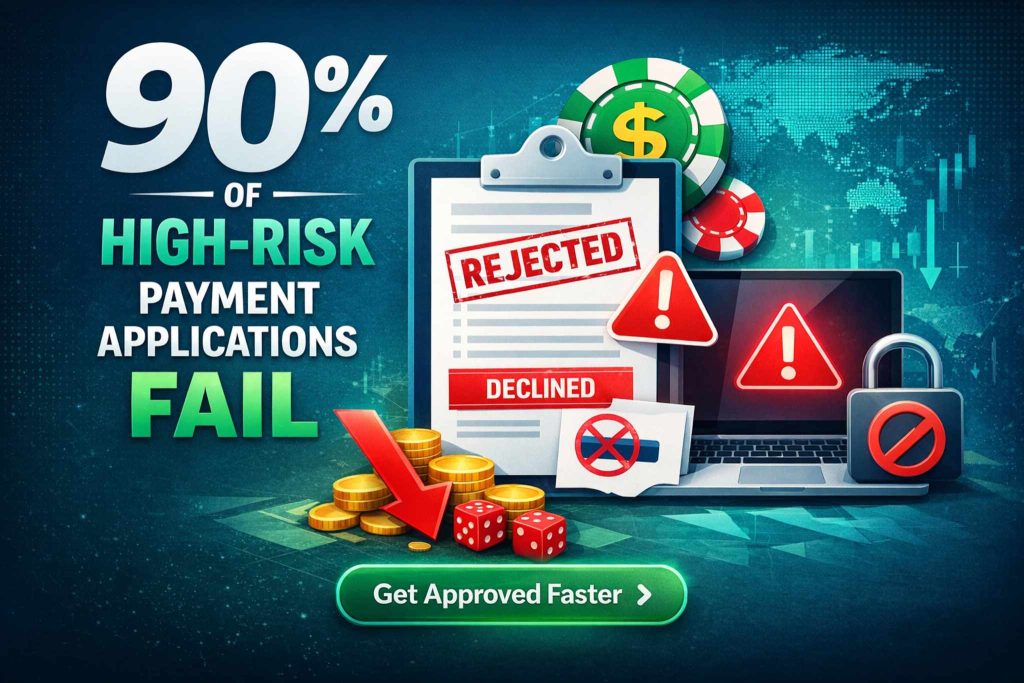
And the reason nearly 90% of applications fail isn’t just because of the industry.
It’s because most businesses don’t understand how to position themselves for approval.
In this guide, you’ll learn:
- Why high-risk payment applications actually fail
- What payment processors look for behind the scenes
- How to structure your business for faster approval
- What you can do today to improve your chances
By the end, you won’t just apply—you’ll apply strategically.
What Is High-Risk Payment Processing?
High-risk payment processing refers to specialized payment solutions designed for businesses that traditional providers consider risky.
These risks can come from multiple factors, including:
- High chargeback potential
- Regulatory complexities
- Cross-border transactions
- Industry-specific risks
Common high-risk industries include:
- Forex and crypto trading
- IPTV and streaming services
- Online gaming and betting
- Adult businesses
- Subscription-based models
Traditional processors often avoid these industries, which is why specialized solutions exist.
But even with specialized providers, approval isn’t guaranteed.
Why 90% of High-Risk Payment Applications Fail
Let’s break this down clearly.
Most rejections are not random—they are triggered by specific risk signals.
1. Your Website Doesn’t Build Trust
Before anything else, underwriters review your website.
If your website raises questions, your application is already at risk.
Common issues include:
- Missing privacy policy or refund policy
- Unclear product or service explanation
- No visible contact details
- Overpromising or misleading claims
From a processor’s perspective, your website reflects your business credibility.
If it looks incomplete or confusing, it signals higher risk.
2. You’re Applying to the Wrong Payment Providers
This is one of the biggest mistakes.
Many businesses apply to mainstream providers that are not designed for high-risk industries.
The result:
- Instant rejection
- Account bans
- Reduced chances with other providers
Each rejection can impact your credibility, making future approvals harder.
3. Your Business Model Isn’t Clearly Defined
Underwriters don’t have time to “figure out” your business.
If they can’t quickly understand:
- What you sell
- How your payment flow works
- Who your customers are
They will reject the application.
Clarity is critical.
4. Documentation Is Incomplete or Inconsistent
Even small inconsistencies can create doubt.
Common problems:
- Mismatched business names
- Missing documents
- Inaccurate financial projections
Payment processors rely on accuracy to assess risk.
If something doesn’t add up, they won’t take the risk.
5. High Chargeback Risk Signals
Chargebacks are one of the biggest concerns for payment processors.
If your business shows signs of:
- Aggressive marketing
- Subscription confusion
- Poor customer support
Your application becomes less attractive.
Processors prefer businesses that demonstrate control over disputes and refunds.
6. No Risk Mitigation Strategy
Most businesses apply without showing how they will manage risk.
This includes:
- Fraud prevention systems
- Chargeback management
- Customer support processes
Without a clear strategy, your business appears unstable.
What Payment Processors Actually Look For
Understanding this changes everything.
Processors evaluate your application based on four key pillars:
1. Transparency
Your business model must be clear and easy to understand.
2. Compliance
Your website and operations must meet regulatory standards.
3. Stability
You should demonstrate consistent operations and realistic projections.
4. Risk Control
You must show how you handle chargebacks and fraud.
If you align with these, your approval chances increase significantly.
How to Get Approved for High-Risk Payment Processing
Now let’s focus on what actually works.
1. Build a Fully Compliant Website
Your website should clearly communicate your business and meet all compliance requirements.
Include:
- Terms and Conditions
- Privacy Policy
- Refund and Cancellation Policy
- Clear product/service details
- Valid contact information
A strong website can instantly improve your credibility.
2. Apply Through High-Risk-Friendly Providers
Instead of applying randomly, choose providers that specialize in high-risk businesses.
These providers:
- Understand your industry
- Offer higher approval rates
- Provide tailored solutions
This single decision can significantly impact your outcome.
3. Prepare Before You Apply
Preparation separates successful applications from failed ones.
Before applying:
- Gather all required documents
- Ensure consistency across all details
- Define your business model clearly
Applying without preparation is one of the biggest reasons for rejection.
4. Demonstrate Risk Awareness
Show that you understand and manage risk.
This includes:
- Clear billing descriptors
- Transparent subscription models
- Customer support systems
- Chargeback prevention tools
This builds trust with underwriters
5. Be Honest and Transparent
Trying to hide details or manipulate information will backfire.
Underwriters verify everything.
Transparency improves your chances of approval and long-term stability.
Why Strategy Is the Real Advantage
Most businesses approach high-risk payment processing as a trial-and-error process.
But the ones that succeed treat it as a strategy.
They:
- Understand what processors expect
- Align their business accordingly
- Apply through the right channels
This is where platforms like Inquid make a difference.
Instead of guessing, you get:
- Access to high-risk-friendly payment processors
- Guidance on improving approval chances
- Faster and more structured onboarding
- Scalable solutions for long-term growth
The Hidden Cost of Rejections
Every rejection has consequences.
It:
- Wastes time and resources
- Delays your business growth
- Impacts your credibility
- Reduces future approval chances
For high-risk businesses, repeated rejection can become a serious bottleneck.
Conclusion
If your high-risk payment application has been rejected before, it doesn’t mean your business is not viable.
It means your approach needs to change.
Once you:
- Strengthen your website
- Clarify your business model
- Apply through the right providers
Approval becomes far more achievable.
Ready to Stop Getting Rejected?
If you want to improve your chances of approval, start by fixing the foundation—not just the application.
Because in high-risk payment processing, success doesn’t come from trying more.
It comes from applying smarter.