
By Inquid Editorial Team | Inquid.net | Last Updated: June 2026
Estimated Read Time: 9 minutes
Quick Answer: A crypto wallet is a digital tool that stores, sends, and receives cryptocurrency without requiring a bank. Unlike traditional banking, crypto wallets operate 24/7, offer near-instant cross-border transfers, and give users full ownership of their funds — making them increasingly popular across Europe for personal finance, crypto payment processing, and business merchant accounts.
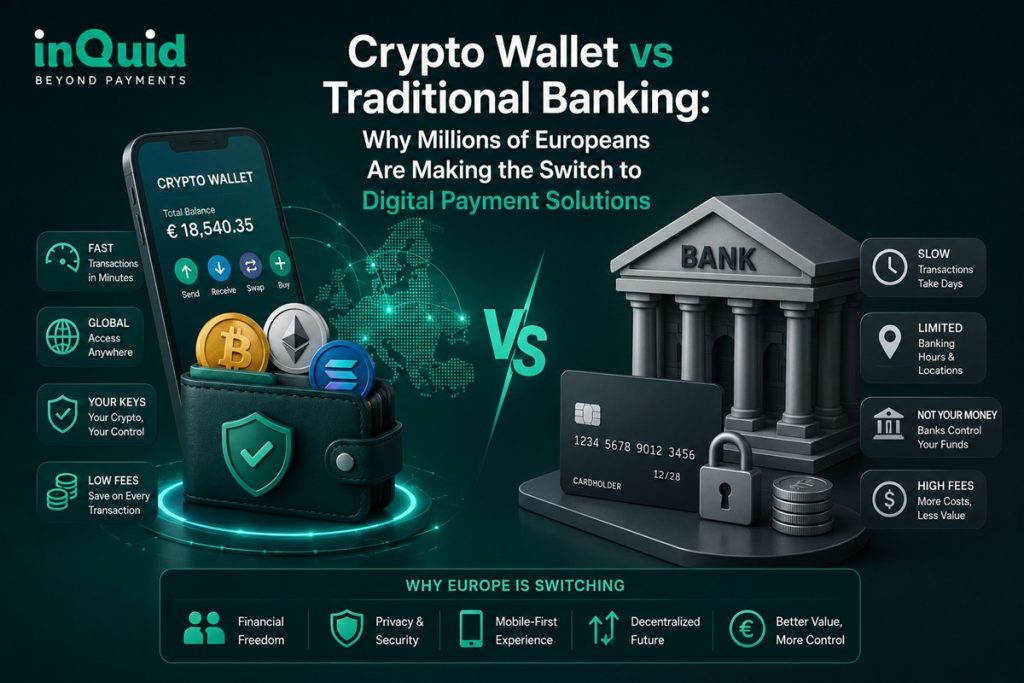
What Is a Crypto Wallet? (Simple Definition)
A crypto wallet is a software or hardware application that stores your private and public cryptographic keys, enabling you to interact with blockchain networks. It does not literally “store” cryptocurrency — instead, it manages the keys that prove ownership of digital assets on the blockchain.
There are three main types:
- Hot wallets (software-based, always online) — ideal for daily crypto payments and quick transactions
- Cold wallets (hardware devices, offline) — best for long-term, high-value asset storage
- Custodial wallets (managed by a third party, like a crypto payment bank or exchange) — similar to a traditional bank account, but for digital assets
For European users comparing crypto banking with traditional financial services, understanding the distinction between custodial and non-custodial wallets is essential.
What Is Traditional Banking? A 2026 Snapshot for European Users
Traditional banking refers to regulated financial institutions — high street banks, digital-only neobanks, and credit unions — that hold customer funds, process payments, and offer credit products under strict EU regulatory frameworks, including the Markets in Crypto-Assets (MiCA) Regulation and the Payment Services Directive 2 (PSD2).
European banks operate under:
- SEPA (Single Euro Payments Area) for intra-EU transfers
- ECB (European Central Bank) oversight
- FSCS-equivalent deposit protection schemes per country
- KYC/AML compliance requirements
While trusted and widely used, traditional banks operate within fixed hours, impose fees on international transfers, and are not designed for blockchain-based financial activities.
Crypto Wallet vs Traditional Banking: Head-to-Head Comparison
| Feature | Crypto Wallet | Traditional Bank Account |
| Availability | 24/7, global | Business hours, region-limited |
| International Transfer Speed | Minutes | 1–5 business days |
| International Transfer Cost | ~0.5–1% | 3–5%+ (SWIFT fees) |
| Deposit Protection | None (non-custodial) | Up to €100,000 (EU Deposit Guarantee Scheme) |
| Privacy | Pseudonymous | Full KYC required |
| Regulatory Oversight | Emerging (MiCA, 2024–2026) | Strict (ECB, national regulators) |
| Credit Products | Limited (DeFi lending) | Full mortgage, credit card, business loan access |
| Merchant Payments | Via crypto merchant account | Via card terminals, bank transfers |
| Self-Custody | Full control (non-custodial) | Bank holds your funds |
| Stablecoin Support | Native | Limited / emerging |
5 Key Reasons Europeans Are Switching to Crypto Wallets
1. Dramatically Lower Fees for Cross-Border Payments
For European businesses and individuals who transact internationally, cost is the number one driver of adoption. Traditional cross-border transfers via SWIFT or correspondent banking networks routinely charge 3–5% in fees, plus unfavourable exchange rates.
Crypto transactions, by contrast, cost approximately 0.5–1% of transaction value on most major networks — and near-zero on newer Layer-2 solutions. The Lightning Network, Bitcoin’s Layer-2 scaling protocol, can theoretically process 1,000,000 transactions per second at fractions of a cent per transaction, outpacing Visa’s 65,000 TPS capacity.
Impact for European SMEs: A small business sending €50,000 monthly in international supplier payments could save €1,000–€2,500 per month by switching to crypto payment processing.
2. True Financial Ownership Through Self-Custody
When you deposit money in a traditional bank, you are technically an unsecured creditor of that bank. The bank owns your funds. Regulations like the EU Deposit Guarantee Scheme protect up to €100,000 per depositor per institution — but beyond this, you have no direct recourse.
A non-custodial crypto wallet inverts this entirely. You hold the private key; you own the asset. There is no third party, no withdrawal limits, and no risk of bank failure wiping out your balance.
This distinction has significant appeal for European users in countries with historically volatile banking systems and for high-net-worth individuals managing assets above deposit guarantee thresholds.
3. 24/7 Access and Instant Settlement
European businesses that operate across time zones or serve global clients frequently run into the same problem: banks close. Wire transfers initiated on a Friday afternoon may not settle until Monday.
Crypto wallets eliminate this friction entirely. Transactions are processed on-chain at any hour, any day, including weekends and public holidays. For e-commerce merchants using a crypto merchant account, this means real-time settlement — without waiting for card networks to batch-process payments.
4. The Rise of Crypto Credit Cards and Hybrid Payment Solutions
The boundary between crypto wallets and traditional banking is dissolving rapidly. Major payment networks are now integrating crypto functionality, and a new class of crypto credit card products has emerged across Europe.
These cards allow users to:
- Spend crypto (or convert it to fiat in real time at point of sale)
- Earn crypto cashback on purchases
- Access crypto-backed credit lines without selling assets
- Use crypto payment bank accounts with IBAN numbers for SEPA transfers
Platforms combining crypto banking features with traditional banking infrastructure are particularly popular in the UK, Germany, the Netherlands, and the Nordics — markets where tech adoption and financial literacy tend to be highest.
5. MiCA Regulation Is Making Crypto Banking Safer in Europe
One of the biggest historical barriers to European crypto adoption was regulatory uncertainty. That changed materially with the Markets in Crypto-Assets (MiCA) Regulation, which entered full force across the EU in 2024–2025.
MiCA establishes:
- Licensing requirements for crypto asset service providers (CASPs)
- Consumer protection standards comparable to traditional finance
- Stablecoin issuance rules (critical for the euro-pegged stablecoin market)
- AML/KYC obligations for crypto exchanges and wallet providers
For European users, this means regulated crypto payment banks and wallet providers now offer a level of oversight and legal protection that reduces the “wild west” perception that previously deterred mainstream adoption.
What Is a Crypto Payment Bank?
A crypto payment bank is a financial services provider that combines traditional banking infrastructure — such as IBANs, SEPA transfers, and card issuance — with native cryptocurrency capabilities including wallet management, on-chain transfers, crypto credit card processing, and stablecoin accounts.
Unlike pure crypto exchanges, a crypto payment bank allows users to:
- Hold and spend both fiat (EUR, GBP, CHF) and cryptocurrency in a single account
- Send and receive SEPA/SWIFT payments alongside on-chain crypto transactions
- Convert between fiat and crypto in real time
- Access crypto credit card products linked to their wallet balance
- Open business-grade crypto merchant accounts for accepting digital payments at scale
Examples of crypto banking models popular in Europe include multi-currency wallets with embedded crypto rails, crypto-backed debit cards, and B2B payment platforms offering crypto credit card processing for online merchants.
How Crypto Merchant Accounts Work for European Businesses
A crypto merchant account enables businesses to accept cryptocurrency payments from customers — either by holding the crypto directly or converting it instantly to EUR upon receipt.
Step-by-step process:
- Merchant signs up with a licensed crypto payment processor
- Unique wallet address or payment link is generated per transaction
- Customer pays in BTC, ETH, USDC, or other accepted currencies
- Payment is confirmed on-chain (typically within seconds to minutes)
- Merchant receives EUR settlement to their bank account, or retains crypto in wallet
Key advantages for EU merchants:
- No chargebacks (blockchain transactions are irreversible)
- Lower processing fees than traditional card networks (typically 0.5–1.5% vs 1.5–3.5%)
- Instant global reach — no currency conversion hassle for international customers
- Compatibility with both B2C and B2B payment flows
Businesses in sectors including SaaS, digital goods, travel, and luxury retail across Europe have been early adopters of crypto merchant account solutions.
Crypto Wallet Security: What European Users Need to Know
Security is the most critical consideration when choosing any crypto wallet. Unlike traditional banking, there is no fraud reversal mechanism for on-chain crypto transactions. Once sent, funds cannot be recalled.
Hot Wallet Security Best Practices
- Enable two-factor authentication (2FA) on all accounts
- Never share your seed phrase — store it offline in a physically secure location
- Use hardware wallets (cold storage) for balances above €500
- Verify every wallet address character before sending
Cold Wallet (Hardware Wallet) Security
Hardware wallets like Ledger and Trezor — both founded by European companies — keep private keys entirely offline. Even if your computer is compromised by malware, a hardware wallet requires physical confirmation for every transaction.
Custodial vs Non-Custodial: The Security Trade-Off
| Custodial Wallet (Crypto Payment Bank) | Non-Custodial Wallet | |
| Who holds the keys? | The provider | You |
| Recovery option? | Yes (customer support) | Only via seed phrase |
| Insurance? | Sometimes (provider-dependent) | No |
| Regulatory protection? | Yes (if MiCA-licensed) | No |
| Best for | Everyday spending, business payments | Long-term holding, maximum privacy |
Traditional Banking vs Crypto Wallets: When to Use Each
Use traditional banking when you need:
- Mortgage or personal loan products
- Deposit guarantee protection (up to €100,000)
- Integration with the mainstream financial system (payroll, direct debits)
- Business credit lines and trade finance
- Tax reporting tools with clear fiat history
Use a crypto wallet when you need:
- Low-cost international transfers
- 24/7 payment capability
- Self-custody and asset ownership
- Access to DeFi (Decentralised Finance) products
- Crypto merchant account functionality for your business
- Privacy-preserving payments within legal frameworks
Use a hybrid crypto payment bank for:
- Daily spending with both fiat and crypto from a single account
- Business payments requiring both SEPA and on-chain rails
- Crypto credit card processing for e-commerce
- Managing multi-currency treasury across EUR, GBP, USDC, BTC
The Future of Crypto Banking in Europe: 2026 and Beyond
The financial landscape in Europe is moving decisively toward hybrid models that blend traditional banking stability with cryptocurrency innovation. Key trends shaping this evolution include:
1. CBDC Integration: The European Central Bank’s Digital Euro project, currently in advanced pilot stages, will create a government-backed digital currency compatible with both traditional bank accounts and crypto wallet infrastructure.
2. Stablecoin Mainstreaming: Euro-pegged stablecoins are gaining traction for B2B payments, remittances, and treasury management. The €213 billion global stablecoin market is expected to grow significantly as MiCA provides a regulated framework for euro stablecoin issuance.
3. Embedded Finance: Traditional banks and fintech platforms across Europe are embedding crypto wallet functionality directly into existing apps — eliminating the need to choose between one system or the other.
4. Institutional Adoption: European asset managers, pension funds, and corporates are increasingly allocating to digital assets and requiring institutional-grade custody solutions that bridge crypto and traditional finance.
Frequently Asked Questions (FAQ)
Q: Is a crypto wallet safer than a bank account in Europe?
A: It depends on the wallet type. Non-custodial wallets give you full control but no recovery option if you lose your private key. Custodial crypto payment banks regulated under MiCA offer consumer protections similar to traditional banks, though typically without deposit guarantee coverage.
Q: Can I open a crypto merchant account in Europe legally?
A: Yes. Since MiCA came into full effect, licensed crypto asset service providers (CASPs) can legally offer crypto merchant accounts across EU member states. Always verify the provider holds a valid CASP licence.
Q: What is the best crypto wallet for European users?
A: The best crypto wallet depends on your use case. For everyday crypto banking, look for MiCA-regulated providers offering IBAN accounts, SEPA compatibility, and crypto credit card access. For self-custody, hardware wallets from EU-based providers offer the highest security.
Q: Do crypto transactions get taxed in Europe?
A: Yes. Most EU countries treat cryptocurrency as a capital asset. Tax rules vary by country — Germany, for example, exempts crypto gains after a 12-month holding period. Always consult a local tax adviser for compliance with national rules.
Q: What is crypto credit card processing?
A: Crypto credit card processing allows businesses to accept payments made with crypto-linked credit or debit cards. The transaction converts crypto to fiat in real time, settling in the merchant’s preferred currency via their crypto merchant account.
Q: Can a crypto payment bank replace a traditional bank?
A: For many everyday needs — spending, transfers, savings, and business payments — yes. However, crypto payment banks currently cannot replace traditional banks for mortgage lending, complex trade finance, or products requiring central bank-backed deposit insurance.
Conclusion: The Smart European Approach Is Hybrid
The narrative of crypto wallet “versus” traditional banking is increasingly outdated. For most European users and businesses, the optimal financial setup in 2026 is a hybrid one: a traditional bank account for mortgage, savings, and regulated financial products — paired with a MiCA-compliant crypto payment bank and crypto wallet for international payments, digital asset management, and business payment processing.
As crypto banking infrastructure matures under European regulation, the friction between these two worlds continues to shrink. For individuals and businesses seeking lower fees, faster transfers, and greater financial autonomy, understanding your crypto wallet options is no longer optional — it is a competitive necessity.
Published by Inquid.net — Your trusted source for digital payment intelligence in Europe.Sources: European Central Bank, MiCA Regulation Official Text (EU 2023/1114), Industry data on transaction benchmarks. All fee estimates are indicative and may vary by provider and network conditions. This article is for informational purposes and does not constitute financial advice.