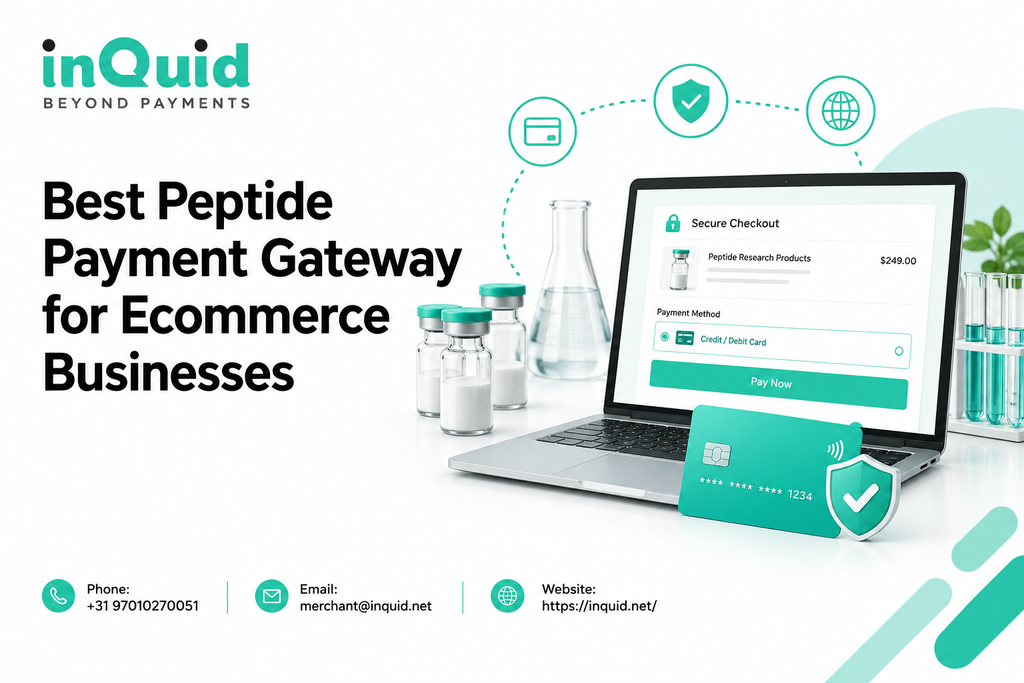
Finding the right peptide payment gateway is an important step for ecommerce businesses looking to accept online payments. Peptide sellers may face additional underwriting requirements, product restrictions, and payment provider policies that differ from those for conventional online stores. Choosing a suitable payment solution requires more than comparing transaction fees. Merchants must consider product eligibility, regulatory requirements, security, settlement terms, and long-term processing needs.
Whether you operate an online research supply store or another peptide-related ecommerce business, understanding these factors can help you evaluate payment providers and prepare a more complete application.
This guide explains how to choose a peptide payment gateway, what to consider when comparing peptide merchant accounts, and how to evaluate payment processing solutions for your business.
What Is a Peptide Payment Gateway?
A peptide payment gateway is the technology that securely transmits payment information between an ecommerce checkout and the relevant payment processing infrastructure. It enables merchants to accept supported online payment methods, including credit and debit cards.
However, a payment gateway alone does not guarantee that a business can process peptide transactions. Merchants also need an appropriate acquiring arrangement and approval for their specific products and business model.
When evaluating providers, consider product eligibility, merchant account requirements, transaction fees, payment security, settlement schedules, and ecommerce integration.
You can learn more about the underlying infrastructure in Inquid’s payment gateway solutions.
Why Peptide Ecommerce Businesses Need Suitable Payment Processing
Peptides are not a single, uniform product category. Different products may have different intended uses, regulatory classifications, and restrictions depending on their composition and the jurisdictions where they are sold.
Consequently, a provider that accepts one type of peptide business may not automatically accept another.
1. Product Eligibility and Regulatory Requirements
Before selecting a peptide payment gateway, establish the legal status of your products in each target market.
Determine whether your products are research materials, regulated pharmaceutical products, prescription-only substances, or another category. Review applicable requirements for product labeling, advertising claims, distribution, and sales.
A research-use disclaimer alone does not establish that a product is lawful to sell or acceptable to a payment provider.
Merchants should accurately describe their products and obtain any required authorizations before accepting payments.
2. Merchant Underwriting and Approval
Payment providers assess applications according to their own policies and the requirements of their acquiring and financial partners.
Depending on the business, an underwriting review may involve:
- Company registration and ownership information.
- Product catalogs and intended-use documentation.
- Supplier records and product specifications.
- Target countries and shipping arrangements.
- Website terms, refund policies, and customer support information.
- Expected monthly processing volume and average order value.
- Relevant licenses or regulatory documentation, where required.
Providing complete and accurate information helps a provider evaluate the actual business model.
For additional guidance, read Inquid’s Merchant Accounts: Complete Guide for Businesses. It explains merchant account arrangements, underwriting considerations, and factors businesses should evaluate before choosing a provider.
3. Chargebacks and Transaction Disputes
Chargebacks can affect a merchant’s processing costs, cash flow, and relationship with an acquiring institution.
Common causes include unclear billing descriptors, delivery disputes, misleading product descriptions, unauthorized transactions, and confusion about refund policies.
Peptide ecommerce businesses should maintain clear product information, provide accurate shipping estimates, issue prompt order confirmations, and offer accessible customer support.
For practical guidance on dispute prevention and payment infrastructure, read Inquid’s High-Risk Payment Gateway for Chargeback Management.
Businesses that require additional underwriting can also explore high-risk merchant account solutions, subject to product eligibility and provider approval.
How to Choose the Best Peptide Payment Gateway
Selecting a peptide payment gateway requires a structured evaluation of provider eligibility, commercial terms, technical compatibility, and operational requirements.
Step 1: Identify Your Peptide Product Category
Document your business model before approaching payment providers.
Identify the products you sell, their intended uses, the countries you serve, the suppliers you work with, and the payment methods your customers need.
This information helps providers determine which underwriting rules apply.
Be transparent about your complete product catalog. A provider cannot reliably assess your eligibility if important product details are missing from your application.
Step 2: Confirm Payment Provider Eligibility
Contact potential providers before committing to an integration.
Ask whether they can review your specific products and business activities. Confirm any restrictions on product categories, customer locations, advertising claims, and sales channels.
Request written clarification about whether approval covers your complete catalog or only selected products.
Provider policies vary, and some peptide products may require additional review or be restricted. Verify each provider’s current policy instead of relying on general statements about peptide payment processing.
For a broader understanding of provider selection, see Inquid’s Ultimate Guide to High-Risk Payment Processors.
This guide can help businesses understand the differences between payment providers and the factors to assess when evaluating processing options.
Step 3: Compare Peptide Merchant Account Options
A merchant account or acquiring arrangement enables a business to receive payments under the applicable contractual terms. A payment gateway securely transmits transaction information and communicates payment responses.
These functions are related, but they are not interchangeable.
When comparing peptide merchant account options, ask:
- Which provider supplies the gateway?
- Which acquiring institution processes the transactions?
- Has the actual product category been reviewed?
- Are separate gateway and merchant account approvals required?
- What transaction, settlement, and reserve conditions apply?
- What happens if the business expands its catalog or enters another market?
Explore Inquid’s merchant account solutions to understand the role of merchant accounts in online payment acceptance.
You can also read The Ultimate Guide to High-Risk Payment Processing for further information about underwriting, payment infrastructure, fraud prevention, and risk management.
Step 4: Compare Total Processing Costs
The lowest advertised transaction fee does not necessarily represent the lowest overall cost.
Request a complete fee schedule and compare the terms relevant to your expected transaction volume.
| Cost component | What to evaluate |
| Setup fees | Initial onboarding and configuration charges |
| Transaction fees | Percentage-based and fixed transaction costs |
| Monthly fees | Recurring gateway or account charges |
| Refund fees | Whether original processing fees are returned |
| Chargeback fees | Costs associated with payment disputes |
| Rolling reserves | Withheld percentages, release schedules, and conditions |
| Settlement fees | Payout, currency conversion, and cross-border charges |
| Contract terms | Minimum commitments and termination fees |
Actual costs depend on the provider, acquiring arrangement, business profile, and agreed contract. Request written pricing rather than relying on generic industry estimates.
Step 5: Review Fraud Prevention and Payment Security
A suitable peptide payment gateway should support security controls appropriate to your business and transaction profile.
Depending on the provider, relevant capabilities may include transaction monitoring, fraud screening, tokenization, and 3-D Secure authentication.
Review the payment provider’s PCI DSS responsibilities and determine which security obligations remain with your ecommerce business.
Fraud prevention tools can help identify suspicious activity, but they cannot eliminate fraud or guarantee payment approval.
Step 6: Check Ecommerce Integration
Your payment infrastructure should integrate with the platform used to manage your online store.
Check compatibility with WooCommerce, Shopify, Magento, or your custom ecommerce system, as applicable.
Confirm that the integration supports your required transaction flow, refunds, payment notifications, reconciliation, and checkout experience.
Technical compatibility does not mean that the provider has approved your products. Commercial eligibility must be established separately.
Explore Inquid’s ecommerce payment solutions to learn more about payment infrastructure for online stores.
Essential Features of Peptide Payment Processing
Once product eligibility is established, compare providers based on the capabilities your business needs.
Reliable Payment Processing
Evaluate gateway availability, transaction reporting, integration support, and the process for investigating failed payments.
A suitable payment setup should provide clear visibility into payment statuses, refunds, settlement records, and transaction errors.
Transparent Settlement Terms
Understand when funds are expected to reach your operating account and what circumstances may affect settlement.
Ask about reserve requirements, payout frequency, settlement currencies, and the conditions under which funds can be withheld.
These details matter when planning inventory purchases, supplier payments, and other working-capital commitments.
Fraud and Chargeback Management
Review the tools available to monitor suspicious transactions and manage disputes.
Relevant capabilities may include transaction alerts, risk rules, authentication options, and dispute documentation workflows.
Establish procedures for reviewing orders, communicating with customers, and responding to legitimate disputes.
For additional guidance, visit Inquid’s chargeback management guide.
International Payment Capabilities
If you serve customers across borders, check supported transaction currencies, settlement currencies, cross-border fees, and geographic restrictions.
Payment availability does not mean every peptide product can be sold in every market. Product eligibility, local requirements, and provider restrictions still apply.
Inquid’s International Payment Processing: Complete Guide provides further information about currencies, payment methods, geographic coverage, settlement, and compliance considerations for international businesses.
Alternative Payment Methods
Depending on your audience and target markets, alternative payment methods may be worth evaluating alongside card payments.
Availability varies by provider, country, business category, and product eligibility. Confirm that the proposed payment method can legally and contractually be used for your business.
Explore Inquid’s alternative payment methods solutions to learn more about supported options for eligible businesses.
How to Prepare for a Peptide Merchant Account Application
Preparing documentation before applying can help reduce avoidable delays during underwriting.
Organize the following information where applicable:
Business documentation: Company registration, ownership details, business address, and identity verification records.
Product documentation: A complete catalog, specifications, intended-use information, labeling, and other requested supporting documents.
Supplier records: Invoices and evidence of legitimate sourcing, where applicable.
Website policies: Clear terms and conditions, shipping information, refund policies, privacy notices, and customer support details.
Processing estimates: Expected monthly sales, average order value, target markets, and anticipated transaction volumes.
Previous processing history: Statements or other records from existing providers, if requested.
Compliance documentation: Any required licenses, authorizations, or product documentation relevant to the products and jurisdictions involved.
Ensure that your website and application accurately reflect the products you intend to sell. Do not conceal products or misrepresent your business model to obtain approval.
Approval remains subject to the provider’s underwriting decision, contractual requirements, and applicable laws.
For further information about business documentation and merchant account options, refer to Inquid’s complete merchant account guide.
Managing Payment Continuity as Your Business Grows
As an ecommerce business expands, its payment infrastructure may need to accommodate higher transaction volumes, additional markets, or new payment methods.
Merchants should periodically review their processing arrangements, contractual terms, settlement exposure, and operational dependencies.
Some businesses may consider multiple merchant accounts where permitted and appropriate for their operating model. Each account must be correctly disclosed, independently approved, and used in accordance with its agreement.
Read Inquid’s article on Multiple Merchant Accounts: Why High-Risk Businesses Need More Than One to understand the potential role of processing redundancy and the considerations involved in managing multiple acquiring relationships.
Businesses should also regularly review their regulatory responsibilities. Inquid’s Global Payment Processing Compliance Guide offers additional background on compliance considerations across payment environments.
Why Consider Inquid for Ecommerce Payment Infrastructure?
Inquid provides fintech and payment infrastructure solutions for businesses evaluating payment acceptance, merchant accounts, and related processing requirements.
Depending on eligibility and provider availability, merchants can explore:
- Payment gateway solutions for online payment acceptance.
- Merchant account solutions for acquiring and payment settlement arrangements.
- Credit card processing solutions for card-based transactions.
- High-risk merchant account solutions for businesses requiring specialized underwriting.
- Ecommerce payment solutions for online stores.
For peptide ecommerce businesses, the next step is to explain the actual products sold, intended use, target markets, and expected transaction profile. This information helps determine whether a suitable provider arrangement can be considered.
Before proceeding, confirm whether the product category is eligible, what documentation is required, and which fees, settlement terms, and restrictions would apply.
Inquid’s services and provider arrangements remain subject to product eligibility, applicable regulations, and underwriting approval.
Frequently Asked Questions
1. What is the best peptide payment gateway for an online store?
The best option is a provider arrangement that has reviewed your actual products, business model, and target markets. Compare product eligibility, processing costs, security, settlement terms, and integration requirements before choosing a solution.
2. Can I use a standard ecommerce payment gateway to sell peptides?
Possibly, depending on the products, applicable regulations, and provider policies. Some peptide sales may be permitted under specific conditions, while other products may require additional approval or be restricted. Confirm eligibility directly with the provider before accepting transactions.
3. Do peptide businesses need a high-risk merchant account?
Not every peptide business receives the same risk classification. Some merchants may need specialized underwriting or a particular acquiring arrangement because of product restrictions, regulatory considerations, or transaction risks.
4. What documents are required for a peptide merchant account?
Requirements vary by provider and product category. Common requests may include company registration, ownership verification, a complete product catalog, supplier documentation, website policies, sales estimates, and relevant regulatory records.
5. How much does peptide payment processing cost?
Costs depend on the provider, transaction profile, business category, and contractual terms. Compare transaction fees, setup and monthly charges, chargeback costs, refund terms, reserve requirements, and settlement fees.
6. Can a payment provider guarantee approval for a peptide business?
Approval depends on the provider’s underwriting criteria, product eligibility, applicable laws, and the business’s specific circumstances. Merchants should be cautious of claims promising guaranteed approval.
7. Can Inquid help me evaluate payment solutions for my peptide store?
You can contact Inquid to discuss your business model and payment requirements. Any available arrangement will depend on product eligibility, provider availability, applicable regulations, and underwriting approval.
Conclusion
Choosing the best peptide payment gateway involves more than finding a provider with competitive fees. Ecommerce businesses should establish product eligibility, understand applicable regulations, and obtain clear information about underwriting requirements.
Once eligibility is confirmed, compare merchant account options, payment security, integration, settlement conditions, and total processing costs. Preparing accurate documentation and maintaining transparent product information can help you evaluate providers more effectively.
To explore suitable payment infrastructure, visit Inquid’s payment gateway solutions, merchant account solutions, or high-risk merchant account solutions.