
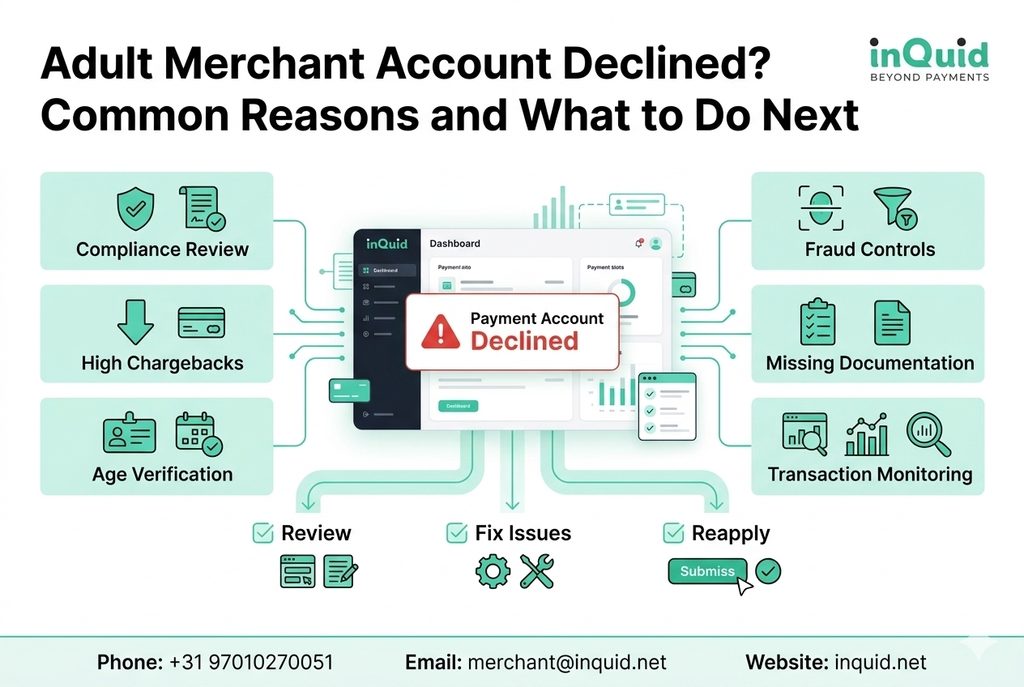
An adult merchant account can be harder to obtain or maintain than a standard merchant account because payment providers may apply additional underwriting, compliance, fraud, and chargeback controls to adult businesses.
Most declines come down to a few areas: business-model eligibility, previous processing history, chargebacks and fraud, compliance controls, age verification, and the provider’s risk appetite.
A declined application does not necessarily mean an adult business cannot accept card payments. It may indicate that the provider needs more information, does not support the particular business model, or has identified a risk that needs to be addressed.
Important: Payment acceptance depends on the merchant, acquiring institution, card-network rules, applicable laws, and provider policies. No payment provider can guarantee approval.
This guide explains the most common reasons an application may be declined, how transaction declines differ from application rejections, and what an adult business can review before applying again.
Application Rejection vs. Transaction Decline
These are two different payment problems.
| Situation | What It Usually Means | What to Review | Possible Next Step |
| Application rejected | Provider does not currently want to onboard the business | Business model, documentation, risk profile | Correct gaps or approach a compatible provider |
| Application delayed | Additional information is required | KYC/KYB, statements, website, ownership | Provide requested documentation |
| Transaction declined | A specific payment was not authorized or processed | Decline code, issuer, gateway, fraud controls | Identify the source of the decline |
| Repeated transaction declines | Payment configuration or customer-risk issue may exist | Authentication, billing data, fraud rules | Review transaction and payment settings |
| Account under review | Provider has identified a risk or compliance issue | Processing activity and documentation | Respond to the review |
| Settlement restricted | Funds are subject to additional controls | Reserve terms, disputes, unusual activity | Work with the provider on the review |
| Account terminated | Provider or acquirer ended the relationship | Termination reason and account history | Understand the cause before reapplying |
The distinction is important because the solution depends on where the problem occurred.
8 Common Reasons an Adult Merchant Account Is Declined
1. The Business Model, Website, or Documentation Is Unclear
These issues often overlap during underwriting.
A provider needs to understand what the business sells, who its customers are, how payments work, and what controls are in place.
Problems can arise when:
- The website does not match the application
- Products or services are poorly explained
- Pricing is unclear
- Subscription terms are difficult to find
- Ownership information is incomplete
- Processing estimates appear unrealistic
- Refund or cancellation policies are missing
- The legal business identity is unclear
Before applying, prepare a consistent information package covering:
- Company registration
- Ownership structure
- Identification documents
- Business bank statements
- Processing history
- Website and checkout details
- Expected monthly processing volume
- Average transaction value
- Refund and cancellation procedures
- Customer support process
- Compliance controls
The goal is to make the business easy for an underwriter to understand.
2. Previous Processing Problems or MATCH Pro Listing
Previous merchant-account problems can affect a future application.
Mastercard operates MATCH Pro, its Mastercard Alert to Control High-Risk Merchants system. Mastercard describes MATCH Pro as a tool that enables acquiring partners to identify merchants previously terminated by another acquiring partner and review applicable termination information.
The current Mastercard Security Rules and Procedures—Merchant Edition also contains MATCH Pro reason codes covering certain circumstances behind merchant termination.
Potential issues can include:
- Fraud
- Compromised account data
- Transaction laundering
- PCI-related problems
- Other qualifying termination reasons
A previous termination does not necessarily mean every future application will be rejected. However, it can become an important part of an acquirer’s risk assessment.
If you believe information associated with a MATCH Pro listing is incorrect, the appropriate route is generally through the relevant acquiring institution rather than attempting to conceal the history in a new application.
3. Chargebacks and Card-Network Monitoring
Chargebacks are an important part of ongoing payment risk.
Visa’s Visa Acquirer Monitoring Program (VAMP) consolidated its previous fraud and dispute monitoring programs into a single program. Visa monitors fraud and dispute levels and identifies merchants or acquirers that exceed applicable thresholds.
For AP, Canada, the EU and U.S., Visa’s current VAMP fact sheet states that the excessive-merchant threshold was reduced to 150 basis points effective April 1, 2026. The same source specifies a minimum monthly count of 1,500 fraud and dispute events for the applicable regions.
These figures should not be treated as a universal “safe” chargeback level. Acquirers can apply their own risk controls and may intervene before a merchant reaches a network-program threshold.
Mastercard operates the Excessive Chargeback Program (ECP) and distinguishes between Excessive Chargeback Merchants and High Excessive Chargeback Merchants. Its current Merchant Edition contains requirements for acquirers to monitor applicable merchant activity and directs readers to Mastercard’s relevant monitoring documentation for operative program details.
For an adult business, effective chargeback management should therefore begin before disputes become a serious problem.
Useful measures include:
- Clear billing descriptors
- Transparent subscription terms
- Easy cancellation
- Responsive customer support
- Fraud monitoring
- Transaction authentication
- Accurate transaction records
- Timely dispute responses
4. Adult-Content Compliance and Age-Verification Gaps
Adult-content businesses can face additional requirements because card networks expect safeguards against illegal or prohibited activity.
Visa’s current Network Integrity guidance says legal adult-content merchants face elevated risk of illegal activity and require enhanced safeguards. Visa’s requirements include age and consent verification, records supporting those checks, and a complaint process for potentially illegal content.
Visa identifies the Visa Integrity Risk Program (VIRP) as part of its framework for preventing, identifying, and removing illegal activity across its ecosystem. Visa says adult-content merchants go through an enhanced registration process and are subject to closer performance monitoring.
Mastercard’s current Merchant Edition also contains specific requirements for non-face-to-face adult-content and services merchants, including registration and controls relating to content providers, age and identity verification, consent records, content review, complaints, and prohibited content.
For a merchant, this means underwriting may involve questions beyond ordinary financial documentation.
Businesses should be prepared to explain:
- How customers’ ages are verified where required
- How performers or content providers are verified
- How consent is documented
- How content is reviewed
- How prohibited content is detected
- How complaints are handled
- How takedown procedures operate
- How relevant records are maintained
A note on legal requirements
Age-verification laws differ by jurisdiction and can change quickly. The information above is a payment-industry overview, not legal advice. Adult businesses should obtain qualified legal advice for the jurisdictions in which they operate and serve customers.
5. Creator, Marketplace, or Payout Models Are Not Clearly Documented
Creator platforms and marketplaces can face additional underwriting questions because the merchant may process payments on behalf of multiple content providers.
For example, a platform may:
- Collect a customer’s payment
- Record the transaction
- Retain a platform fee
- Pay a creator
- Manage refunds and disputes
The provider may therefore want to understand the complete money flow.
Businesses using this model should document:
- How creators are onboarded
- How creator identity is verified
- How age is verified
- How consent is documented
- How payouts are calculated
- When payouts occur
- What happens after a refund
- Who is responsible for chargebacks
- How prohibited creators or content are removed
This is also relevant to card-network compliance. Mastercard’s current rules specifically address third-party content providers and verification requirements for applicable adult-content merchants.
Clear creator onboarding and payout procedures can therefore become part of the underwriting package rather than an operational detail handled later.
6. Fraud Controls Are Too Weak for the Processing Model
Online adult businesses may face fraud, card testing, account takeover, and disputed transactions.
Depending on the business model, relevant controls can include:
- 3-D Secure
- Card security checks
- Velocity limits
- Transaction monitoring
- Device and IP analysis
- Risk scoring
- Bot and card-testing controls
- Manual review
- Account-takeover protection
Mastercard’s current rules require monitoring of relevant merchant activity and risk indicators, including fraud, chargebacks, transaction volume, and activity inconsistent with the merchant’s approved business model.
The objective is not to reject every unusual transaction. It is to identify transactions that create an unacceptable level of fraud or payment risk while allowing legitimate customers to complete purchases.
7. Processing Activity Does Not Match the Underwriting Profile
Payment providers assess a business using information available when the account is opened.
For example, hypothetically, a merchant might estimate $20,000 in monthly processing and then quickly begin processing $150,000.
A significant change like that could result in additional review because the provider’s original risk assessment was based on a very different transaction profile.
Other changes can include:
- A major increase in average transaction value
- Rapid international expansion
- Higher refund activity
- Significant subscription growth
- New products or services
- New customer markets
- Major increases in transaction volume
If material changes are expected, discuss them with the provider rather than assuming the original underwriting profile will automatically remain appropriate.
8. The Provider Does Not Support the Business Model or Geography
Sometimes the problem is simply provider fit.
A business can be legitimate, well documented, and professionally operated but still fall outside a provider’s underwriting policy.
Support can differ based on:
- Adult-content category
- Subscription model
- Digital products
- User-generated content
- Creator marketplaces
- Recurring payments
- Merchant jurisdiction
- Customer geography
- Settlement requirements
This is why businesses should not compare providers only by advertised processing rates.
The more important question is whether the provider’s acquiring and payment infrastructure is compatible with the actual business model.
Transaction Declines: What Should You Check?
An application rejection is different from a declined customer transaction.
If your merchant account is already active but transactions are being declined, review the decline reason first.
Common causes can include:
- Issuer declines
The cardholder’s issuing bank may decline a transaction because of insufficient funds, suspected fraud, card restrictions, or another issuer-side decision.
- AVS or billing-information failures
Incorrect billing information can trigger payment or fraud rules, particularly for card-not-present transactions.
- 3-D Secure or authentication failures
A customer may fail or abandon required authentication, resulting in an unsuccessful payment.
- Gateway or fraud-rule blocks
Your gateway or fraud system may block a transaction because it matches a risk rule.
- Card or account restrictions
The card may be expired, blocked, restricted for online transactions, or otherwise unable to complete the purchase.
The practical approach is to identify the source of the decline rather than assuming the merchant account itself is the problem.
Age-Verification Requirements Are Becoming More Important
Age assurance is increasingly relevant to adult businesses operating across multiple markets.
- United Kingdom
Ofcom states that pornography services covered by the UK’s Online Safety Act must use highly effective age assurance to prevent children from encountering pornographic content.
This is not simply a theoretical compliance issue. On September 22, 2026, Ofcom opened an investigation into Aylo Freesites Ltd. concerning its adult service Pornhub and whether its age-assurance process meets the required standard. The investigation is ongoing, and the opening of an investigation does not itself establish a violation.
For adult businesses serving UK users, age assurance should therefore be treated as an operational and compliance consideration.
- European Union
The European Commission has developed a privacy-preserving EU age-verification solution for age-restricted online content.
The Commission says its recommendation sets out actions for Member States to roll out age-verification tools by the end of 2026. The approach is designed to allow users to prove they are over 18 without unnecessarily sharing additional personal information.
The Commission also states that the solution is designed to work with the EU Digital Identity Wallet framework being rolled out across Member States.
- United States
The U.S. approach is more fragmented because age-verification requirements can vary by state.
Texas provides a significant example. In Free Speech Coalition v. Paxton, decided June 27, 2025, the U.S. Supreme Court upheld Texas H.B. 1181, which requires certain commercial websites publishing sexually explicit material that is obscene to minors to verify visitors are 18 or older.
The Court’s opinion also noted that Texas was among a growing group of states with similar age-verification requirements.
For businesses operating nationally, the practical implication is that age-assurance requirements should be reviewed based on the states and jurisdictions being served.
What to Do If Your Adult Merchant Account Is Declined
1. Request the General Reason
Ask the provider why the application was declined and whether additional information could support a reconsideration.
A provider may not disclose every internal underwriting factor, but even a general reason can help identify what needs to change.
2. Audit Your Website and Checkout
Review:
- Pricing
- Terms and conditions
- Refund policy
- Cancellation process
- Privacy policy
- Customer support
- Subscription disclosures
- Legal business identity
- Product or service descriptions
The website, application, and actual payment flow should be consistent.
3. Review Your Processing History
Prepare:
- Previous processing statements
- Chargeback data
- Refund data
- Fraud information
- Average ticket
- Monthly volume
- Decline rates
- Previous provider correspondence
If there was a previous termination, determine whether MATCH Pro information may be relevant.
4. Review Compliance Controls
For applicable adult-content businesses, document:
- Customer age-assurance procedures
- Creator/content-provider verification
- Performer identity and age verification
- Consent records
- Content moderation
- Complaint handling
- Takedown procedures
- Prohibited-content controls
These controls can be particularly important where the business operates a platform or marketplace.
5. Address Chargebacks Before Reapplying
Do not simply submit another application while the underlying dispute problem remains.
Build a documented chargeback management process covering:
- Prevention
- Customer communication
- Refunds
- Evidence collection
- Dispute responses
- Monitoring
- Root-cause analysis
Visa’s VAMP framework and Mastercard’s chargeback-monitoring requirements illustrate why fraud and dispute performance can affect payment relationships beyond the initial onboarding decision.
6. Review Your Payment Infrastructure
An account is only one part of the payment stack.
Review the relationship between:
- Merchant account
- Acquirer
- Payment gateway
- Fraud tools
- Authentication
- Recurring billing
- Checkout
- Settlement
- Dispute management
For businesses operating across countries, an international payment gateway may also need to be evaluated for currency support, geographic coverage, acquiring relationships, and risk controls.
Need Help Reviewing Your Payment Setup?
If your adult merchant account application has been declined, the first step is to understand the reason and identify what needs to change.
Talk to the Inquid team about your business model, processing requirements, target markets, and payment infrastructure.
Choosing a Provider After a Decline
When evaluating another provider, look beyond the advertised processing rate.
- Industry compatibility
Confirm that the provider supports your specific adult business model.
- Geographic coverage
Check whether it supports the jurisdictions where your business and customers operate.
- Payment methods
Determine whether you need cards only or additional alternative payment methods.
- Recurring payments
If your business uses subscriptions, confirm that recurring billing is supported.
- Fraud controls
Ask what fraud-monitoring and authentication tools are available.
- Chargeback support
Understand how disputes are monitored and what evidence can be supplied.
- Compliance
Ask what documentation and ongoing reviews apply to your category.
- Settlement
Review settlement timing, reserves, limits, and other applicable controls.
- Integration
Confirm compatibility with your website, shopping cart, subscription platform, and existing payment technology.
A provider that understands the business model may be more appropriate than one offering a lower headline rate without a suitable underwriting pathway.
Adult Merchant Account: Pros and Cons of Specialized Processing
Pros
- Can accommodate business models that some mainstream providers do not support
- May provide underwriting designed around higher-risk industries
- Can support specialized fraud and dispute controls
- May accommodate recurring or international payment models where supported
- Can provide infrastructure aligned with specific business requirements
Cons
- Underwriting may be more detailed
- Processing costs can be higher
- Reserves or additional risk controls may apply
- Compliance requirements can be extensive
- Processing limits may apply
- Provider availability varies by business model and geography
Commercial terms depend on the merchant, provider, acquiring arrangement, jurisdiction, and risk profile.
Frequently Asked Questions
- Why was my adult merchant account declined?
Common reasons include an unsupported business model, incomplete documentation, previous processing problems, MATCH Pro history, chargeback exposure, weak fraud controls, compliance gaps, geographic restrictions, or provider risk appetite.
- Can a MATCH Pro listing affect a new application?
Yes, it can be considered during acquiring decisions. Mastercard describes MATCH Pro as a system for identifying merchants previously terminated by another acquiring partner and reviewing relevant termination information.
- Are adult businesses subject to additional card-network requirements?
Yes. Visa requires enhanced safeguards for applicable adult-content merchants, including age and consent verification and complaint handling. Mastercard also has specific requirements for applicable non-face-to-face adult-content merchants.
- Can chargebacks cause an account to be reviewed?
They can contribute to monitoring and risk decisions. Visa operates VAMP, while Mastercard operates ECP and other monitoring programs.
- Can adult businesses use recurring billing?
Some providers support recurring billing, while others may restrict it. Confirm support before onboarding and provide clear subscription and cancellation disclosures.
- What if my business is a creator or adult-content marketplace?
Expect additional questions about creator onboarding, identity and age verification, consent, content moderation, payouts, refunds, and dispute responsibility.
- Do UK adult businesses need age verification?
Relevant adult services are subject to highly effective age-assurance duties under the UK’s Online Safety Act. Ofcom actively monitors compliance with these requirements.
- Are EU adult businesses affected by age-verification requirements?
The European Commission is developing and rolling out privacy-preserving age-verification tools and has called for Member States to take steps toward rollout by the end of 2026.
- What changed in the U.S. regarding age verification?
In June 2025, the U.S. Supreme Court upheld Texas H.B. 1181, which requires age verification for certain websites providing sexually explicit material that is obscene to minors. State requirements can differ.
- Can a payment gateway fix an adult merchant account rejection?
Not by itself. A gateway is one part of the payment infrastructure. Approval depends on underwriting, acquiring, business-model eligibility, compliance, risk, and other factors.
- What should I do before applying again?
Review the rejection reason, website, documentation, processing history, MATCH Pro exposure, chargebacks, fraud controls, compliance procedures, creator onboarding, and target markets before submitting another application.
Conclusion
An adult merchant account decline can result from several different issues, and the most effective response is to identify the specific problem before applying again.
For some businesses, the issue may be documentation or an unclear business model. For others, previous processing history, MATCH Pro information, chargebacks, fraud exposure, age-assurance requirements, content controls, creator onboarding, or provider eligibility may be more significant.
The payment environment is also changing. Visa’s VAMP program now uses updated monitoring thresholds, Visa applies enhanced controls to applicable adult-content merchants through its Visa Integrity Risk Program, and Mastercard maintains specific rules for adult-content acquiring and monitoring.
At the same time, age-assurance requirements are developing across the UK, EU, and U.S., making compliance an increasingly important part of the payment strategy for adult businesses serving multiple markets.
For businesses seeking reliable payment processing, the goal should not simply be to find a provider that says yes. It is to build a payment setup that accurately represents the business, manages fraud and disputes, supports applicable compliance requirements, and can accommodate its expected processing profile.
If your application has been declined, start with the reason for the decision. Then review your business documentation, payment infrastructure, risk controls, compliance procedures, and target markets before approaching another provider.
Need to review your payment requirements? Talk to Inquid about your merchant-account and payment-processing needs, including high-risk payment infrastructure, international payment acceptance, and other payment solutions.
Authoritative Resources