Introduction
For US businesses serving customers internationally, choosing the right payment infrastructure can become increasingly important as transaction volume and geographic reach grow. Cross-border card payments, multiple currencies, foreign-exchange costs, chargebacks, settlement requirements, and local payment preferences can all influence revenue and cash flow.
In some cases, offshore merchant account providers may offer an international acquiring structure that suits businesses with significant cross-border activity or specialized payment requirements. An offshore merchant account generally involves an acquiring or merchant-account relationship established outside the United States.
However, offshore payment processing should not be viewed as a shortcut around underwriting, compliance, or card-network requirements. The business still needs to provide accurate information, pass appropriate due diligence, maintain suitable security controls, and operate within applicable laws and payment-network rules.
This guide explains how offshore merchant accounts work for US businesses, why a company might consider one, how to compare providers and costs, what risks to evaluate, and how international payment processing can fit into a broader growth strategy in 2026.
Important: “Offshore merchant account” is a broad commercial term rather than a standardized regulatory category. The actual acquiring bank, processing entity, jurisdiction, and contractual structure matter more than the label itself.
What Is an Offshore Merchant Account?
An offshore merchant account is a payment-processing arrangement in which the merchant-account or acquiring relationship is established outside the merchant’s home country.
For a US business, this may mean working with an acquiring bank or payment provider based in another jurisdiction.
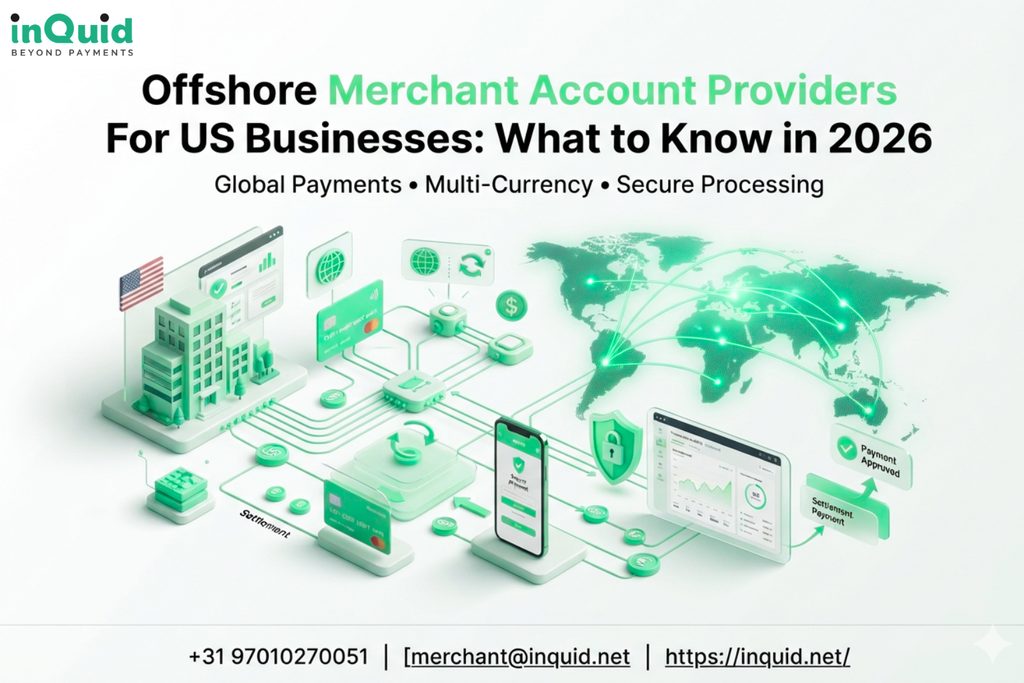
A simplified payment flow looks like:
US Business → Payment Gateway → Acquirer → Card Network → Customer’s Issuing Bank → Authorization → Settlement
The merchant may still accept major card brands, but the underlying acquiring relationship, supported currencies, settlement options, underwriting process, and commercial terms can differ from a conventional domestic merchant account.
It is also important to understand what “offshore” does and does not mean.
An offshore merchant account does not automatically mean:
- The business is incorporated offshore
- Customers must be outside the US
- Funds must be held offshore
- US obligations disappear
- Card-network rules no longer apply
The term primarily describes the location or jurisdiction of the acquiring arrangement.
Are Offshore Merchant Accounts Legal for US Businesses?
An offshore merchant account is not inherently unlawful simply because the acquiring relationship is outside the United States.
What matters is whether the overall structure complies with applicable laws, contracts, sanctions requirements, tax obligations, card-network rules, and regulatory requirements.
A business should never use an offshore structure to conceal beneficial ownership, misrepresent its products or services, disguise processing activity, or bypass restrictions.
US businesses should be prepared to provide accurate information about:
- Legal entity and ownership
- Beneficial owners
- Products and services
- Website domains
- Expected processing volume
- Average and maximum transaction size
- Customer locations
- Processing currencies
- Refund history
- Chargeback history
Visa states that acquirers must conduct applicable compliance checks before merchants can accept Visa payments. Visa also identifies legal adult-content and gambling businesses as categories that can carry elevated risk for illegal activity and says merchants in these categories can be subject to enhanced registration and closer performance monitoring.
The important takeaway is straightforward:
Offshore payment processing does not mean regulation-free payment processing.
Why Would a US Business Consider an Offshore Merchant Account?
Not every US business needs offshore acquiring. For a company that primarily sells domestically in USD, a US merchant account may remain the simpler choice.
An international acquiring structure may be worth evaluating when there is a genuine commercial reason.
- International Customer Base
A business generating a substantial share of revenue from customers outside the US may need infrastructure designed around cross-border transactions.
- Multi-Currency Requirements
Companies selling in several markets may want customers to pay in familiar currencies and may also require settlement in more than one currency.
- Specialized Business Models
Certain industries may have narrower acquiring options. Depending on the business model and provider’s underwriting criteria, an international arrangement may provide an additional structure to evaluate.
- International Expansion
A company entering multiple overseas markets may prefer a payment infrastructure that can support different countries without requiring a completely separate payment project for each market.
- Settlement Requirements
Some businesses may find multi-currency settlement commercially useful when their operating costs, suppliers, or treasury activities are spread across several jurisdictions.
The goal should always be the same:
Use an international acquiring structure because it solves a genuine payment requirement—not simply because it sounds easier.
Offshore Merchant Account vs. Domestic Merchant Account
US businesses often compare an offshore merchant account with a conventional domestic account.
| Feature | Offshore Merchant Account | Domestic Merchant Account |
| Acquiring location | Outside the US | Generally within the US |
| Typical use case | International or specialized processing | Primarily domestic processing |
| Currency support | May support multiple currencies | Usually centered on USD |
| Cross-border transactions | Often important | May be supported depending on provider |
| Settlement | May support multiple currencies | Usually simpler domestic settlement |
| Underwriting | Provider- and jurisdiction-dependent | US acquiring relationship-dependent |
| Compliance | Potentially multiple jurisdictions | Primarily US-focused plus network requirements |
| FX exposure | Potentially higher | Usually lower |
| Reconciliation | Can involve multiple currencies | Generally simpler |
| Provider due diligence | Essential | Essential |
Neither option is automatically better.
A US company selling almost entirely to domestic customers may have little reason to use offshore acquiring. A business with significant international revenue, multiple currencies, or specialized processing needs may have a stronger reason to compare offshore and international merchant-account options.
How Offshore Payment Processing Works
The transaction normally involves several stages.
1. Customer Checkout
The customer purchases a product or service through the merchant’s website, application, ecommerce platform, or subscription system.
The merchant can price the transaction in USD or another supported currency.
2. Offshore Payment Gateway
An offshore payment gateway provides the technical connection between the merchant’s checkout and payment-processing infrastructure.
Depending on the solution, it may support:
- Payment authorization
- Tokenization
- Recurring billing
- Fraud screening
- Authentication
- Refund processing
- Transaction reporting
3. Acquirer
The acquiring institution processes the transaction through the applicable card-network infrastructure.
4. Issuing Bank
The customer’s bank evaluates the payment and returns an approval or decline.
5. Clearing and Settlement
Approved transactions move through clearing and settlement according to the merchant agreement.
Settlement timing, currencies, reserves, and payout conditions can vary depending on the provider and acquiring arrangement.
Offshore Merchant Account Providers for US Businesses
The following companies are included as providers or payment platforms to evaluate, not as an independent ranking from an unrelated third party. Their suitability depends on the merchant’s industry, countries served, processing volume, risk profile, acquiring arrangement, and current eligibility requirements.
1. Inquid
Inquid is a strong option to evaluate when a US business needs specialized or international payment infrastructure.
Inquid currently promotes high-risk merchant-account solutions across the US, UK, and Europe and describes support for businesses with complex acquiring requirements. Its site also provides specialized industry payment solutions, including adult merchant accounts and payment gateways.
For businesses comparing offshore merchant account providers, areas to evaluate with Inquid can include:
- High-risk merchant accounts
- International payment processing
- Payment gateway solutions
- Multi-currency payment capabilities
- Chargeback and risk-management support
- Specialized industry solutions
- Cross-border payment infrastructure
Inquid is particularly relevant to businesses whose payment requirements are more complex than a standard domestic ecommerce setup.
Best suited for: Eligible US businesses evaluating specialized, international, or high-risk merchant-account and payment-processing solutions.
Important: Eligibility, acquiring structure, supported industries, fees, and settlement terms should be confirmed directly with Inquid during underwriting.
2. WebPays
WebPays presents itself as a financial-services and payment-gateway company supporting international and high-risk businesses. Its current LinkedIn company profile lists payment gateways, high-risk merchant accounts, global processing, and merchant-account services among its specialties.
Its published material also discusses high-risk processing, global payment support, multi-currency payment options, and cross-border payment infrastructure.
For merchants considering WebPays, due diligence should include verifying:
- The actual acquiring institution
- Countries supported
- Settlement currencies
- Processing and gateway fees
- Reserve requirements
- Contract terms
- Customer-support arrangements
- Compliance documentation
This is especially important for any offshore or international merchant account because the provider’s marketing description may not reveal the full acquiring structure.
Best suited for: Businesses evaluating high-risk and international merchant-account or gateway solutions.
3. Amald
Amald offers merchant accounts, payment gateways, credit-card processing, eCheck solutions, fraud-management tools, recurring billing, and international merchant-account services. Its international merchant-account page specifically describes offshore/international accounts, global card acceptance, multi-currency processing, fraud controls, and chargeback management.
Amald also states that it works with a range of industries and offers high-risk merchant-account services, multiple gateways, fraud alerts, recurring billing, and international merchant accounts.
For a US business, relevant areas to compare include:
- International merchant accounts
- High-risk payment processing
- Credit-card processing
- Multi-currency capabilities
- Payment gateways
- Fraud prevention
- Chargeback management
- Recurring payments
Best suited for: Businesses looking for international and specialized merchant-account/payment-gateway capabilities.
4. PAYCLY
PAYCLY markets offshore merchant accounts, high-risk merchant accounts, international payment gateways, and cross-border card processing. Its current offshore merchant-account material describes international card acceptance, multi-currency processing, and services for businesses operating across borders.
PAYCLY’s published material also emphasizes international and high-risk payment processing, including merchant accounts for businesses expanding globally.
US businesses evaluating PAYCLY should confirm:
- Actual acquiring-bank relationships
- Supported US and international markets
- Processing currencies
- Settlement currencies
- Fees
- Rolling reserves
- Transaction limits
- Chargeback policies
- Compliance requirements
Best suited for: Businesses evaluating offshore or international merchant-account and payment-processing options, particularly those with cross-border or higher-risk requirements.
5. Stripe
Stripe is different from the other names on this list. It is a mainstream global payments platform rather than a specialist offshore merchant-account provider.
Stripe provides extensive payment infrastructure for eligible businesses, but businesses must review its current prohibited and restricted-business policies before applying.
Most importantly for this comparison, Stripe’s current FAQ states that it cannot currently work with businesses that sell or offer adult content or services, even where that activity is legal in the merchant’s market. The policy includes pornography, sexually explicit materials, adult live chat, sexually oriented products, and various other adult categories.
Stripe also places restrictions on gambling and other higher-risk categories.
For eligible mainstream businesses, Stripe can still be highly relevant for global payment technology, APIs, billing, and payment-method integration.
Best suited for: Eligible mainstream US businesses seeking established global payment infrastructure.
Provider Comparison
| Provider | Primary Positioning | International Processing | High-Risk Focus | Multi-Currency | Important Consideration |
| Inquid | Specialized merchant and payment solutions | Yes | Yes | Available | Strong option to evaluate for complex/high-risk payment needs |
| WebPays | High-risk merchant and payment gateway services | Yes | Yes | Available | Verify acquiring structure, fees, reserves, and terms |
| Amald | Merchant accounts and payment gateways | Yes | Yes | Yes | Offers international and specialized processing options |
| PAYCLY | Offshore and international payment processing | Yes | Yes | Yes | Confirm actual acquiring relationship and commercial terms |
| Stripe | Mainstream global payment platform | Yes | Category-dependent | Yes | Not a direct offshore/high-risk equivalent; adult content is currently unsupported |
Offshore Merchant Account Requirements
Before approaching any offshore or international payment provider, prepare a complete underwriting package.
Business Documents
Typically, a provider may request:
- Company incorporation documents
- Ownership information
- Beneficial-owner identification
- Business address
- Banking information
- Website and domain details
Website Review
Your website may be reviewed for:
- Products or services
- Pricing
- Terms and conditions
- Privacy policy
- Refund policy
- Cancellation procedures
- Customer support
- Geographic restrictions
- Billing practices
Processing History
Established businesses may need to provide previous processing statements showing:
- Monthly volume
- Average transaction size
- Chargeback levels
- Refund levels
- Processing history
Expected Activity
You should be able to explain:
- Expected monthly volume
- Average ticket
- Maximum ticket
- Customer locations
- Currencies
- Recurring versus one-time billing
- Expected growth
Accurate underwriting information matters because material differences between expected and actual activity can lead to further account review.
How Much Do Offshore Merchant Accounts Cost?
There is no standard price for an offshore merchant account.
Pricing may depend on business model, processing history, monthly volume, customer geography, transaction size, chargeback performance, currencies, acquiring jurisdiction, and provider terms.
| Cost Component | What It May Cover |
| Processing fee | Percentage of the transaction |
| Fixed transaction fee | Flat charge per transaction |
| Gateway fee | Gateway access or transaction costs |
| Monthly fee | Recurring account/platform fee |
| Chargeback fee | Cost of payment disputes |
| Refund-related cost | Potential refund-processing charges |
| Cross-border fee | International payment costs |
| Currency conversion | Foreign-exchange costs |
| Rolling reserve | Funds held temporarily as a risk control |
| Additional services | Fraud, authentication, reporting, or technical features |
Do not compare providers solely on the percentage rate.
Calculate the total cost of payment acceptance.
A provider with a lower processing rate may still be more expensive after gateway fees, FX costs, chargeback expenses, reserves, monthly fees, and international transaction charges.
Multi-Currency Payment Processing for US Businesses
A US company selling globally may need customers to pay in different currencies.
For example:
US → USD
UK → GBP
Europe → EUR
Australia → AUD
Local-currency checkout can create a more familiar customer experience.
But merchants should distinguish between:
Payment currencies — currencies customers can use.
Settlement currencies — currencies in which the merchant receives funds.
These capabilities should be evaluated separately.
Businesses should also review:
- FX pricing
- Conversion timing
- Refund treatment
- Settlement schedules
- Reconciliation tools
- Accounting requirements
A good international payment gateway can simplify the technical side, but commercial terms still matter.
Offshore Credit Card Processing
For many businesses, cards remain an important part of international payment acceptance.
Offshore credit card processing can provide an acquiring structure through which eligible businesses accept international card payments.
When evaluating a provider, look beyond the ability to process Visa or Mastercard.
Check:
- Geographic coverage
- Card brands
- Authorization performance
- Transaction limits
- Fraud tools
- Chargeback processes
- Settlement currencies
- Refund procedures
- Support
Payment stability can be more valuable than a marginally lower processing rate.
Risk Management and Chargebacks
International and high-risk merchants can face enhanced risk-management requirements.
Providers may consider:
- Chargeback levels
- Refund ratios
- Customer complaints
- Fraud indicators
- Transaction spikes
- Geographic exposure
- Fulfillment risk
- Industry characteristics
As a result, merchants can encounter:
- Rolling reserves
- Transaction limits
- Volume limits
- Manual reviews
- Enhanced monitoring
- Settlement delays
These controls are not automatically a sign of a poor provider. They can be part of legitimate acquiring risk management.
The key is transparency.
The merchant should understand the reserve percentage, release conditions, settlement schedule, transaction limits, and circumstances that could trigger a review.
How to Reduce Chargebacks
Use a recognizable billing descriptor.
Make cancellation and refund policies easy to find.
Clearly disclose subscription pricing and renewal conditions.
Use appropriate fraud screening.
Maintain transaction and customer-service records.
Monitor unusual processing changes.
Review disputes promptly.
PCI DSS and Offshore Processing
Offshore acquiring does not remove payment-security responsibilities.
PCI SSC explains that when payment processing is outsourced, merchants still have responsibilities concerning third-party service providers, written agreements, provider compliance, and shared security responsibilities. When the merchant fully outsources payment processing and does not otherwise handle cardholder data, many PCI DSS requirements may not apply directly to the merchant’s environment, but the merchant still needs to manage the third-party relationship appropriately.
PCI SSC also provides ecommerce guidance addressing specific security requirements that can remain relevant even when payment processing is outsourced.
The exact compliance requirements depend on the payment architecture and applicable validation requirements.
US businesses should confirm:
- Which systems are in scope
- Which controls remain with the merchant
- Which controls are handled by the provider
- How provider compliance is documented
- What validation method applies
Visa and Mastercard Requirements
Offshore processing does not remove card-network requirements.
Visa states that acquirers must conduct relevant compliance checks before merchants accept Visa payments. It also says some legally operating high-risk categories, including adult content and gambling, can require enhanced registration and closer monitoring.
Mastercard’s published transaction-processing rules include requirements related to card-not-present transactions and recurring payment arrangements. Its rules include requirements concerning recurring payment terms and cardholder consent.
That matters for businesses using subscriptions, recurring billing, or card-not-present transactions.
A legitimate offshore payment processor should therefore be able to explain how the merchant’s acquiring arrangement addresses applicable Visa and Mastercard requirements.
International Compliance Considerations
A cross-border merchant may have responsibilities involving more than one jurisdiction.
Depending on the business and markets involved, considerations can include:
- Consumer protection
- Data protection
- Payment regulations
- AML requirements
- Sanctions
- Tax
- Card-network rules
- Licensing requirements
The merchant, payment processor, acquiring bank, and other financial intermediaries can have different legal responsibilities.
The UK FCA, for example, maintains a regulatory framework for firms carrying out regulated payment-services and electronic-money activities. That framework is relevant to regulated firms in the UK, but a US merchant using a foreign payment provider does not automatically become a regulated payment institution in that jurisdiction.
Businesses should obtain professional legal, tax, and regulatory advice when entering new jurisdictions.
How to Choose the Right Offshore Merchant Account Provider
Check the Acquirer
Ask who actually acquires the transactions.
A provider should be able to explain:
- Acquiring bank
- Processing entity
- Jurisdiction
- Settlement arrangement
- Merchant relationship
Check Geographic Coverage
Make sure the provider supports your current markets and planned expansion markets.
Compare Currencies
Review both payment currencies and settlement currencies.
Review the Gateway
Confirm compatibility with your website, ecommerce platform, billing system, or custom application.
Compare Total Costs
Include all processing, gateway, FX, reserve, chargeback, and settlement costs.
Review Risk Management
Ask about fraud tools, chargebacks, reserves, transaction limits, and monitoring.
Review Settlement
Understand when you are paid, in which currencies, and under what conditions funds can be delayed.
Check Scalability
The provider should be able to support higher transaction volume and new markets.
Evaluate Support
Review support availability and escalation processes before an issue occurs.
How US Businesses Can Vet Offshore Providers
Before signing an agreement, verify:
Legal Entity
Check the provider’s legal company name, registered address, and jurisdiction.
Acquiring Structure
Understand which bank or acquiring entity ultimately processes the transactions.
Contract
Review:
- Processing fees
- Gateway fees
- Reserve terms
- Settlement terms
- Refund rules
- Chargeback fees
- Termination clauses
- Processing limits
Compliance
Do not rely solely on phrases such as “fully compliant” or “guaranteed approval.”
Ask which specific licenses, registrations, certifications, and compliance controls apply to the service being provided.
Funds
Ask where settlement funds are held and what can cause a delay.
Support
Confirm who handles urgent account, technical, and settlement issues.
Pros and Cons
Pros
International reach: Offshore or international acquiring can help eligible businesses serve customers across borders.
Multi-currency capabilities: Some providers support multiple payment and settlement currencies.
Specialized acquiring options: Certain businesses may have additional structures to evaluate when domestic options do not match their requirements.
Global scalability: An appropriately structured payment environment can support international expansion.
Integrated services: Some providers combine merchant accounts with gateways, fraud tools, recurring billing, and reporting.
Cons
Potentially higher costs: Cross-border and specialized processing can carry additional fees.
More complex compliance: Multiple jurisdictions can increase operational complexity.
Foreign-exchange exposure: FX costs and movements can affect margins.
Reserve requirements: Some businesses may face rolling reserves or transaction limits.
Settlement complexity: Multi-currency settlement can increase reconciliation requirements.
Provider risk: Weak due diligence can result in unsuitable contractual terms or operational problems.
Real-World Business Examples
US SaaS Business Expanding Internationally
A SaaS company starts in the US and later expands into the UK, Europe, and Asia.
Its requirements change from simple US card processing to:
- Multi-currency payments
- Recurring billing
- International card acceptance
- Fraud controls
- Multi-currency settlement
- Centralized reporting
An international merchant-account structure may be worth evaluating as the company’s payment requirements expand.
US Ecommerce Business Entering Europe
A US ecommerce company plans to serve customers in the UK and Germany.
It needs GBP and EUR support, international credit-card processing, local payment methods, fraud protection, and dependable settlement.
Instead of comparing providers only by price, it should evaluate geographic coverage, authorization performance, total costs, settlement, and support.
US Specialized Business
A US merchant operating in a specialized or higher-risk industry has limited domestic acquiring options.
Rather than searching for a provider that promises approval without underwriting, the business prepares complete documentation, accurately represents its activity, reviews the acquiring structure, and compares fees, reserves, transaction limits, chargeback management, and compliance.
This is a more sustainable way to evaluate offshore payment processing.
These examples are illustrative and do not guarantee provider approval, pricing, processing limits, or availability.
When Does an Offshore Merchant Account Make Sense?
An offshore or international acquiring structure may be worth evaluating when:
- A significant share of revenue comes from international customers
- Multiple currencies are commercially important
- Cross-border payment processing is central to the business
- International settlement is useful
- The business has specialized acquiring needs
- The company is expanding into several overseas markets
It may be less compelling when:
- Most customers are US-based
- USD is the only required currency
- Domestic processing is readily available
- International settlement offers little benefit
- The main goal is simply easier approval
The right question is not:
“Can I get an offshore merchant account?”
It is:
“Does this acquiring structure solve a real payment requirement for my business?”
Questions to Ask Offshore Merchant Account Providers
Before choosing a provider, ask:
- Which acquiring institution processes my transactions?
- Where is the acquirer located?
- Which countries can I accept payments from?
- Which currencies can customers pay in?
- Which currencies can I settle in?
- What are the complete processing and gateway fees?
- What cross-border and FX charges apply?
- Are rolling reserves required?
- How and when are reserves released?
- What transaction and monthly limits apply?
- How are chargebacks handled?
- What fraud tools are included?
- What PCI DSS responsibilities remain with the merchant?
- Which payment methods are supported?
- What happens if transaction volume grows?
- Which legal entity provides the service?
- What regulatory framework applies to that entity?
- How are account and technical escalations handled?
Clear answers can help distinguish a suitable payment partner from an arrangement that creates unnecessary operational risk.
Offshore Merchant Account Checklist for US Businesses
Before signing an agreement, confirm:
- Business-model eligibility
- Acquiring bank identity
- Provider legal entity
- Acquiring jurisdiction
- Target-country coverage
- Supported payment currencies
- Settlement currencies
- Processing fees
- Gateway fees
- Cross-border costs
- FX costs
- Reserve requirements
- Transaction limits
- Chargeback procedures
- Fraud controls
- PCI DSS responsibilities
- Contract termination provisions
- Reporting and reconciliation
- Customer support
- Scalability
Frequently Asked Questions
- What are offshore merchant account providers?
Offshore merchant account providers are companies that arrange or provide merchant-account or acquiring services through financial institutions located outside the merchant’s home country. For a US business, this can involve an acquiring relationship in another jurisdiction.
- Are offshore merchant accounts legal for US businesses?
An offshore merchant account is not inherently illegal because the acquiring relationship is outside the US. The merchant still needs to comply with applicable laws, tax obligations, sanctions, contracts, card-network rules, and provider requirements.
- Why would a US business use an offshore merchant account?
Possible reasons include international customers, multi-currency processing, international settlement, cross-border expansion, or specialized acquiring requirements.
- Are offshore merchant accounts more expensive?
They can be. Pricing depends on the merchant’s business model, risk profile, transaction volume, customer geography, currencies, acquiring structure, reserve requirements, and commercial terms.
- Can a US business accept US customers through an offshore merchant account?
Potentially, yes. The ability to process US cardholders depends on the provider, acquiring arrangement, merchant eligibility, card-network rules, and transaction structure.
- Can offshore merchant accounts support multiple currencies?
Some providers support multi-currency payment acceptance and settlement. Merchants should confirm payment currencies and settlement currencies separately.
- Do offshore merchant accounts avoid US compliance requirements?
No. Offshore processing should not be treated as a way to avoid applicable US laws, sanctions, tax obligations, card-network rules, or underwriting requirements.
- Does PCI DSS apply when payment processing is outsourced?
Yes, but the specific requirements applying directly to the merchant depend on the payment architecture and applicable validation requirements. PCI SSC explains that outsourcing does not eliminate the merchant’s third-party oversight and shared-responsibility obligations.
- Is Stripe an offshore merchant account provider?
Not in the specialist sense used in this article. Stripe is a mainstream global payment platform. Its current policies also make certain categories, including adult content and services, unsupported.
- What should US businesses compare when choosing offshore merchant account providers?
Compare the actual acquiring relationship, jurisdiction, supported countries, payment and settlement currencies, gateway, processing fees, reserves, chargeback procedures, fraud tools, security responsibilities, support, and scalability.
Conclusion
For some US businesses, an offshore merchant account can be a useful component of a broader international payment processing strategy.
It may support cross-border transactions, multi-currency payment acceptance, international settlement, and specialized acquiring requirements. However, offshore processing should never be treated as a shortcut around underwriting, payment-network requirements, or regulatory obligations.
The right offshore merchant account providers should be transparent about the entities involved, acquiring relationship, pricing, supported markets, currencies, settlement structure, risk controls, security responsibilities, and contract terms.
The five providers covered here offer different approaches. Inquid is positioned around specialized and high-risk payment requirements; WebPays markets high-risk and international merchant-account and gateway services; Amald offers international merchant accounts and broader payment tools; PAYCLY focuses on offshore and international payment processing; and Stripe is a mainstream global platform with significant eligibility restrictions for certain business categories.
This is why US businesses should not choose a provider solely because it uses the term “offshore.”
Instead, evaluate:
Acquiring Structure + Payment Fit + Total Cost + Risk Management + Compliance + Scalability
For eligible businesses with more complex international or high-risk payment requirements, Inquid provides high-risk merchant account solutions and payment gateway solutions.
Ready to evaluate your payment infrastructure? Contact Inquid to discuss merchant-account and payment-processing options for your business.
Authoritative Resources
- PCI Security Standards Council: PCI DSS
- PCI SSC: Outsourced payment processing and merchant responsibilities
- Visa: Network Integrity and merchant safeguards
- Visa: Visa Rules
- Mastercard: Transaction Processing Rules
- Mastercard: Rules and compliance resources
- Stripe: Prohibited and Restricted Businesses FAQ
- FCA: Payment Services and Electronic Money regulatory guidance