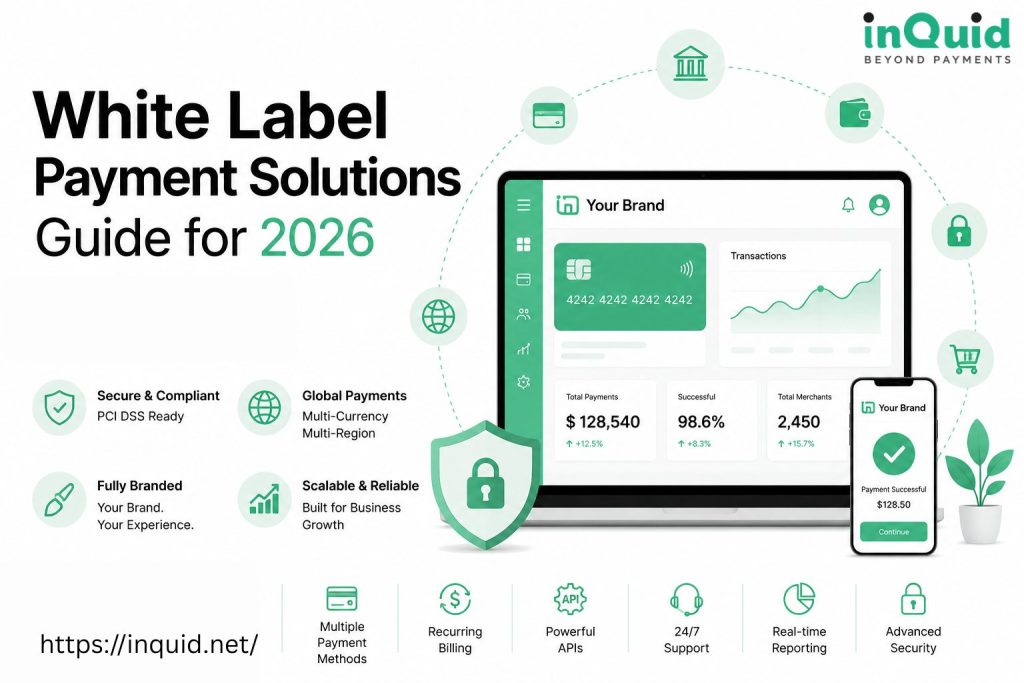
White label payment solutions let businesses launch a fully branded payment platform without building the underlying technology from scratch. A specialized provider handles the infrastructure, compliance, and processing — your company handles the branding, pricing, and customer relationship.
As digital payments keep growing worldwide, more fintechs, SaaS companies, and marketplaces are using this model to enter the payments market faster and at lower cost. This guide covers how they work, their real benefits, what to look for in a provider, and how to choose between white label and building in-house.
What Are White Label Payment Solutions?
A white label payment solution is a payment platform built by one company and rebranded by another. Instead of spending months building a payment gateway, merchant-acquiring system, or digital wallet, a business licenses proven infrastructure and puts its own logo, colors, and domain on top.
Customers only ever see your brand. The processing, security, and compliance work happens behind the scenes with the provider.
Common components include a payment gateway, merchant account management, digital wallets, subscription billing, and fraud management tools.
How They Work
Setting one up generally follows four steps:
- Partner with a provider that offers customizable white label infrastructure.
- Brand the platform — logo, colors, domain, merchant dashboard, and customer portal.
- Integrate payment methods via API or plugin — cards, bank transfers, digital wallets, open banking, and recurring billing.
- Launch and scale, adding currencies and regional payment methods as transaction volume grows internationally.
Your customers never interact directly with the technology provider — only with your brand.
10 Benefits of White Label Payment Solutions
- Faster time to market — launch in weeks instead of the 12–18+ months custom development typically takes.
- Lower development costs — avoid hiring a full payment engineering and compliance team.
- Stronger brand identity — customers stay inside your branded experience end to end.
- Enterprise-grade security — PCI DSS compliance, tokenization, encryption, and fraud detection come built in.
- Global reach — multi-currency support and cross-border settlement without rebuilding infrastructure.
- New revenue stream — markup transaction fees or add a revenue share on top of processing.
- Scalable infrastructure — the same platform can support you from early stage through enterprise volume.
- Flexible integrations — ready-made connections to Shopify, WooCommerce, Magento, and custom CRM/ERP systems.
- Reduced compliance burden — the provider maintains PCI DSS, AML, and KYC processes on your behalf.
- Better customer experience — a seamless, branded checkout reduces friction and builds trust.
White Label vs. Custom-Built Payment Platforms
| Factor | White Label | Custom-Built |
| Development time | Weeks | 12–24 months |
| Initial investment | Low–moderate | Very high |
| Branding control | High | Full |
| Compliance | Provider-managed | Your responsibility |
| Maintenance | Provider-managed | In-house team |
| Best for | Startups, SaaS, PSPs wanting speed | Businesses needing full infrastructure control |
For most companies outside large-scale fintechs, a white label solution offers the better cost-to-speed ratio. Building in-house tends to make sense only once volume justifies the infrastructure investment.
Industries That Use Them
- FinTech startups — digital wallets, merchant acquiring, embedded finance
- SaaS companies — billing built directly into CRM, healthcare, or property management software
- eCommerce platforms and marketplaces — checkout, multi-currency payments, split settlements
- Banks and financial institutions — modernizing digital payment services
- Enterprises — centralizing payment operations across regions
Features to Look For in a Provider
- Multi-currency and multiple payment method support (cards, wallets, open banking, local rails)
- PCI DSS compliance, tokenization, and fraud detection built in
- Developer-friendly REST APIs, SDKs, and sandbox environments
- Real-time reporting on transactions, chargebacks, and settlements
- Transparent pricing with no hidden fees
How to Choose the Right Provider
Security and compliance — confirm current PCI DSS certification, plus AML and KYC processes. This shouldn’t be negotiable. The PCI Security Standards Council publishes the current compliance requirements if you want to verify a provider’s claims directly.
Pricing structure — compare flat-fee, interchange-plus, and revenue-share models; the lowest headline rate isn’t always the cheapest once volume fees are factored in.
Integration depth — some providers only allow a logo swap, while others let you rebrand the entire checkout, dashboard, and reporting suite.
Support — ask about uptime SLAs, dispute turnaround, and whether you get a dedicated account manager.
For more detail on evaluating vendors, see our guides on choosing a payment gateway and merchant account solutions. Stripe’s own breakdown of white-label payment facilitators is also a useful external reference for how a major processor frames the buy-vs-build decision.
Pros and Cons
| Pros | Cons |
| Faster deployment | Less infrastructure control |
| Lower upfront cost | Provider dependency |
| Built-in security and compliance | Customization limits vary by provider |
| Fully branded experience | Ongoing subscription/revenue-share fees |
| Ready-to-use APIs | Migration later can require planning |
FAQs
What are white label payment solutions? Ready-built payment platforms that businesses rebrand as their own, avoiding the cost of building infrastructure from scratch.
Are they secure? Reputable providers offer PCI DSS compliance, tokenization, encryption, and fraud monitoring as standard.
Can they handle international payments? Most support multiple currencies, cross-border settlement, and local payment methods.
How long does implementation take? Typically, weeks, depending on how much customization and integration is required.
How do businesses make money from them? Through transaction fee markups, revenue share, or bundling payments into an existing subscription product.
How do I pick the right provider? Weigh security certifications, pricing transparency, integration depth, and support quality — not price alone.
Final Thoughts
White label payment solutions give businesses a practical way to launch branded payments without the cost and delay of building infrastructure in-house. The right choice comes down to your transaction volume, compliance appetite, and how much control you need over the customer experience.
Shortlist two or three providers, compare pricing models side by side, and confirm PCI compliance and support terms before signing. Done well, a white label payment solution can become a genuine growth lever for your business rather than just a checkout feature.
Why Choose Inquid for White Label Payment Solutions
Inquid provides modern, secure, white label payment infrastructure for fintechs, PSPs, SaaS companies, and marketplaces — including a fully branded checkout, multi-currency processing, open banking integration, and PCI DSS-ready security. Explore Inquid’s white label services to see how quickly you can launch under your own brand.