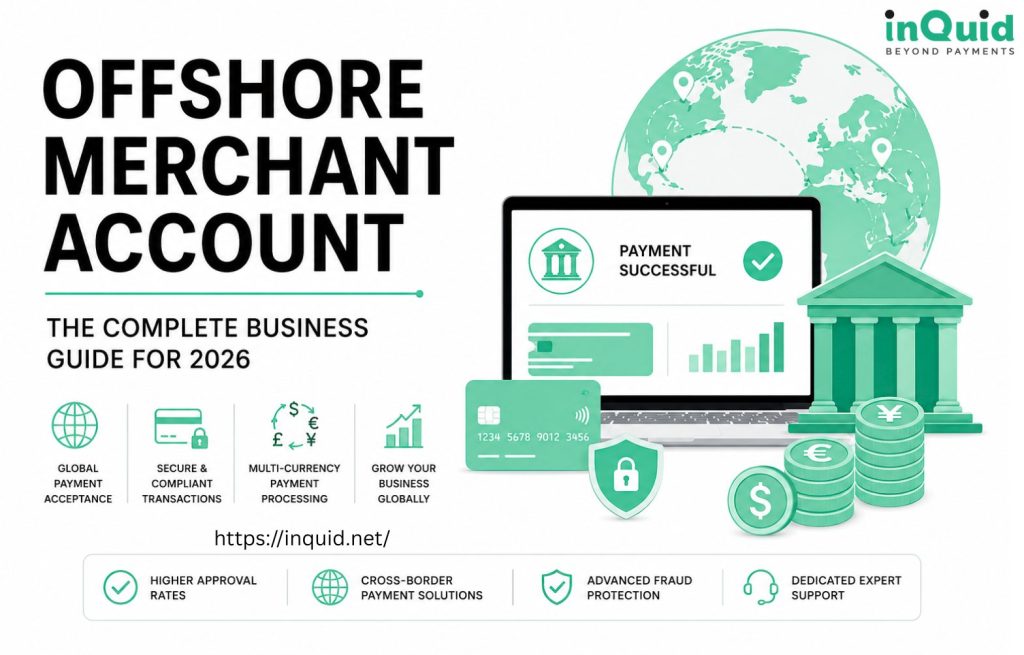
Expanding into international markets takes more than a great product — it takes payment infrastructure that can keep up. An offshore merchant account lets businesses accept online payments through an acquiring bank located outside their country of incorporation, making it easier to process international transactions, support multiple currencies, and serve customers around the world.
Whether you run an eCommerce store, SaaS platform, marketplace, travel company, forex brokerage, iGaming business, subscription service, or another high-risk enterprise, choosing the right provider can meaningfully improve approval rates, reduce transaction failures, and support global growth.
These accounts are often misunderstood, though. Many businesses assume they exist only for high-risk industries or companies trying to sidestep regulation. Reputable providers operate within international financial regulations and offer secure, compliant solutions for companies expanding into global markets — high-risk or not.
This guide covers how offshore acquiring works, who needs it, the benefits, approval requirements, and what to look for in a provider.
What Is an Offshore Merchant Account?
It’s a business account that lets companies accept debit and credit card payments through an acquiring bank located outside the country where the business is registered.
Unlike a domestic setup, which routes payments through a local acquiring bank, this structure connects businesses to international acquiring banks capable of supporting global transactions, multiple currencies, and industries that often face restrictions from local financial institutions.
Businesses typically use this structure to:
- Accept international card payments
- Process transactions in multiple currencies
- Expand into new markets
- Increase payment approval rates
- Support customers worldwide
- Access solutions built for high-risk industries
- Diversify processing across multiple acquiring banks
For many international businesses, this isn’t just a payment tool — it’s a strategic asset that supports scalability and operational flexibility.
How It Works
The process mirrors a standard merchant account, except the acquiring bank sits in a different jurisdiction, connected through an international payment gateway built to route cross-border transactions securely.
- Customer initiates payment — they select a product or service and enter payment details at checkout.
- The offshore payment gateway encrypts the data and sends it securely to the acquiring bank.
- The acquiring bank processes the transaction as part of secure credit card processing, forwarding the request through the relevant card network (Visa, Mastercard, etc.).
- The issuing bank authorizes payment — verifying funds, running fraud checks, and approving or declining.
- Payment confirmation is sent to the customer once approved.
- Settlement — funds move to the merchant account on the provider’s settlement schedule.
The whole cycle usually takes seconds, backed by encryption, tokenization, fraud monitoring, and PCI DSS compliance.
Offshore vs. Domestic: Which One Do You Need?
| Feature | Offshore | Domestic |
| Acquiring bank location | Outside the business’s home country | Within the business’s country |
| International transactions | Strong | Limited in some regions |
| Multi-currency support | Extensive | Usually limited |
| Cross-border cost efficiency | Optimized | Often higher fees |
| High-risk industry support | Strong | Often restricted |
| Global expansion fit | Ideal | Better suited to local markets |
| Approval flexibility | Higher for many business models | More restrictive |
| Settlement options | Multiple international options | Primarily domestic |
A domestic account is usually sufficient if you’re serving customers in a single country. It’s worth going offshore when your business sells internationally, operates across currencies, needs flexible acquiring relationships, sits in a high-risk category, or needs higher approval rates than a domestic bank can offer. Many global businesses run both in parallel to optimize performance and reduce concentration risk with any one acquirer.
Who Actually Needs One
Contrary to the common assumption, this isn’t just for high-risk businesses — it benefits any company with international ambitions or specialized payment needs.
eCommerce businesses selling internationally get localized checkout experiences and multi-currency acceptance, which reduces cart abandonment and improves conversion.
SaaS and subscription companies processing recurring payments across borders benefit from better authorization rates and multi-currency billing — particularly valuable for software companies with a global customer base.
Digital service providers — consulting, education, marketing, cloud services — simplify cross-border client payments.
Marketplaces need infrastructure that can handle buyers and sellers across currencies, settlement methods, and regions at volume.
Travel and hospitality businesses — agencies, airlines, booking platforms — deal with high-value international transactions daily and benefit from stronger fraud management and higher authorization rates.
FinTech companies often need international acquiring relationships, API flexibility, and support for embedded finance and Open Banking.
High-risk businesses — iGaming, forex, adult entertainment, IPTV, nutraceuticals, subscription services, and digital goods among them — frequently face stricter underwriting from traditional banks, whereas specialized offshore providers offering dedicated high-risk payment processing tend to have more relevant compliance and chargeback-management expertise. (Note: cryptocurrency and CBD are sometimes grouped here too, but both carry distinct, fast-moving regulatory requirements — confirm any provider’s actual licensing and jurisdictional scope for these specifically before assuming coverage.)
Key Benefits
Global payment acceptance. Accept customers across multiple countries without relying solely on domestic banking rails — this tends to translate into higher conversion and broader reach.
Multi-currency processing. Letting customers pay in their own currency reduces friction and improves trust at checkout, while simplifying the numbers behind a global expansion strategy.
Higher approval rates. Multiple acquiring relationships, smarter payment routing, and regional expertise all help cut down on declined transactions that have nothing to do with actual fraud.
Stronger support for high-risk industries. Specialized providers bring tailored underwriting, industry-specific risk management, and chargeback mitigation that generalist banks typically can’t offer.
Flexible growth. As a business expands into new countries, having access to international settlement options and multiple acquiring relationships means you’re not stuck renegotiating your payment stack every time you enter a new market.
Choosing the Right Provider
Comparing transaction fees alone isn’t enough — evaluate whether a provider can support long-term growth and operational complexity.
- Global coverage — international acquiring relationships, multiple countries, worldwide settlement.
- Multi-currency support — number of currencies, conversion transparency, local settlement options.
- Payment method breadth — Visa, Mastercard, Amex, Apple Pay, Google Pay, bank transfers, open banking, and alternative payment methods (APMs).
- Security and compliance — PCI DSS, tokenization, end-to-end encryption, 3D Secure, and active fraud monitoring.
- Integration options — compatibility with Shopify, WooCommerce, Magento, BigCommerce, custom builds, mobile apps, CRM, and ERP systems, plus developer-friendly APIs.
- Support quality — technical assistance, dedicated account management, response times, and genuine industry expertise.
Approval Requirements
Most providers run a due-diligence process before approval, typically requiring:
- Business registration — certificate of incorporation, registration documents, ownership details.
- Identity verification — passport or national ID and proof of address for directors and beneficial owners.
- A professional website — clearly showing products/services, terms and conditions, privacy policy, refund policy, and contact information.
- Financial information — recent bank statements, processing history if available, estimated volume, and average transaction value.
- Risk assessment — industry type, chargeback history, fraud exposure, and target markets.
Businesses with transparent operations and clean compliance documentation tend to move through underwriting noticeably faster.
Pros and Cons
| Pros | Cons |
| Supports international expansion | Additional compliance requirements |
| Higher payment approval rates | Underwriting can take longer |
| Multi-currency acceptance | Fees vary by business type |
| Stronger support for high-risk industries | Some providers apply rolling reserves |
| Access to global acquiring banks | Documentation requirements can be extensive |
| Flexible settlement options | Provider quality varies significantly |
| Cross-border payment optimization | Requires careful provider vetting |
Common Challenges (and How to Handle Them)
Longer approval timelines. Prepare all documentation in advance and work with a provider that already understands your industry.
Higher chargeback exposure on cross-border sales. Layer in fraud monitoring, AVS verification, 3D Secure, clear refund policies, and responsive support.
Evolving regulatory requirements. Partner with a provider that keeps its compliance standards current rather than static.
Payment declines. Look for providers using multiple acquiring banks, smart routing, and regional optimization to cut unnecessary failures.
Real-World Examples
A European eCommerce brand expanding into North America, Asia, and the Middle East implemented multi-currency processing and saw checkout friction drop as customers could pay in their local currency.
A SaaS company serving 50+ countries used this structure to run recurring billing across currencies while improving authorization rates through broader acquiring relationships.
A licensed online gaming company facing repeated declines from domestic providers moved to a specialist offshore provider and gained payment infrastructure suited to its regulatory and operational needs.
Why Inquid
Choosing the right payment partner matters as much as choosing the account type itself. Inquid builds solutions for startups, enterprises, eCommerce businesses, SaaS platforms, marketplaces, fintech companies, and high-risk industries, combining:
- Global payment acceptance across multiple countries through scalable payment gateway solutions
- Merchant account solutions built for international and specialized businesses
- Multi-currency processing for smoother global checkout
- Support for high-risk categories including iGaming, forex, IPTV, adult, travel, subscriptions, and digital goods
- Open Banking integration and digital banking solutions for account-to-account payments
- Alternative payment methods (APMs) for local and global preferences
- PCI DSS-ready infrastructure, tokenization, encryption, and fraud prevention
- Developer-friendly API integrations with Shopify, WooCommerce, Magento, BigCommerce, and custom or mobile applications
(If crypto-wallet payment support is something your business needs, confirm current availability and jurisdictional coverage directly with Inquid — this is one of the fastest-changing compliance areas in payments right now.)
Frequently Asked Questions
What is an offshore merchant account? An account that lets a business accept card payments through an acquiring bank based outside its country of registration — commonly used for international commerce, multi-currency processing, and specialized payment needs.
Who should use one? Businesses selling internationally, processing cross-border payments, working across currencies, or operating in industries like SaaS, travel, fintech, iGaming, forex, digital goods, subscriptions, or adult services.
Is it legal? Yes — when established with licensed financial institutions and operated in compliance with applicable tax law, AML requirements, and KYC standards.
How long does approval take? It varies by provider, business model, documentation, and risk profile. Many providers complete underwriting within several business days; more complex applications can take longer.
What documents are required? Business registration, director identification, proof of address, company website, processing history if available, bank statements, and a business description.
Can it support multiple currencies? Yes — most providers support dozens of currencies, enabling localized checkout experiences.
Is this only for high-risk businesses? No. eCommerce, SaaS, travel, and marketplace businesses use offshore accounts regularly to improve global payment capability, independent of risk category.
How is this different from an offshore bank account? A merchant account processes customer card payments; a bank account holds and manages business funds. Many businesses use both together, but they serve different functions.
How can businesses reduce chargebacks? Fraud detection tools, 3D Secure authentication, clear refund policies, responsive support, and regular transaction monitoring.
How do I pick the right provider? Look for global acquiring capability, multi-currency support, strong security standards, transparent pricing, flexible APIs, responsive support, and real experience in your specific industry.
Conclusion
As global commerce keeps expanding, businesses need payment infrastructure that goes beyond domestic processing. An offshore merchant account provides access to international acquiring banks, multi-currency acceptance, cross-border support, and the flexibility to expand into new markets with confidence.
Whether you run an eCommerce store, SaaS platform, marketplace, fintech company, travel business, or high-risk enterprise, choosing the right provider can improve approval rates, strengthen security, and support sustainable growth. Before deciding, compare providers on global reach, supported payment methods, security standards, compliance, integration options, settlement flexibility, and support quality — a well-informed choice today builds the foundation for international growth tomorrow.
References
- PCI Security Standards Council — PCI DSS Standard and Resources
- Visa — Visa Rules and Policies
- Mastercard — Mastercard Rules for Merchants
- Financial Conduct Authority (UK) — FCA Official Site
- European Banking Authority (EU) — EBA: Payment Services Directive (PSD2)
- SWIFT — International Payments Overview