
Virtual banking is changing how businesses move money, track payments, and operate across borders. Instead of relying on branch visits, manual paperwork, and multiple physical accounts, businesses can use digital banking infrastructure to create virtual accounts, monitor transactions in real time, automate reconciliation, and receive international payments more efficiently.
Think of virtual banking as a central financial hub. Rather than managing separate physical accounts for each customer, department, or region, a business can operate through one master account linked to multiple virtual account numbers. That structure can simplify operations, improve visibility, and reduce the time spent on manual finance tasks.
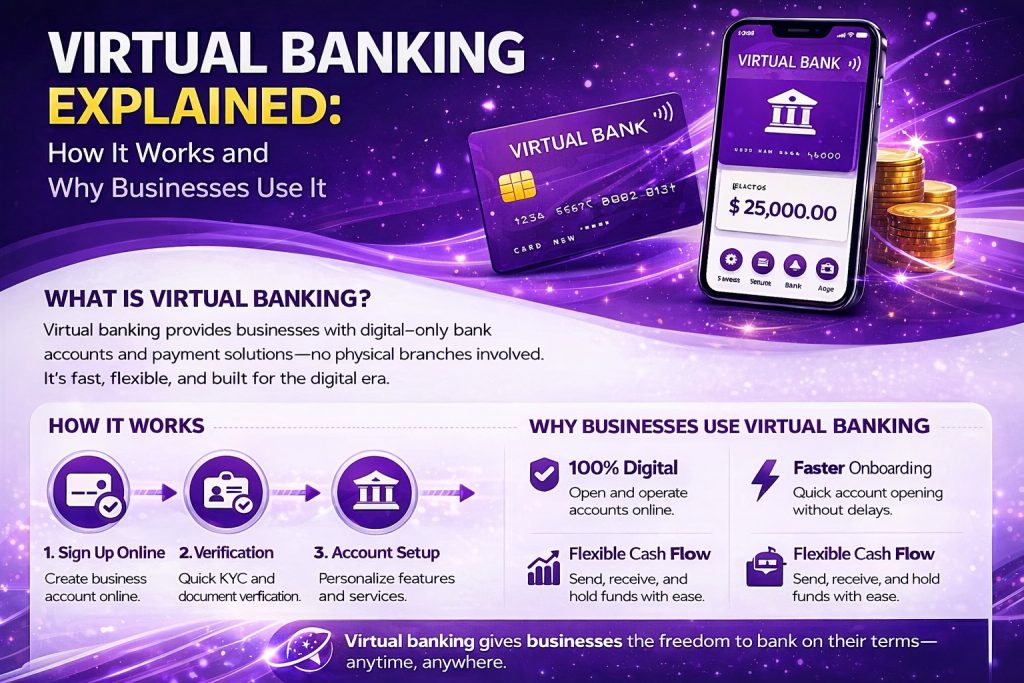
As remote work, cross-border commerce, and digital services continue to grow, businesses need payment systems that are fast, scalable, and easy to manage. Traditional banking often struggles with slow settlement, higher transfer fees, and limited transaction visibility. Virtual banking helps close that gap by giving businesses more control over how payments are collected, tracked, and reconciled.
What You Need to Know About Virtual Accounts for Secure Payment Processing
A virtual account is a unique digital account number connected to a primary master account. It usually does not hold funds itself. Instead, it works as a tracking layer that helps identify and organize incoming and outgoing payments.
That makes virtual accounts especially useful for businesses handling a high number of transactions. Without them, finance teams often spend hours matching payments to invoices or customers. With virtual accounts, each payer or business unit can receive a distinct account number, making reconciliation much faster and more accurate.
For businesses in regulated or higher-risk industries, this level of visibility is even more valuable. Detailed transaction records can support internal controls, audit readiness, and compliance reporting. Virtual accounts also reduce exposure of the main bank account number, which can add an extra layer of security.
Virtual Banking vs. Online Banking: What’s the Difference?
Virtual banking and online banking are often confused, but they are not the same thing. Online banking gives customers digital access to traditional banking services. Virtual banking goes further by creating payment infrastructure designed for automation, scale, and multi-market operations.
| Feature | Virtual Banking | Online Banking |
| Physical branch requirement | No | Often yes |
| Virtual accounts | Yes | Limited |
| Automated reconciliation | Advanced | Basic |
| Multi-currency support | Strong | Varies |
| Global payment optimization | High | Moderate |
| Business scalability | Excellent | Moderate |
For international businesses, virtual banking usually offers more flexibility. Many providers support payment rails such as SWIFT, ACH, SEPA, and local transfer networks, which helps customers pay in familiar ways while giving businesses better control over collections.
How to Transfer Money to a Virtual Account Number
Sending money to a virtual account is usually very similar to making a standard bank transfer. The difference happens behind the scenes, where the system identifies the payment and routes it to the correct master account.
The process is simple:
- The recipient generates a virtual account number.
- The payer receives the account details.
- The payment is sent through a supported rail.
- The platform matches the payment automatically.
- The funds settle in the underlying master account.
This setup can reduce confusion, speed up reconciliation, and improve cash flow visibility. It is especially useful for businesses receiving payments from customers in multiple countries, since local payment methods can lower friction and make the checkout or transfer process feel more familiar.
Virtual Bank Account Without KYC: What Businesses Should Know
The phrase “virtual bank account without KYC” often attracts startups and freelancers looking for quick onboarding. KYC, or Know Your Customer, is a verification process used to reduce fraud, identity theft, and financial crime.
While some providers advertise simplified onboarding, businesses should be cautious about any service that removes compliance too aggressively. Financial providers still need to meet regulatory standards, and weak verification can lead to account freezes, service interruptions, or legal issues later.
A better approach is streamlined KYC. Many legitimate providers now use digital verification tools that can approve applications quickly while still meeting compliance requirements. That gives businesses speed without sacrificing long-term stability.
Virtual Payment Address vs. Virtual Bank Account
A Virtual Payment Address (VPA) and a virtual bank account solve different problems.
A VPA is mainly a payment alias. It lets users share a simple identifier instead of full banking details. This is useful for convenience and ease of use.
A virtual bank account is more focused on tracking, reconciliation, and reporting. It is designed for businesses that need to map payments to specific customers, invoices, regions, or product lines.
| Feature | Virtual Payment Address | Virtual Bank Account |
| Main purpose | Payment convenience | Payment tracking |
| Business reconciliation | Limited | Strong |
| Unique customer mapping | Rare | Common |
| International use cases | Moderate | Strong |
| Treasury management | Minimal | Advanced |
For businesses with larger or more complex payment flows, virtual bank accounts usually provide more operational value.
Why Virtual Bank Accounts Help With International Payments
Virtual bank accounts make it easier for businesses to receive payments from customers around the world without opening multiple traditional bank accounts in every country. Many providers offer local receiving details in currencies such as USD, GBP, and EUR, which helps customers pay through familiar channels.
This can be especially useful for exporters, SaaS companies, agencies, consultants, and freelancers. Instead of asking clients to send costly international wires, businesses can give them local payment details that are faster and easier to use.
Virtual account dashboards can also bring payment activity, settlement status, and multi-currency movement into one place. That makes it easier for finance teams to understand what has been paid, what is pending, and where cash is moving.
How Virtual Banking Supports Higher-Risk Merchants
Businesses in higher-risk sectors often face stricter underwriting, more payment friction, and closer compliance review. Virtual banking helps by improving visibility across transactions and giving businesses stronger reporting tools.
One major advantage is traceability. Virtual accounts can help businesses connect payments to specific customers or orders, which supports dispute resolution and internal review. Automated reconciliation also reduces the manual workload that often comes with high transaction volume.
Another benefit is better treasury control. Businesses can assign virtual accounts to different regions, products, or business units, then monitor performance more clearly. That structure can support better forecasting and faster decision-making.
Can Virtual Banking Simplify Payments for High-Risk Industries?
Yes, virtual banking can make payment operations more manageable for industries that need tighter control, better reporting, and clearer transaction history. It does not remove compliance obligations, but it can make the payment layer easier to organize.
For businesses that process complex or international transactions, virtual accounts create a more structured payment environment. That can improve both internal efficiency and customer experience.
Conclusion
Virtual banking has moved from a niche fintech tool to a practical business infrastructure choice. By combining virtual accounts, automated reconciliation, multi-currency support, and stronger payment visibility, it helps businesses simplify operations and scale across markets.
For startups, exporters, SaaS brands, freelancers, and businesses in higher-risk sectors, virtual banking can reduce manual work, improve financial control, and support international growth without the burden of managing multiple physical accounts.
As digital commerce keeps expanding, businesses that invest in clear, efficient payment infrastructure will be better positioned to compete. Virtual banking is no longer just a convenience. For many companies, it is becoming part of the foundation of modern finance.
FAQs
1. What is a virtual bank account?
A virtual bank account is a unique digital account number linked to a master account. It helps businesses track and reconcile payments more efficiently.
2. Are virtual accounts safe for international payments?
Yes, when offered by a reputable provider. They can improve tracking, reduce exposure of the main account number, and support stronger payment monitoring.
3. Can virtual bank accounts hold money?
Usually, no. The virtual account is typically a reference layer, while the actual funds sit in the underlying master account.
4. Do virtual bank accounts support multiple currencies?
Many providers do. Businesses may be able to receive payments in currencies such as USD, GBP, and EUR.
5. Are virtual bank accounts useful for higher-risk businesses?
Yes. They can improve reconciliation, transaction visibility, and reporting, which can be helpful for businesses with more complex payment needs.