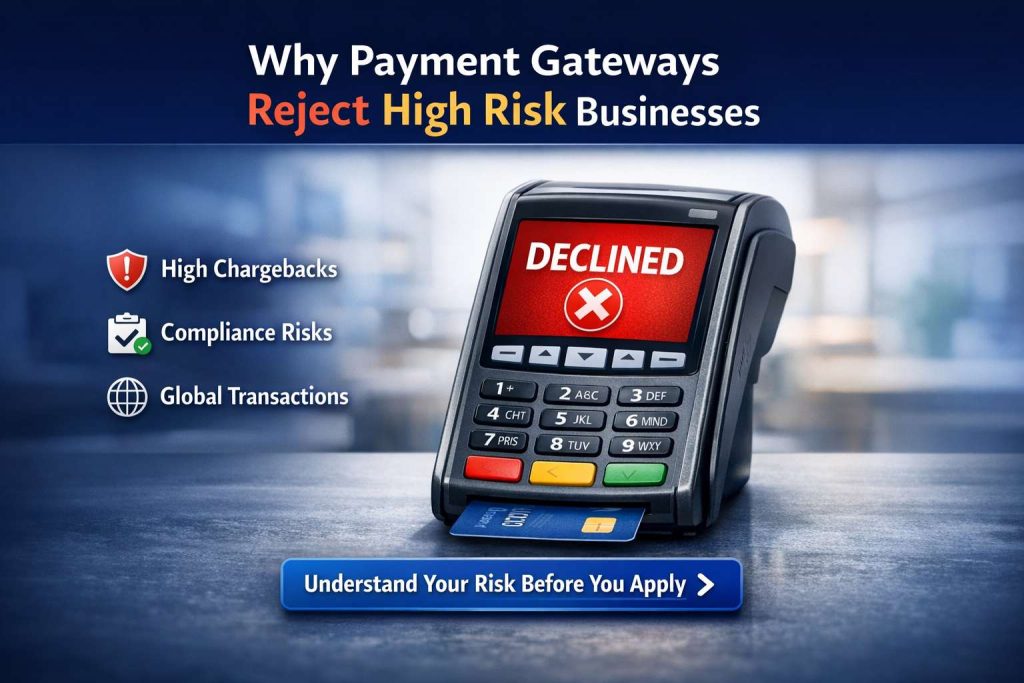
Getting rejected by a payment gateway can be confusing, especially when your business is legitimate and ready to grow. Many companies invest time and resources into building their products and acquiring customers, only to encounter unexpected declines, account suspensions, or delayed approvals.
In most cases, the issue is not the business itself, but how payment providers evaluate risk. Understanding why these rejections happen is the first step toward building a more reliable and scalable payment setup.
What Is a High-Risk Business?
A high-risk business is one that payment processors consider more likely to generate financial or regulatory challenges.
This classification is typically based on:
- Industry type
- Transaction patterns
- Customer geography
- Business model structure
Being categorized as high-risk does not mean a business is unreliable or unsafe. It simply means that it requires a different level of risk management compared to standard businesses.
Key Reasons Payment Gateways Reject High-Risk Businesses
1. High Chargeback Rates
Chargebacks are one of the most significant concerns for payment providers. When customers dispute transactions, it creates financial liability for the processor.
Industries such as trading platforms and online gaming often experience higher chargeback rates due to the nature of their services. As a result, they are more likely to be flagged during the approval process.
2. Industry Classification
Some industries are automatically categorized as high-risk regardless of business size or reputation. These commonly include:
- Financial trading platforms
- Gaming and betting services
- Subscription-based models
- Digital streaming platforms
This classification alone can significantly reduce the chances of approval with standard payment providers.
3. Regulatory and Compliance Requirements
Payment providers must adhere to strict regulatory frameworks, including identity verification and anti-money laundering protocols.
Businesses that operate across multiple jurisdictions or lack structured compliance processes are often viewed as more complex and therefore higher risk.
4. Cross-Border Transactions
Global transactions introduce additional challenges such as currency conversion, varying regulations, and increased fraud risk.
Businesses that rely on international customers are often subject to stricter scrutiny due to these complexities.
5. Limited Processing History
New businesses or those without a consistent transaction history are more difficult for payment providers to evaluate. Without historical data, it becomes harder to assess risk accurately.
6. Lack of Transparency
The way a business presents itself online plays a significant role in approval decisions. Common issues include:
- Missing legal documentation such as terms and conditions
- No clear refund or cancellation policies
- Incomplete or unclear service descriptions
These factors can reduce trust and increase perceived risk.
7. Previous Payment Issues
If a business has experienced account suspensions, high dispute rates, or compliance issues in the past, it may be flagged in risk assessment systems, making future approvals more difficult.
A Practical Perspective
In many cases, businesses face repeated rejections not because they are non-compliant, but because they are applying to systems that are not suited to their operational model.
For example, a subscription-based platform serving a global audience may struggle with standard payment gateways due to recurring billing and cross-border transactions. However, when evaluated within a framework designed for higher-risk models, the same business can operate smoothly.
This highlights an important point: the challenge is often a mismatch between the business model and the payment system.
Why Traditional Payment Gateways Often Fall Short
Most widely used payment gateways are optimized for low-risk industries such as retail and conventional e-commerce.
Their systems are designed to:
- Minimize exposure to disputes
- Simplify regulatory compliance
- Avoid industries with higher uncertainty
As a result, businesses with more complex transaction patterns or regulatory requirements often find themselves outside the scope of these systems.
How Businesses Can Reduce the Risk of Rejection
While some factors are inherent to the industry, there are several ways businesses can improve their chances of approval.
1. Strengthen Trust Signals
Ensure that your website clearly communicates:
- Business identity and contact details
- Terms and conditions
- Privacy and refund policies
Clear and transparent communication helps build credibility.
2. Improve Compliance Readiness
Prepare documentation related to:
- Business registration
- Identity verification processes
- Transaction monitoring practices
A structured approach to compliance can significantly improve approval outcomes.
3. Manage Chargebacks Effectively
Implement systems that help reduce disputes, such as:
- Clear billing descriptions
- Responsive customer support
- Transparent transaction processes
Lower chargeback rates contribute to long-term stability.
4. Choose the Right Type of Payment Infrastructure
Not all payment solutions are designed for every type of business. Companies operating in higher-risk environments often require systems that can handle:
- Complex transaction flows
- International payments
- Increased compliance requirements
Selecting a payment setup that aligns with your business model is often the most important step in avoiding repeated rejections.
Key Takeaways
- Payment gateway rejections are typically based on risk assessment, not business legitimacy
- High-risk classification depends on multiple factors, including industry and transaction behavior
- Traditional payment systems are not always suitable for complex business models
- Aligning with the right type of payment infrastructure improves stability and scalability
Frequently Asked Questions
Why do payment gateways reject high-risk businesses?
Because of higher chargeback rates, regulatory complexity, and transaction patterns that require advanced risk management.
Can high-risk businesses still process payments?
Yes, but they generally require payment systems designed to handle higher levels of risk.
Does industry type affect approval chances?
Yes, certain industries are automatically categorized as high-risk and face stricter evaluation.
How can businesses improve approval chances?
By improving transparency, strengthening compliance, managing chargebacks, and aligning with suitable payment systems.
Conclusion
Payment gateway rejections can be challenging, but they are often a signal that a business requires a different approach to payment processing.
As digital commerce continues to evolve, businesses operating in complex or high-risk environments need systems that are designed to support their specific needs. Understanding how risk is evaluated allows businesses to make informed decisions and build more reliable payment structures.
A well-aligned payment setup not only reduces the likelihood of rejection but also creates a stronger foundation for long-term growth.