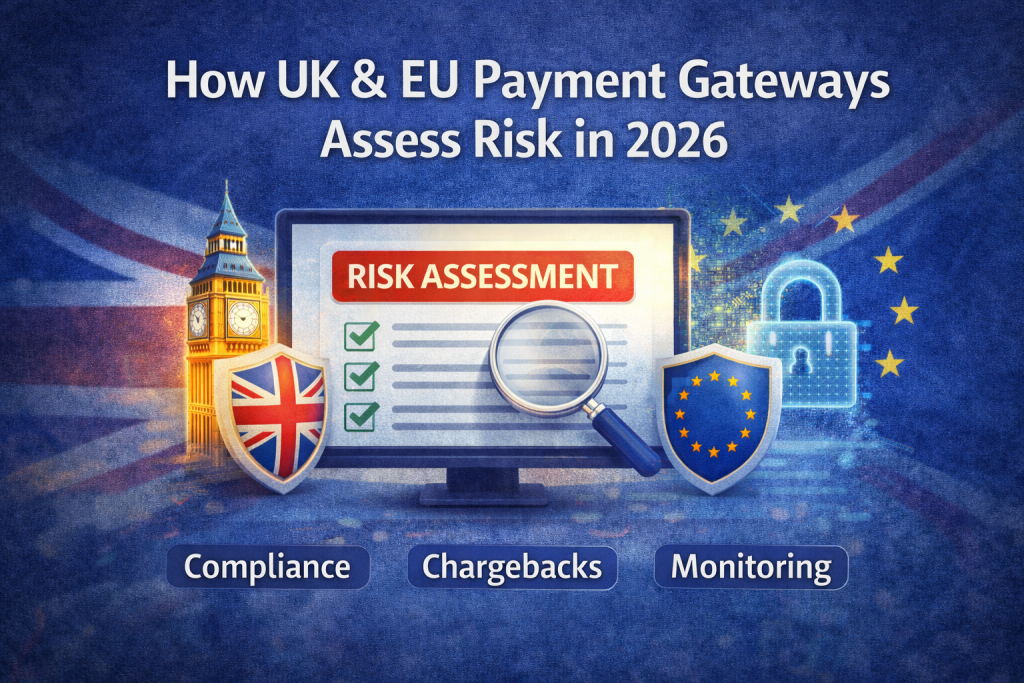
Payment gateway approvals in the UK and Europe have changed significantly over the last few years.
In 2026, approvals are no longer based on simple checklists or one-time reviews.
Instead, UK and EU payment gateways use continuous risk assessment models that monitor businesses before and after approval.
Understanding how this risk assessment works is essential for any high-risk or cross-border business.
What Has Changed in Payment Gateway Risk Assessment?
Earlier, payment gateways focused on static checks such as:
- Industry type
- Business location
- Company documents
Today, UK and EU gateways evaluate how risk behaves over time, not just how it looks at onboarding.
This shift explains why many businesses:
- Get approved but later restricted
- Face sudden transaction limits
- Experience silent account reviews
Key Risk Factors UK & EU Payment Gateways Evaluate
1. Business Model Clarity
Payment gateways assess whether a business model is easy to understand and monitor.
Risk increases when:
- Revenue streams are unclear
- Multiple services are bundled together
- Pricing or billing logic is confusing
Clear business explanations reduce approval friction.
2. Website Compliance and Transparency
In the UK and EU, websites are treated as risk indicators.
Gateways look for:
- Clear terms and conditions
- Refund and cancellation policies
- GDPR-compliant privacy notices
- Accurate product or service descriptions
A compliant website signals operational maturity.
3. Chargeback and Dispute Risk
Chargebacks remain one of the highest risk signals.
Gateways assess:
- Refund flow clarity
- Subscription transparency
- Dispute prevention mechanisms
- Historical or projected dispute ratios
Even businesses with no processing history are evaluated based on expected dispute behaviour.
4. Merchant Category Code (MCC) Accuracy
MCCs help gateways understand how transactions should behave.
Risk increases when:
- The MCC does not match the business activity
- Transaction behaviour differs from the assigned category
- Revenue sources are not clearly mapped
Incorrect MCC alignment is a common cause of rejection or post-approval review.
5. Geographic and Cross-Border Exposure
UK and EU gateways closely monitor where transactions originate.
Higher risk is assigned when:
- Customers come from multiple high-risk regions
- Cross-border volumes increase rapidly
- Currency flows are inconsistent
Geographic transparency improves approval stability.
6. Compliance Readiness and Monitoring
In 2026, compliance is continuous—not one-time.
Payment gateways evaluate:
- PCI DSS readiness
- GDPR-aligned data handling
- Internal risk monitoring processes
- Ability to respond to compliance reviews
Gateways want businesses that can be monitored, not just approved.
7. Processing Structure and Redundancy
Single-gateway dependency increases risk.
UK and EU gateways prefer businesses that:
- Use multi-PSP strategies
- Have fallback routing options
- Can manage downtime or sudden restrictions
Redundancy signals resilience.
Why Risk Is Assessed After Approval
Many merchants assume approval means safety. That is no longer true.
In 2026:
- Risk scores update continuously
- Transaction patterns are monitored in real time
- Threshold breaches trigger reviews automatically
This is why some accounts face restrictions without warning.
How Businesses Can Reduce Risk Perception
Businesses can improve long-term approval stability by:
- Explaining business models clearly
- Fixing website compliance early
- Preparing accurate onboarding documentation
- Aligning MCCs correctly
- Monitoring chargeback ratios
- Avoiding sudden volume spikes
Risk does not need to be eliminated—only managed and explained.
Final Thoughts
UK and EU payment gateways no longer ask:
“Is this business risky?”
They ask:
“Can this risk be monitored and controlled over time?”
Businesses that understand this shift experience smoother approvals, fewer reviews, and better processing stability.