Morocco has become an increasingly attractive base for businesses targeting customers in Europe, the United Kingdom, and the United States. From forex and trading platforms to digital services, gaming, and subscription-based businesses, many Moroccan companies are operating globally from day one.
However, one challenge consistently slows growth or stops it entirely: payment gateway access.
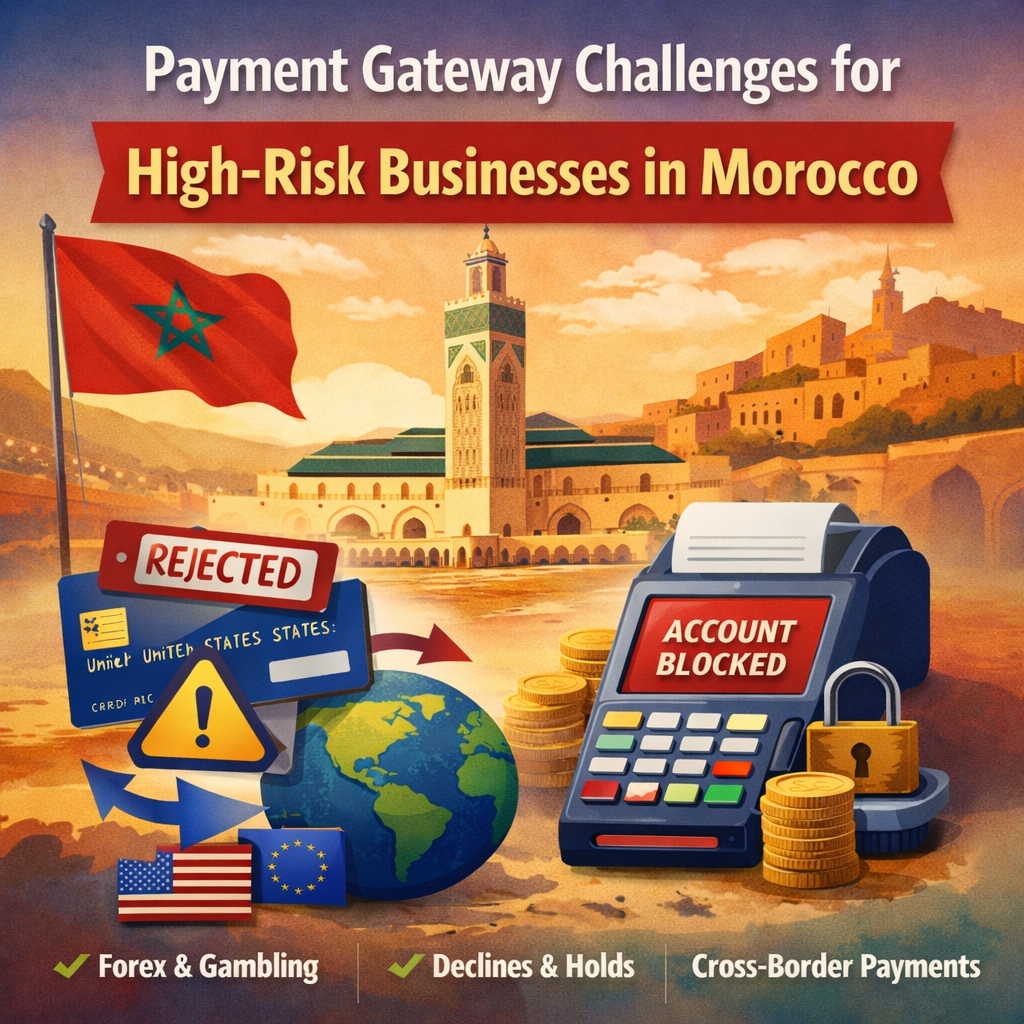
High-risk businesses in Morocco often face rejected applications, sudden transaction declines, payout delays, or complete gateway shutdowns—even when their operations are legitimate. These issues are not random, and they are rarely caused by the business model alone.
In most cases, the problem lies in using a payment gateway that is not structured for high-risk, cross-border transactions.
This article explains why high-risk businesses in Morocco struggle with payment gateways, how international risk assessment works, and what businesses can do to improve payment stability when targeting EU and US markets.
Understanding High-Risk Classification in Morocco
A business is considered “high-risk” not because it is illegal, but because it presents a higher level of exposure to payment processors and acquiring banks.
For Moroccan businesses, high-risk classification often results from a combination of factors, including:
- Serving customers in Europe or the United States
- Operating in regulated or chargeback-prone industries
- Processing cross-border card-not-present transactions
- Handling recurring or subscription payments
- Limited local acquiring options for certain business models
High-risk classification is based on risk probability, not intent. Even compliant and well-run businesses may fall into this category due to their industry or transaction behavior.
Industries in Morocco Commonly Affected by Payment Gateway Restrictions
Several industries in Morocco are more likely to experience payment gateway challenges due to how acquiring banks assess risk.
Forex and Online Trading
Forex brokers and trading platforms often face high chargeback ratios due to disputes, refund requests, or misunderstanding by end users. Cross-border card payments further increase scrutiny.
Gambling, Betting, and Gaming
Gaming-related businesses are heavily regulated in many regions. When operated from Morocco and serving international users, gateways apply strict monitoring and often restrict accounts after volume increases.
Cryptocurrency and Digital Asset Platforms
Crypto-related businesses face enhanced AML, KYC, and transaction monitoring requirements. Many standard gateways are not equipped to manage this level of oversight.
Subscription and Recurring Billing Models
Subscription businesses often experience higher dispute rates, especially when serving international customers. This triggers gateway reviews and reserve requirements.
These industries typically require specialized high-risk payment gateway setups, not standard eCommerce solutions.
Why Standard Payment Gateways Fail High-Risk Businesses in Morocco
Many Moroccan businesses begin with mainstream payment gateways because they offer quick onboarding and simple integrations. Unfortunately, these gateways are built for low-risk domestic transactions, not international high-risk operations.
Common Failure Patterns
High-risk businesses in Morocco often experience the same progression:
- Initial approval with minimal checks
- International traffic begins to scale
- Transaction reviews increase
- Rolling reserves are introduced
- Payouts are delayed or limited
- Account is restricted or terminated
This happens because risk assessment does not stop at onboarding. Gateways continuously evaluate transaction data once real volume starts flowing.
Cross-Border Risk: The Core Issue for Moroccan Businesses
Most payment gateway challenges in Morocco are linked to cross-border risk, not geography alone.
When a business processes EU or US payments from Morocco, acquiring banks analyze:
- Country of incorporation vs customer location
- Currency mismatch
- Chargeback ratios from international cards
- Transaction velocity and average ticket size
- Refund behavior and dispute timing
If a gateway is not designed to handle these factors, risk escalates quickly.
This is why many Moroccan businesses are approved initially but face restrictions after growth begins.
How High-Risk Payment Gateways Work Differently
A high-risk payment gateway is structured specifically to manage elevated risk levels over time.
Ongoing Underwriting
High-risk gateways operate under continuous underwriting models. Risk is assessed dynamically based on transaction behavior rather than one-time approval.
Advanced Risk Monitoring
Transactions are monitored for:
- Chargeback velocity
- Fraud indicators
- Geographic inconsistencies
- Sudden changes in volume or traffic sources
This allows risk to be managed proactively instead of reactively.
Compliance Alignment
High-risk gateways support stricter compliance requirements, including AML and KYC checks, which are critical for international processing.
Flexible Acquiring Support
Some high-risk gateways route transactions across multiple acquiring partners to balance approval rates and manage regional exposure.
Processing EU and US Payments from Morocco
For Moroccan businesses targeting EU and US customers, payment success depends heavily on gateway structure.
Common Mistakes
- Using single-country acquiring for international traffic
- Underestimating chargeback thresholds
- Changing marketing channels without notifying processors
- Scaling volume faster than projected
Each of these increases perceived risk and often triggers gateway reviews.
Key Features Moroccan Businesses Should Look for in a Payment Gateway
When evaluating a payment gateway, high-risk businesses in Morocco should prioritize the following:
- Support for high-risk merchant accounts
- Experience with EU and US acquiring banks
- Multi-currency processing and settlement
- Chargeback monitoring and dispute management tools
- Transparent reserve and payout policies
- Scalability for cross-border growth
Gateways that promise “instant approval” without discussing risk controls often lead to instability.
Why Payment Gateway Structure Matters More Than Location
A common misconception is that Moroccan businesses face payment issues because of where they are based. In reality, gateway structure and risk alignment matter far more.
When payment infrastructure is designed to meet international underwriting expectations, Moroccan businesses can process payments as reliably as companies based in Europe or the US.
The difference lies in preparation, transparency, and choosing the right gateway setup.
How Moroccan High-Risk Businesses Can Improve Payment Stability
Businesses can significantly reduce payment disruptions by:
- Providing realistic volume and growth projections
- Implementing chargeback prevention tools early
- Maintaining transparent refund and billing policies
- Avoiding sudden changes in traffic sources
- Working with payment providers experienced in high-risk, cross-border processing
Stability is achieved through alignment, not shortcuts.
Choosing the Right Payment Gateway Partner
Not all payment providers understand the challenges faced by high-risk businesses in Morocco. Some simply resell generic gateways without proper acquiring support.
Experienced providers like Inquid work with acquiring partners that understand international risk models and help businesses structure payment gateways that can scale globally.
Rather than focusing only on speed of approval, the right partner prioritizes long-term processing reliability.
Future Outlook for High-Risk Payment Processing in Morocco
As more Moroccan businesses expand internationally, payment gateways are becoming stricter rather than more flexible. Increased regulatory oversight, tighter chargeback thresholds, and enhanced monitoring are now standard.
Businesses that adapt early by using risk-aligned gateway infrastructure will be better positioned to grow sustainably in EU and US markets.
Conclusion
Payment gateway challenges for high-risk businesses in Morocco are not unusual—and they are rarely caused by poor business practices. Most issues arise from using payment infrastructure that is not designed for high-risk, cross-border transactions.
By understanding how payment gateways assess risk and choosing solutions built for international processing, Moroccan businesses can reduce restrictions, improve stability, and scale with confidence.