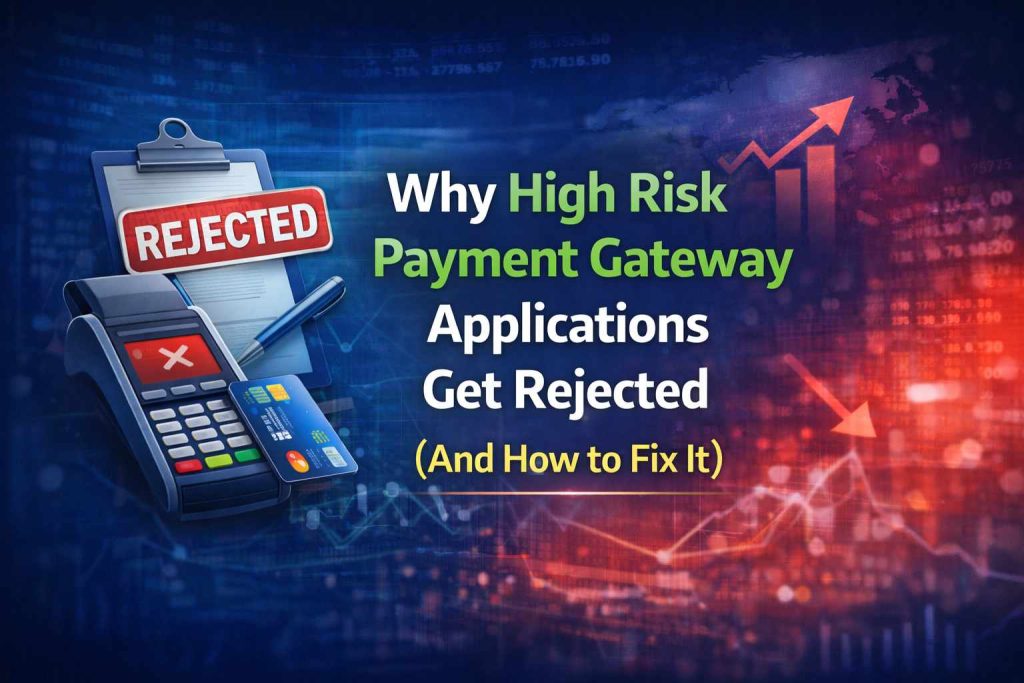
You submit your application.
Everything looks fine.
Then comes the rejection.
No clear explanation. Just a “declined” status.
If you’re applying for a high risk payment gateway, this situation is more common than you think.
But here’s the truth:
Most applications don’t get rejected because of the industry — they get rejected because of avoidable mistakes.
Once you understand what goes wrong, you can fix it — and get approved much faster.
Why Payment Providers Reject High-Risk Businesses
Payment providers are not just approving businesses — they are managing risk.
Before approving your application, they evaluate:
- Financial risk
- Fraud exposure
- Chargeback probability
- Regulatory compliance
If your business appears unstable or unclear, they reject it to protect themselves.
👉 It’s not personal — it’s risk management.
Top Reasons High Risk Payment Gateway Applications Get Rejected
Let’s break down the real reasons.
1. Your Website Doesn’t Build Trust
This is one of the biggest reasons.
Payment providers review your website carefully.
Common issues:
- No refund or cancellation policy
- Unclear pricing
- Missing business information
- Overpromising claims
👉 If your website looks incomplete or misleading, approval becomes unlikely.
2. Using the Wrong Payment Provider
Many businesses apply through standard gateways.
This leads to:
- Instant rejection
- Account shutdowns later
👉 High-risk businesses need specialized providers
3. Weak Compliance Setup
If you don’t show compliance, providers see risk.
Missing elements include:
- KYC process
- Terms & conditions
- Licensing (if required)
👉 Compliance is not optional in high-risk processing.
4. High Chargeback Risk
If your business model suggests frequent disputes, it raises red flags.
Examples:
- Subscription models
- Digital products
- Aggressive marketing funnels
👉 Providers want to know how you will handle disputes.
5. No Fraud Prevention System
Without fraud controls, your business looks unsafe.
You need:
- Fraud detection tools
- 3D Secure authentication
- Transaction monitoring
👉 This shows you can manage risk proactively.
6. Geography Mismatch
This is a hidden but critical issue.
Problems occur when:
- Traffic comes from high-risk regions
- Currency does not match your market
- Processing setup is inconsistent
👉 Misalignment creates risk signals.
7. Applying Too Early
Many businesses apply before they are ready.
This includes:
- Incomplete website
- Missing policies
- No risk setup
👉 Early applications often lead to rejection.
How to Fix Rejection Issues (Step-by-Step)
Now the important part — how to fix it.
Step 1: Fix Your Website First
Ensure your website clearly includes:
- Terms & Conditions
- Refund policy
- Business details
- Transparent pricing
👉 This alone can improve approval chances significantly.
Step 2: Choose the Right Payment Provider
Work with providers that:
- Support high-risk industries
- Offer flexible processing
- Understand your business model
👉 This increases approval probability.
Step 3: Strengthen Your Compliance
Make sure you have:
- KYC processes
- Legal documentation
- Regulatory alignment
👉 This builds trust with payment providers.
Step 4: Implement Risk Management
Set up:
- Fraud detection tools
- Chargeback monitoring
- Secure payment flow
👉 Show that you can handle risk.
Step 5: Align Your Business Structure
Ensure:
- Traffic matches your target region
- Currency setup is logical
- Payment flow is consistent
👉 Alignment reduces rejection signals.
How Fast Can You Get Approved After Fixing Issues?
Once your setup is corrected:
- Approval time: 24–72 hours
- Higher success rate
- Better long-term stability
👉 Fixing the root issues changes everything.
Real Insight: Rejection Is Not the End
Most businesses think rejection means failure.
It doesn’t.
It’s actually feedback.
👉 It shows what needs to be fixed.
Once corrected, approvals become much easier — even with the same business model.
Conclusion
High risk payment gateway rejection is not random.
It follows patterns.
And those patterns are fixable.
If you:
- Improve your setup
- Fix compliance gaps
- Choose the right provider
👉 Approval becomes faster, smoother, and more stable.
Get Approved Without Rejections
At Inquid, we help high-risk businesses fix their setup and get approved faster.
We focus on:
- Approval optimization
- Risk reduction
- Global payment processing
- Long-term stability
If your application was rejected, the problem is usually fixable.
👉 Apply Now and Get Approved Faster:
https://inquid.net/contact-us/
FAQs
Why do high risk payment gateway applications get rejected?
Due to poor setup, weak compliance, or high perceived risk.
Can I get approved after rejection?
Yes. Fixing the issues improves approval chances significantly.
How long does approval take after fixing issues?
Usually 24–72 hours.
What is the biggest reason for rejection?
A weak website and lack of transparency.