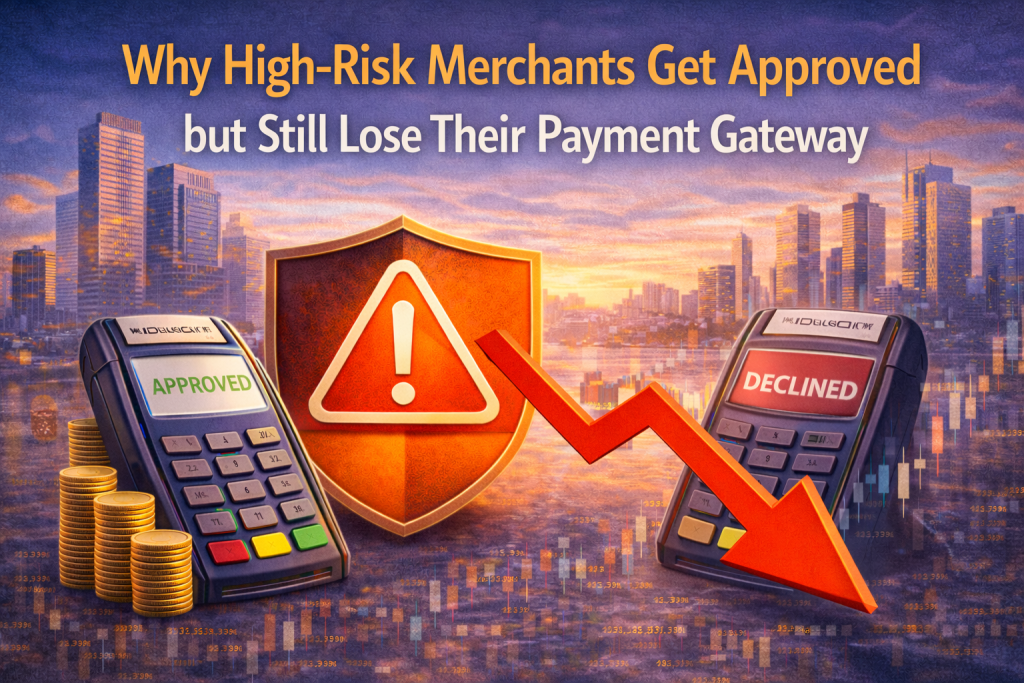
For many high-risk merchants, payment gateway approval feels like a major milestone.
After weeks of documentation, reviews, and compliance checks, the approval email finally arrives.
But then, months later — sometimes even weeks — payments suddenly stop.
Accounts are reviewed.
Limits are reduced.
Settlements are delayed.
In the worst cases, the gateway is terminated entirely.
This is one of the most frustrating experiences in high-risk payment processing.
And it happens far more often than most merchants expect.
In 2026, approval does not guarantee payment stability.
In fact, many high-risk merchants lose their payment gateway after being approved — not because they did something illegal, but because of how payment risk is evaluated over time.
This article explains why this happens, what most merchants misunderstand, and how high-risk businesses can reduce the risk of losing their payment gateway after approval.
Approval Is Only the Beginning in High-Risk Payments
In low-risk industries, approval often means long-term stability.
In high-risk industries, approval simply means:
“Your business looks acceptable based on projected behavior.”
Those projections are tested only after real transactions begin.
Payment providers expect:
- Predictable transaction patterns
- Controlled growth
- Stable customer behavior
When actual processing does not align with expectations, risk reviews begin.
Why High-Risk Merchants Lose Gateways After Approval
Most gateway losses are not caused by a single mistake.
They result from structural and behavioral risk, not compliance failures.
1. The Payment Setup Was Designed Only for Approval
Many merchants build their payment setup to pass onboarding.
They:
- Underestimate projected volumes
- Narrow customer geography during review
- Simplify business descriptions
Once approved, real business activity begins.
If live behavior differs significantly from what was approved, payment providers respond quickly.
Approval-focused setups are fragile by design.
2. Transaction Growth Happens Faster Than Expected
Growth is good for business, but in high-risk payments, rapid growth without explanation is a red flag.
Sudden increases in:
- Daily volume
- Transaction frequency
- Average ticket size
often trigger:
- Manual reviews
- Rolling reserves
- Processing limits
High-risk payment systems expect controlled, staged growth, not sudden spikes.
3. Cross-Border Activity Expands Without Structural Changes
Many high-risk merchants start with one primary market and expand globally.
Problems arise when:
- New countries are added quickly
- Additional currencies appear
- Acquiring structures remain unchanged
Cross-border expansion without proper restructuring is one of the most common reasons gateways are lost after approval.
4. Over-Reliance on a Single Payment Gateway
Many high-risk merchants depend entirely on one gateway.
If that provider:
- Tightens its risk policy
- Changes acquiring bank relationships
- Reduces exposure to certain industries
The merchant has no fallback.
Single-gateway dependency is one of the most dangerous weaknesses in high-risk payment processing.
5. Refund and Dispute Patterns Change Over Time
Refunds and disputes rarely stay consistent.
As a business grows:
- Customer expectations change
- Refund requests increase
- Dispute ratios fluctuate
Payment providers continuously monitor these metrics.
Even moderate increases can trigger reviews or restrictions.
Why Compliance Alone Does Not Protect High-Risk Merchants
Many merchants believe that full compliance guarantees safety.
While compliance is essential, it is insufficient.
Payment providers also evaluate:
- Behavioral risk
- Transaction predictability
- Operational maturity
Even a conforming company that exhibits erratic behavior is seen as risky.
This is why compliant, legitimate merchants still lose gateways.
Why Gateway Loss Often Feels Sudden
Merchants often say:
“Our payment gateway stopped without warning.”
In reality, warning signs usually appear early:
- Slower settlements
- Small processing limits
- Increased document requests
These are signals that risk tolerance is tightening.
Ignoring them often leads to termination.
How High-Risk Merchants Can Reduce the Risk of Losing Their Gateway
While no setup is risk-free, high-risk merchants can significantly reduce disruption by focusing on structure, not speed.
Key principles include:
- Designing payment systems for live behavior, not onboarding
- Planning growth stages in advance
- Aligning acquiring routes with customer geography
- Avoiding dependency on a single provider
- Monitoring risk signals continuously
Payment stability is engineered — not assumed.
The Importance of Diversified Payment Structures
Diversification is not about complexity.
It is about resilience.
Using:
- Multiple payment gateways
- Alternative payment methods
- Region-aligned acquiring routes
helps absorb risk changes when one provider tightens controls.
Diversified setups protect revenue continuity.
How Inquid Helps High-Risk Merchants Maintain Payment Stability
Many high-risk merchants lose their payment gateway not because of fraud or misconduct, but because their payment structure cannot withstand scale and monitoring.
Inquid works with high-risk businesses to:
- Design payment systems built for real-world transaction behavior
- Reduce single-provider dependency
- Support international and cross-border payment strategies
- Anticipate risk reviews before they become disruptions
The focus is not just approval — it is long-term payment continuity.
What High-Risk Merchants Should Expect Going Forward
Looking ahead, high-risk payment environments will become stricter.
Payment providers will:
- Monitor behavior earlier
- React faster to growth anomalies
- Reduce tolerance for fragile setups
Merchants that invest in robust payment structures now will face fewer disruptions later.
Conclusion
For high-risk merchants, payment approval is not the finish line.
It is the starting point.
In 2026, the businesses that succeed in high-risk payment processing are not those that get approved the fastest — but those that design their payment systems to survive growth, scrutiny, and change.
Understanding why gateways are lost after approval is the first step toward building a payment setup that lasts.