
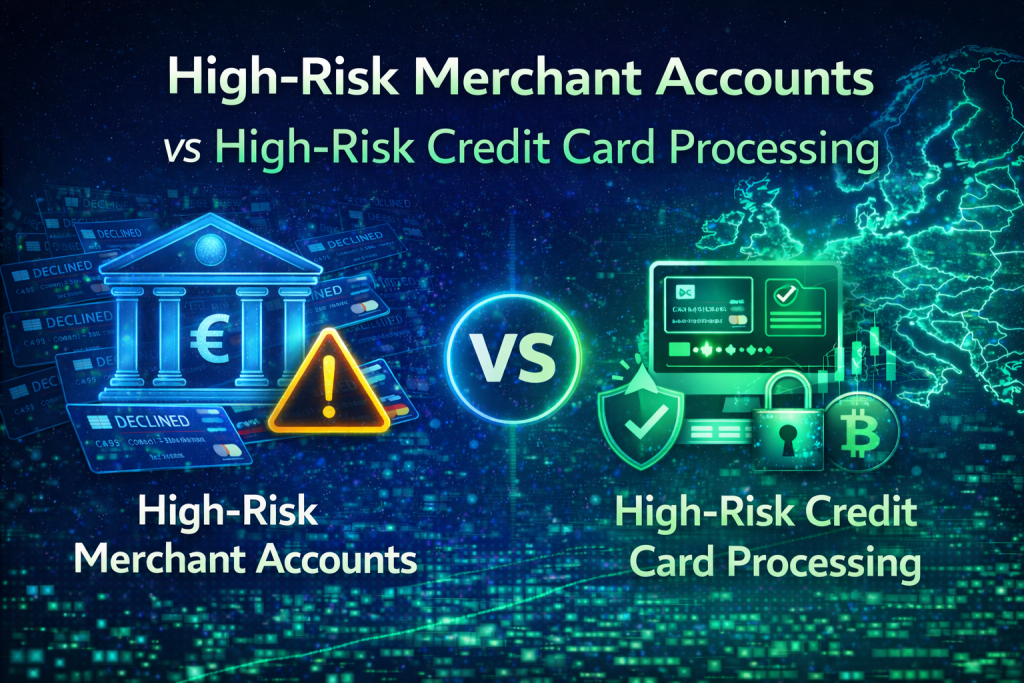
Many high-risk businesses use the terms high-risk merchant account and high-risk credit card processing as if they mean the same thing.
They do not.
Understanding the difference between the two is critical.
Choosing the wrong setup often leads to:
- Falling approval rates
- Account reviews and reserves
- Sudden processing shutdowns
- Lost revenue during scale
This guide explains how these two concepts differ, how they work together, and how high-risk businesses should evaluate them.
What Is a High-Risk Merchant Account?
A high-risk merchant account is a bank-issued account that allows businesses classified as high risk to accept card payments.
Banks label a business “high risk” due to factors such as:
- Industry type (gaming, forex, adult, crypto, etc.)
- High transaction volume
- Subscription or recurring billing
- Cross-border customers
- Elevated chargeback risk
The merchant account is where funds are settled after transactions are approved.
Think of it as the bank relationship layer.
Without a merchant account:
- Payments cannot be settled
- Funds cannot be received
- Card networks cannot be accessed
What Is High-Risk Credit Card Processing?
High-risk credit card processing refers to the entire payment flow, not just the bank account.
It includes:
- Payment gateway
- Transaction routing
- Risk and fraud controls
- Acquirer selection
- Issuer communication
- Approval rate optimisation
Credit card processing is the engine that decides:
- Whether a transaction is approved or declined
- Which bank processes the payment
- How risk signals are handled
- How stable approvals remain over time
A merchant account is part of processing — but it is not the whole system.
The Key Difference in Simple Terms
Here is the simplest way to understand it:
- High-risk merchant account = where money is settled
- High-risk credit card processing = how payments succeed or fail
Many merchants get approved for a merchant account but still face poor performance because the processing layer is weak.
Why This Confusion Causes Problems for High-Risk Merchants
Most problems happen when businesses focus on approval instead of structure.
A common scenario looks like this:
- Merchant gets approved for a high-risk merchant account
- Payments work initially
- Volume increases or geography expands
- Approval rates drop
- Account review starts
At this stage, merchants believe:
“The bank is the problem.”
In reality, the issue is often the processing setup, not the account itself.
How High-Risk Merchant Accounts Work in Practice
A merchant account is provided by an acquiring bank.
That bank:
- Assumes risk on your transactions
- Monitors chargebacks
- Sets rolling reserves or limits
- Can terminate processing if risk increases
High-risk merchant accounts usually include:
- Higher fees
- Rolling reserves
- Volume caps
- Strict monitoring
These conditions are normal in high-risk environments.
What matters is how well the processing system protects that relationship.
How High-Risk Credit Card Processing Protects the Merchant Account
Strong processing setups reduce pressure on the merchant account.
They do this by:
- Distributing transactions across multiple acquirers
- Routing payments by geography
- Reducing false declines
- Stabilising approval rates
- Managing chargeback exposure proactively
Weak processing setups push all risk into one place.
Banks notice this quickly.
Single Acquirer vs Distributed Processing
One of the biggest differences between average and strong high-risk setups is acquirer dependency.
Single-Acquirer Setup
- All transactions go through one bank
- Risk accumulates quickly
- Approval drops happen suddenly
- Shutdown risk is high
Distributed Processing Setup
- Transactions are routed across multiple banks
- Risk is spread
- Issuer confidence improves
- Stability increases
The merchant account survives because the processing system is designed properly.
Why Approval Rates Matter More Than Fees
Many merchants choose providers based on pricing.
This is risky.
A 5–10% drop in approval rate costs more than any fee difference.
High-risk credit card processing should prioritise:
- Issuer trust
- Consistent approvals
- Long-term stability
Low fees do not compensate for lost transactions.
Industry Differences: Why One Setup Doesn’t Fit All
High-risk industries behave differently.
Gaming & Betting
- High transaction frequency
- Peak-time spikes
- Issuer sensitivity
Forex & Trading
- High ticket sizes
- Volatile volume
- Regulatory pressure
Adult & Subscription
- Regional issuer restrictions
- Brand sensitivity
- Higher decline risk
Crypto
- Price volatility
- Sudden volume surges
- Enhanced fraud monitoring
Merchant accounts alone cannot manage this complexity.
Processing logic must adapt.
Compliance Is Necessary, But Not Enough
Many merchants assume compliance equals safety.
Compliance helps.
It does not guarantee performance.
A compliant setup can still suffer from:
- Poor routing
- Overblocking
- Issuer distrust
Processing quality determines whether compliance actually works in practice.
Why Most High-Risk Failures Happen After Approval
This is the critical point many miss.
High-risk merchants rarely fail at onboarding.
They fail after scale begins.
Reasons include:
- Static processing rules
- No regional optimisation
- No approval monitoring
- Reactive risk controls
Merchant accounts get blamed.
Processing design is the real issue.
How to Evaluate High-Risk Merchant Accounts Correctly
When evaluating a merchant account, ask:
- What are the volume limits?
- How are chargebacks monitored?
- What triggers reviews?
- How flexible is the relationship?
But these questions are only half the picture.
How to Evaluate High-Risk Credit Card Processing Properly
More important questions include:
- How many acquiring partners are used?
- Can routing change by region?
- How are approval rates tracked?
- How does the system respond to volume spikes?
- What happens when an acquirer exits?
If these answers are unclear, stability will suffer.
Why the Best High-Risk Setups Treat Payments as Infrastructure
High-risk payments are not plug-and-play.
They require:
- Ongoing optimisation
- Risk distribution
- Monitoring
- Adjustment over time
This is why experienced merchants work with infrastructure-focused providers.
Platforms like Inquid focus on building payment environments where merchant accounts and processing systems work together, rather than in isolation.
Merchant Account vs Processing: What You Actually Need
You do not choose one or the other.
You need both, properly aligned.
A strong setup looks like this:
- Merchant accounts protected by smart processing
- Processing logic designed to support bank risk tolerance
- Approval optimisation treated as ongoing work
This is how high-risk businesses scale safely.
Conclusion
The difference between high-risk merchant accounts and high-risk credit card processing is not technical.
It is strategic.
Merchant accounts allow you to exist.
Processing determines whether you grow.
Businesses that understand this distinction avoid shutdowns, maintain approvals, and build stable revenue.
Those that don’t learn it the hard way.