Last Updated: 11 June 2026
Reading Time: 10 minutes
Author: Inquid Editorial Team
The global digital banking platform market is on track to reach $44 billion in 2026, growing at close to 20% annually. That headline figure captures the scale of the transformation underway — but it obscures a critical divide: the businesses driving the fastest adoption of digital banking solutions are often the same ones that traditional banks are least willing to serve.
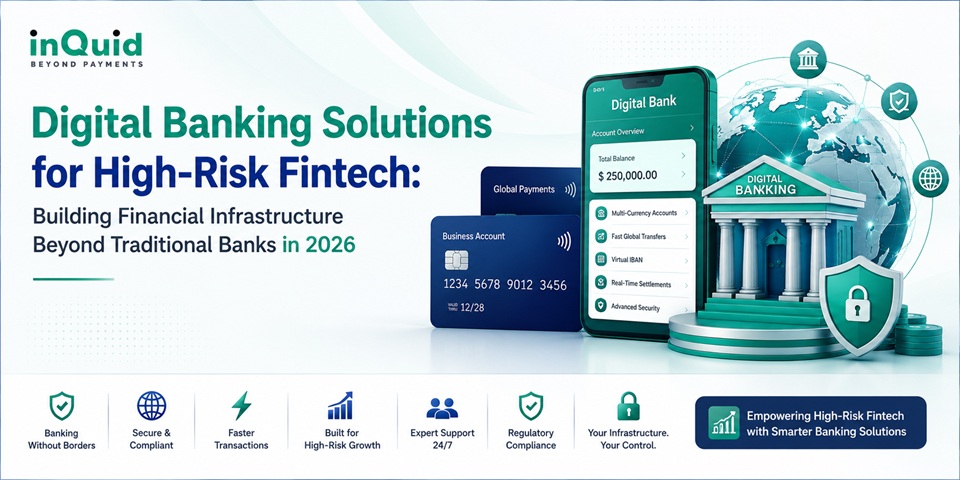
High-risk fintech companies — payment facilitators, money service businesses, cryptocurrency platforms, peer-to-peer lending marketplaces, and remittance providers — sit at the intersection of high regulatory complexity and high demand for sophisticated financial infrastructure. They need the most capable banking solutions and have the least access to them through conventional channels.
What Is a Digital Banking Solution for Fintech?
A digital banking solution for fintech is a financial infrastructure stack that provides the banking primitives fintech companies need to operate — account management, payment initiation, currency exchange, card issuing, and compliance tooling — through an API-first, cloud-native architecture, delivered by a licensed financial institution or technology partner.
For high-risk fintech specifically, the key distinction from generic digital banking platforms is the provider’s willingness and capability to serve regulated-but-high-complexity industries: cryptocurrency exchanges, Forex platforms, payment aggregators, online gaming operators, adult content platforms, and money service businesses.
At inquid, we recognize that large banking technology providers such as Temenos, Finastra, and nCino are designed to support traditional financial institutions operating at enterprise scale. However, high-risk industries often face unique compliance, underwriting, and payment challenges that require a more specialized approach.
That is where inquid stands apart. Our solutions are built specifically for high-risk businesses, addressing the complex requirements of industries such as gaming, forex, adult, crypto, IPTV, and other regulated sectors. Rather than relying on platforms designed for conventional banking environments, we focus on providing payment and merchant account solutions that support the real-world challenges high-risk merchants encounter every day.
Core Components of a Digital Banking Solution for High-Risk Fintech
Ledger and Account Management
Every financial product starts with a ledger — a system of record for balances, transactions, and movements. Digital banking platforms for fintech provide multi-currency ledgers that can support fiat and crypto balances, customer sub-accounts, and complex holding structures.
For a peer-to-peer lending platform, this means managing lender balance accounts, borrower loan accounts, and platform reserve accounts simultaneously. For a Forex aggregator, this means maintaining trader account balances in multiple base currencies, reconciled against positions in real time.
The ledger infrastructure determines the speed, accuracy, and scalability of everything built on top of it. API-first ledgers are increasingly preferred over batch-processing legacy systems — real-time balance updates are a baseline expectation in 2026, not a premium feature.
Payment Rails Access
A fintech company’s utility to its customers depends directly on which payment rails it can access. A digital banking solution for high-risk fintech should provide access to:
- Faster Payments (UK) — Real-time GBP transfers, 24/7
- SEPA Instant (EU) — Sub-10-second EUR transfers across the Eurozone
- SWIFT — Global cross-border payments in 140+ currencies
- CHAPS (UK) — High-value same-day sterling settlement
- ACH / RTP (USA) — Domestic USD transfers, with Real-Time Payments (RTP) and FedNow providing instant capability
- Open banking payment initiation — PISP API access for pay-by-bank functionality
- Crypto settlement rails — On-chain transfers for stablecoin and cryptocurrency movements
Most high-risk fintech businesses need the majority of these rails. Providers who offer only a subset significantly limit the addressable market for the fintech’s own products.
IBAN and Account Number Issuance
To receive payments from customers and counterparties, fintech companies need assignable account numbers — IBANs in SEPA markets, sort codes in the UK, routing and account numbers in the US. Digital banking solutions for fintech typically offer:
- Shared IBANs (multiple fintech clients share an IBAN with transaction reference codes)
- Segregated IBANs (unique IBAN per fintech company)
- Virtual IBANs per end customer (unique IBAN assigned to each of the fintech’s own customers)
The virtual IBAN-per-customer model is particularly powerful for payment platforms, Forex brokers, and gaming operators who need automated reconciliation of high-volume inbound payment flows.
Card Issuing Infrastructure
For fintech companies building consumer or business payment products, card issuing — the ability to issue physical or virtual Visa or Mastercard debit cards to end users — is a key differentiator. Digital banking solutions for fintech increasingly include card issuing capabilities through Visa/Mastercard principal member or issuer-processor partnerships.
For high-risk fintech, card issuing is subject to the same network rules that apply to processing — certain business categories face restrictions. Providers with experience in navigating card scheme rules for complex industry verticals are significantly more valuable than generic card issuing platforms.
Compliance and Regulatory Infrastructure
High-risk fintech companies operate in regulatory environments where compliance failures carry existential consequences — licence revocation, criminal liability, regulatory sanctions. Digital banking solutions built for this market should include:
KYC/AML tooling — Identity verification APIs, sanctions screening (OFAC, UN, EU, HMRC lists), PEP screening, adverse media monitoring. Integration with specialist providers (Jumio, Onfido, Sumsub, ComplyAdvantage) through the banking platform is increasingly standard.
Transaction monitoring — Rules-based and ML-driven anomaly detection for unusual transaction patterns, with configurable alert thresholds and a case management workflow for SAR filing.
Regulatory reporting support — CBUAE, FinCEN, FCA, and other regulatory reporting format support, with audit trails that satisfy examiner requirements.
On-chain analytics — For fintech companies dealing in cryptocurrency, integration with blockchain analytics providers (Chainalysis, Elliptic) for wallet screening and transaction tracing.
The Digital Banking Landscape for High-Risk Fintech by Region
United Kingdom
The UK fintech ecosystem is among the most developed globally, with over 40 FCA-authorised EMIs and PI providers serving business clients. For high-risk fintech companies, the FCA’s sandbox and regulatory innovation framework provide pathways for novel business models to operate under temporary permissions while seeking full authorisation.
The Open Banking framework provides UK fintech companies with PISP and AISP API access to 99% of UK retail bank accounts — the broadest open banking coverage of any major market.
European Union
Post-MiCA, the EU has one of the most comprehensive regulatory frameworks for crypto-adjacent fintech. Lithuania, Malta, and the Netherlands have developed as fintech EMI licensing hubs, with efficient authorisation processes and strong regulatory-commercial ecosystems for high-risk verticals.
PSD3 implementation, progressing through 2026 and 2027, will strengthen API standardisation and open banking payment initiation capabilities across the EU — directly benefiting fintech companies building on open banking rails.
United States
US digital banking for high-risk fintech operates through a combination of state-licensed money transmitter licences, federal bank partnerships (Banking as a Service models), and the evolving federal framework for stablecoin and crypto services under the GENIUS Act. The regulatory complexity of operating across all 50 states makes US market entry significantly more demanding than the UK or EU.
Global / Offshore
For high-risk fintech companies operating from offshore jurisdictions — Seychelles, BVI, Cayman, Curaçao — digital banking solutions that provide international reach through SWIFT access and virtual IBANs in regulated jurisdictions are the primary infrastructure option. Several EU and UK EMIs actively serve offshore-incorporated fintech companies, subject to full KYC/AML compliance.
Evaluating Digital Banking Solutions for Your High-Risk Fintech
Regulatory licence breadth — Confirm which jurisdictions the provider is licensed in and which payment schemes they can access. A provider licensed only in one small EU member state may have limited SWIFT and US payment access.
Industry-specific experience — Ask for case studies or reference clients in your specific industry vertical. A provider with 50 gaming operator clients has a very different compliance programme than one whose high-risk experience is limited to one or two clients.
API quality and documentation — The quality of the API, sandbox environment, and technical documentation is a direct predictor of how much internal development resource will be required to integrate. Evaluate these thoroughly before committing.
Scalability — What are the volume limits? What is the SLA for API uptime? Can the provider scale with your business to £10M, £100M, or £1B in monthly volumes? Ask specifically about the infrastructure architecture and capacity.
Total cost of ownership — Beyond per-transaction fees, understand monthly account fees, SWIFT transfer costs, currency conversion spreads, and setup costs. For high-volume fintech operations, small differences in conversion spreads can represent significant annual costs.
Frequently Asked Questions
1. What is the difference between a digital banking solution and a banking-as-a-service (BaaS) platform?
Banking-as-a-service (BaaS) is a delivery model where a licenced bank or EMI makes its banking infrastructure available to third parties (fintechs) via API, so the fintech can build financial products on top of it. A digital banking solution is a broader term for cloud-native banking infrastructure, which may be BaaS-delivered or provided as a standalone platform for the fintech’s own use. In practice, many digital banking solutions for fintech use BaaS delivery models.
2. Can a fintech company get a digital banking solution without its own licence?
Yes. Many fintechs build on top of a licenced provider’s infrastructure under an agent or principal model, operating under the provider’s regulatory licence rather than holding their own. This is common for early-stage fintech businesses that have not yet obtained their own FCA EMI authorisation or equivalent. As the business scales, obtaining its own licence provides greater operational independence.
3. How does a digital banking solution handle AML compliance for a high-risk fintech?
Most digital banking platforms for fintech include built-in KYC/AML tooling or integrations with specialist compliance providers. However, the regulatory responsibility for AML compliance remains with the fintech company as the regulated entity (or with the licenced provider if the fintech operates under their licence). Digital banking solutions provide the tools and data; the compliance programme, risk assessment, and reporting obligations require human oversight and documented processes.
4. How long does it take to integrate a digital banking solution and go live?
Integration timelines vary significantly depending on the platform’s API maturity and the fintech’s technical resources. A payment initiation integration (accepting deposits via open banking or crypto) can be live in two to four weeks. Full account management, card issuing, and multi-currency ledger integration for a complex fintech platform may take three to six months. Realistic scope assessment upfront is critical.
5. What is the impact of MiCA on digital banking solutions for EU crypto fintech?
MiCA requires crypto asset service providers operating in the EU to obtain a CASP licence from a national competent authority by December 2024 (for exchanges and wallet providers) or mid-2025 (for issuers of other crypto assets). Fintech companies building on digital banking infrastructure that includes crypto components need to either hold their own CASP licence or operate under a licenced provider’s authorisation. MiCA has increased regulatory clarity but also raised the compliance bar for market entry.
Inquid provides digital banking and payment infrastructure for high-risk fintech companies globally. Our platform combines high-risk card processing, virtual IBANs, open banking, and crypto settlement — delivering the full financial infrastructure stack that high-risk fintech requires. Contact our team to design your solution.