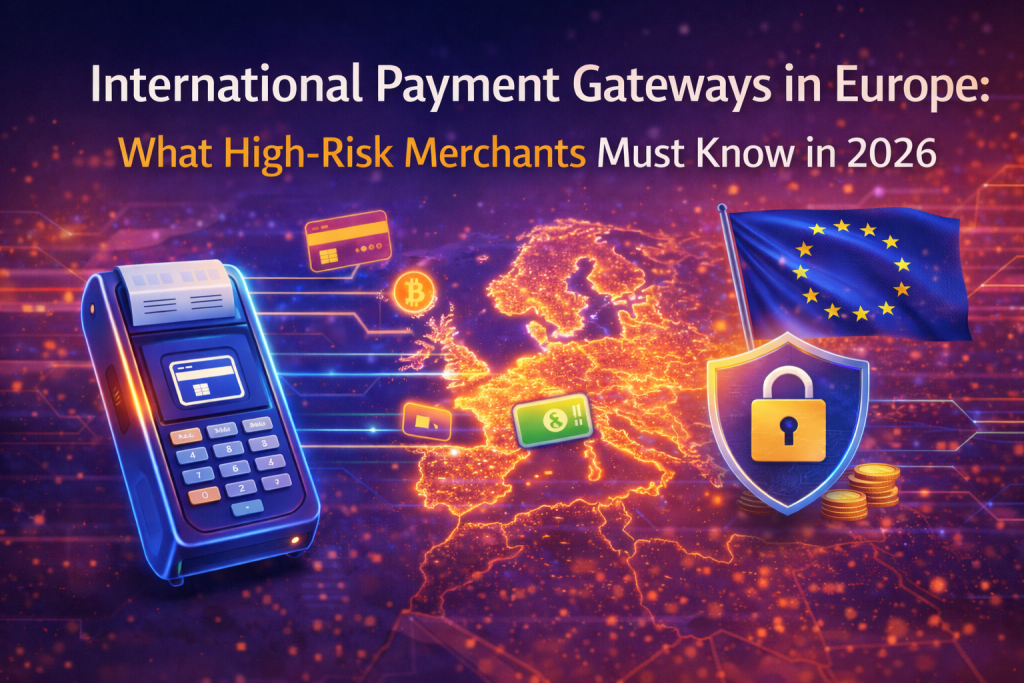
Europe remains one of the most attractive regions for online businesses.
It offers strong consumer trust, high purchasing power, and access to global markets.
At the same time, Europe is also one of the most difficult regions for high-risk merchants to operate in.
Many businesses enter Europe with confidence. They assume that if their product is legal and their website looks professional, payment acceptance will be smooth.
In reality, many face rejected applications, long onboarding delays, payment reviews, or sudden account pauses.
In 2026, choosing the right international payment gateway in Europe is no longer about quick approvals.
It is about structure, predictability, and long-term stability.
This article explains how international payment gateway work in Europe, why high-risk merchants struggle, and what businesses must understand to succeed.
What Is an International Payment Gateway?
An international payment gateway is a system that allows businesses to accept payments from customers in different countries and currencies.
It connects:
- The customer
- The merchant
- The acquiring bank
- Card networks or alternative payment rails
In Europe, international payment gateways must support:
- Cross-border transactions
- Multiple currencies
- Regional regulations
- Continuous risk monitoring
For high-risk merchants, these gateways apply additional controls and reviews.
Why Europe Is a Difficult Market for High-Risk Merchants
Europe has one of the most regulated payment environments in the world.
Banks and payment providers operate under strict oversight from regulators and card networks.
Because of this, European payment gateways:
- Perform deeper underwriting
- Monitor transactions earlier
- React quickly to unusual behavior
High-risk merchants face lower tolerance for sudden changes compared to other regions.
This does not mean Europe blocks high-risk businesses.
It means Europe expects higher discipline and consistency.
What Makes a Business High-Risk in Europe?
A business may be classified as high-risk for many reasons.
Common factors include:
- Industry type
- Cross-border customers
- Subscription or recurring billing
- High transaction values
- Refund and dispute exposure
Industries often labeled high-risk include:
- Forex and CFD trading
- Crypto exchanges and related services
- Online gaming and betting
- IPTV and streaming platforms
- Adult and dating services
- Digital subscription businesses
Being high-risk does not mean illegal.
It means the business requires specialized payment infrastructure.
How International Payment Gateways Evaluate High-Risk Merchants
European payment gateway do not only review documents.
They also evaluate behavior and structure.
They look at:
- How transactions are expected to behave
- How fast volume may grow
- Where customers are located
- How refunds and disputes will be handled
Even after approval, monitoring continues.
Approval means:
“This setup is acceptable under current assumptions.”
If those assumptions change, reviews follow.
Common Problems High-Risk Merchants Face in Europe
Many international merchants fail in Europe for the same reasons.
1. Choosing the Wrong Payment Gateway
Low-risk gateways are designed for stable, predictable businesses.
They are not built for high-risk industries.
These gateways may:
- Approve accounts quickly
- Lack long-term risk support
- Pause accounts once volume increases
This creates false confidence.
2. Poor Cross-Border Alignment
European payment providers expect logic in payment flows.
Problems arise when:
- Customer locations do not match acquiring regions
- Currencies do not align with customer behavior
- Traffic expands into unsupported markets
These mismatches trigger reviews.
3. Over-Reliance on a Single Gateway
Many merchants depend on one payment gateway.
When that gateway:
- Reviews the account
- Imposes limits
- Pauses processing
Revenue stops instantly.
In 2026, single-gateway dependency is a major risk factor.
4. Weak Transparency
European gateways expect clear communication.
Missing or unclear:
- Business details
- Refund policies
- Pricing terms
- Contact information
often leads to rejection or delayed approval.
What High-Risk Merchants Should Look for in 2026
In 2026, the best international payment gateways in Europe share common traits.
✔ High-Risk Industry Support
The gateway must support your business model long-term, not just during onboarding.
✔ Experience With European Acquirers
Understanding European banking expectations matters more than brand recognition.
✔ Cross-Border Capability
Multi-currency processing and international card support are essential.
✔ Proactive Risk Monitoring
Early detection of risk is better than sudden shutdowns.
✔ Focus on Stability
Fast approval is meaningless if the account does not last.
International vs Local Payment Gateways in Europe
Some merchants believe local gateways are safer.
Others believe international gateways offer more flexibility.
The truth is more balanced.
Local gateways:
- Offer strong regional alignment
- Work well for specific markets
International gateways:
- Support scale and expansion
- Handle multiple regions and currencies
The right choice depends on:
- Business model
- Customer geography
- Risk profile
There is no universal solution.
Why Approval Is Only the Beginning
Many merchants celebrate approval too early.
In Europe, approval often means:
“You are now under observation.”
Once processing begins, gateways monitor:
- Volume changes
- Customer behavior
- Dispute patterns
Merchants that plan only for approval often struggle later.
Successful merchants prepare for:
- Growth pressure
- Market expansion
- Payment reviews
This preparation reduces disruption.
The Role of Alternative Payment Methods
In 2026, many high-risk merchants reduce dependency on cards.
Alternative payment methods help:
- Improve acceptance rates
- Reduce dispute exposure
- Offer customers more choice
Examples include:
- Bank transfers
- Digital wallets
- Local payment methods
A balanced payment mix increases stability.
How Inquid Supports International Payments in Europe
Many businesses struggle not because of demand, but because their payment structure is fragile.
Inquid helps merchants approach international payment gateways in Europe by focusing on:
- Gateway selection aligned with business risk
- Cross-border payment structuring
- Europe-specific requirements
- Reducing dependency on a single provider
The focus is long-term continuity, not short-term approval.
The Future of International Payment Gateways in Europe
Looking ahead to 2026 and beyond:
- Risk monitoring will become more automated
- Reviews will happen earlier
- Single-gateway setups will become riskier
- Payment diversification will increase
Merchants who adapt early will face fewer disruptions.
Conclusion
International payment gateways in Europe are not simple tools.
They are risk control systems.
High-risk merchants that succeed in Europe understand this reality.
They build payment setups designed for:
- Transparency
- Predictability
- Resilience
With the right structure, Europe remains a powerful growth market — even for high-risk businesses.